Get in Touch with Zhouxiang

Updated August 2026
Welding robot financing and leasing options are loan, lease, and program structures used to fund a robotic welding deployment while matching supplier cash calls and preserving operating liquidity. Usually, the right answer is not the offer with the smallest displayed monthly payment.
Short answer: map the complete project first, test each cost line for eligibility, compare eight commercial funding routes, and negotiate the events that release funds or start payment. Then stress-test the arrangement with three months of delayed savings before choosing a loan, lease, SBA-backed route, service arrangement, or cash purchase.
This is a US-focused decision guide, not a rate sheet or legal, accounting, or tax opinion. Actual eligibility, pricing, collateral, documentation, acceptance, and tax treatment depend on the applicant, lender, contract, state law, and placed-in-service facts.
A financing option may preserve cash and reduce an upfront cost, yet early lease payments can erase that advantage. Compare vendor financing, an equipment loan, bank lines of credit, and specialist equipment financing companies with the same complete scope; “flexible financing” or “affordable monthly payments” is marketing until a written financing agreement defines the outlay, timing, duties, and exit.
The Short Answer: Fund the Deployment, Not Just the Robot
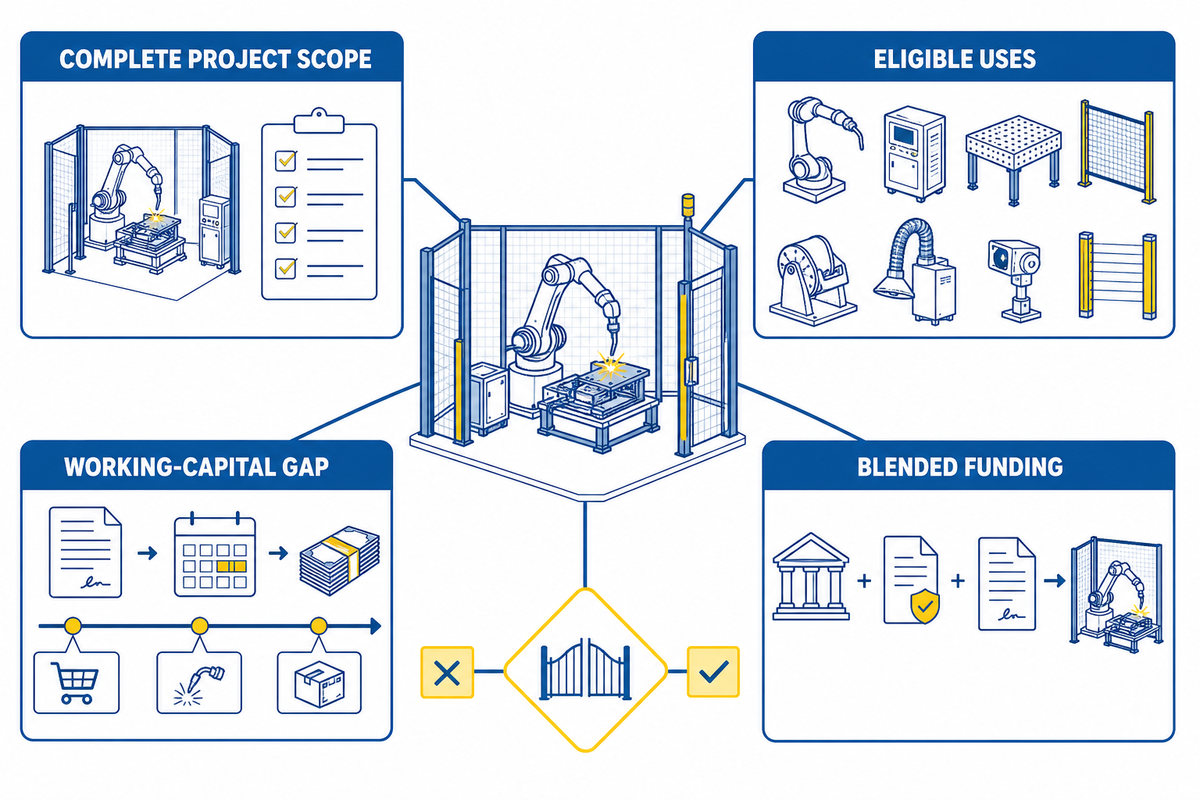
Start with the cash needed to reach stable production, not the robot-arm invoice. Use a funding plan that distinguishes equipment, integration services, facility work, supplier milestones, taxes and fees, and a working-capital reserve; it then checks which items each proposed structure can legally and commercially cover.
That distinction matters even inside SBA programs. Current SBA 7(a) program guidance lists machinery and equipment purchase and installation among eligible uses. By contrast, the SBA 504 page focuses on qualifying fixed assets, requires eligible long-life machinery to have at least 10 years of useful remaining life, and excludes working capital.
Finance principle
“Fund the deployment” is a budgeting instruction, not a claim that one facility will finance every project cost. Blended funding may be necessary when fixed assets, services, facility changes, and ramp cash receive different treatment.
Define the Financeable Cell Boundary Before You Apply
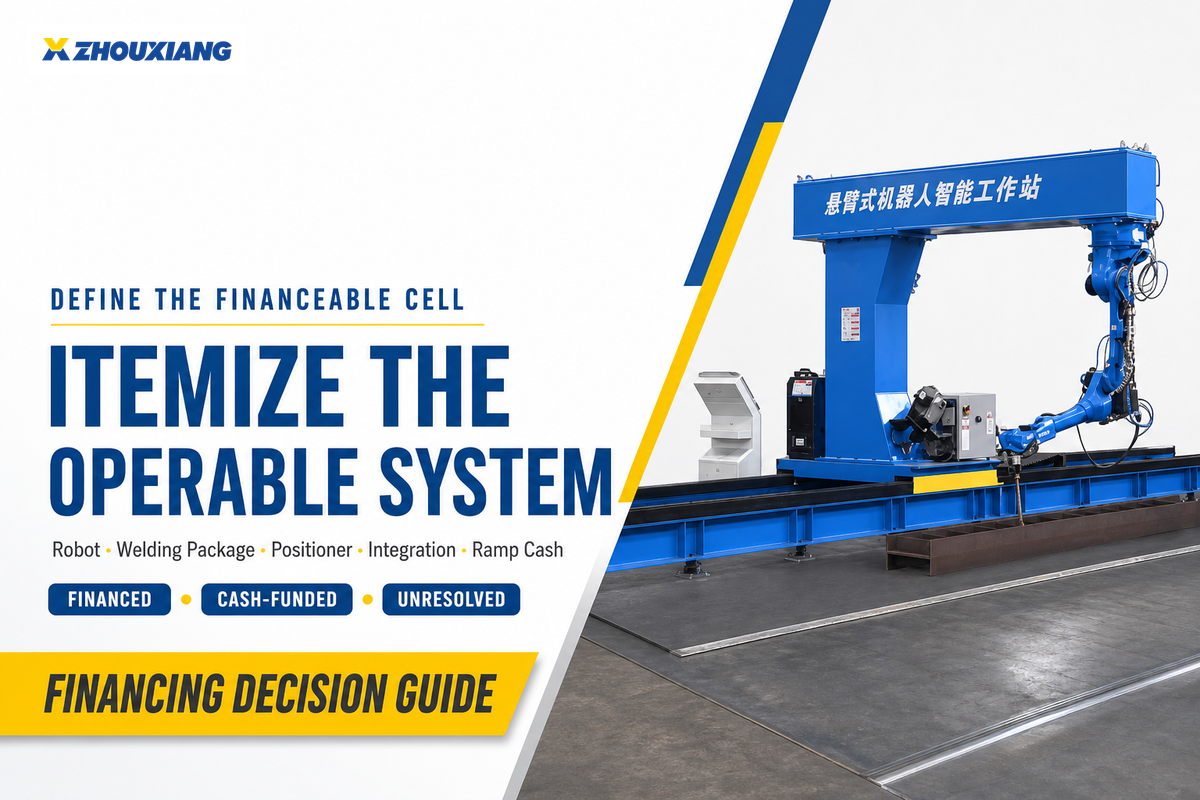
The Financeable Cell Boundary is a line-item map of everything required for an operable cell, who supplies it, when cash is due, and whether the proposed funder will include it. It prevents a financed robot from arriving while guarding, fixtures, power work, training, or ramp liquidity remains unfunded.
For example, a single robot welding workstation may combine the robot, welding power source, controller, positioner, and optional sensing or vision choices. Its linked product page should handle specifications, configuration, price requests, and quotation; this guide uses the robotic cell only to show why the financeable scope is larger than one asset label.
| Cost line | Supplier evidence | Funding question | Cash-gap risk |
|---|---|---|---|
| Robot and welding package | Itemized quote and serializable assets | Eligible collateral and useful life? | Deposit before approval |
| Positioner, fixtures, guarding, sensing | Bill of materials and drawings | Included with the equipment advance? | Vendor split across invoices |
| Integration and commissioning | Scope, milestones, deliverables | Funded as a soft cost or excluded? | Progress draw precedes acceptance |
| Facility and utility work | Contractor quote and responsibility map | Part of project collateral or separate? | Site work starts early |
| Training and ramp reserve | Staffing plan and cash forecast | Eligible use, separate line, or cash funded? | Payments begin before savings |
Mark every row as financed, cash funded, conditional, or unresolved. Do not let “up to 100% financing” language replace a written schedule showing which invoice lines, fees, deposits, taxes, and soft costs are actually included.
Compare Eight Funding Routes
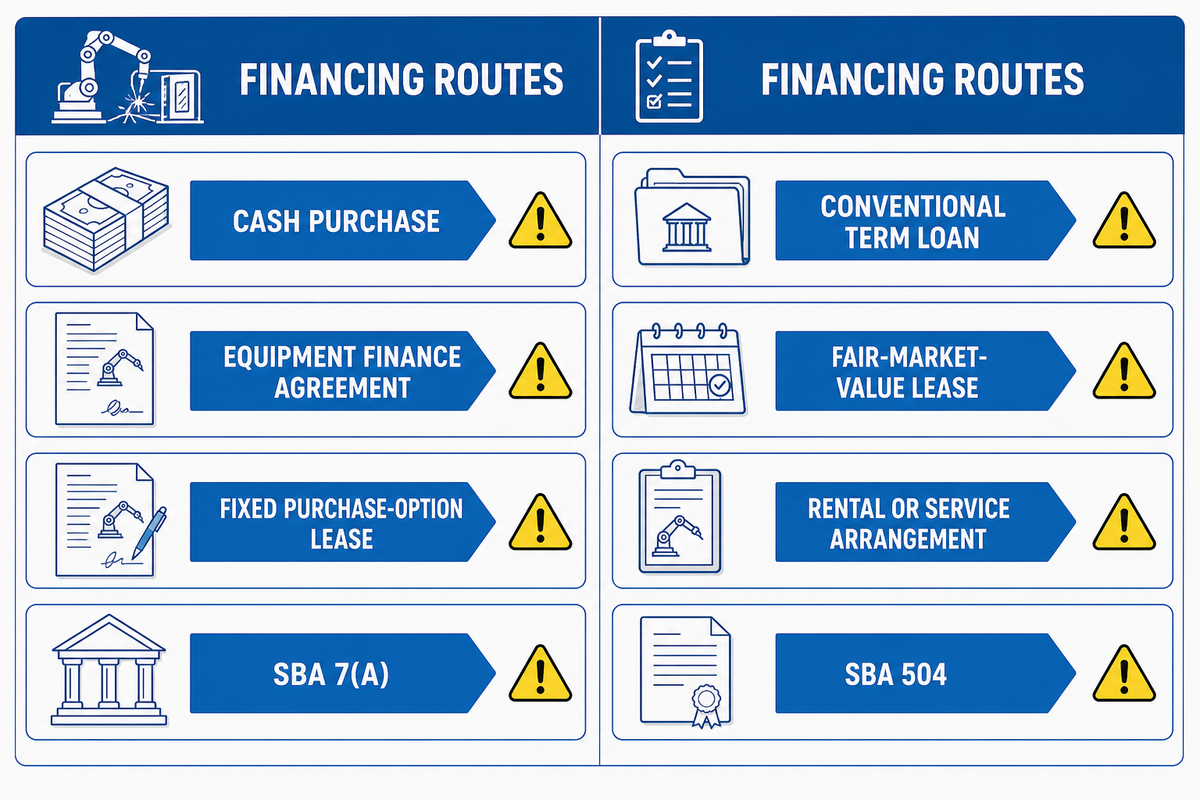
Eight commercial routes cover most discussions, but the labels are not fixed legal or accounting classifications. UCC 1-203 makes transaction facts and economics relevant when distinguishing a lease from a security interest, so counsel and the accountant must review the executed documents.
| Funding type / route | Useful starting case | Primary watch item |
|---|---|---|
| 1. Cash purchase | Strong liquidity and a long ownership horizon | Working capital consumed before production stabilizes |
| 2. Conventional term loan | Ownership is desired and the bank accepts the project | Collateral, covenants, down payment, and payment-start date |
| 3. Equipment finance agreement | Asset-focused financing with intended ownership | Security interest, fees, default remedies, and included soft costs |
| 4. Fair-market-value lease | Upgrade or return flexibility has real value | Residual assumptions, return condition, location, maintenance, and purchase option |
| 5. Fixed or bargain-purchase-option lease | Ownership is expected after scheduled payments | Economic substance, tax treatment, and whether the “lease” is legally secured financing |
| 6. Rental, service, or usage arrangement | Available provider bears defined asset or service duties | Availability, minimum use, uptime remedy, data, consumables, and exit terms |
| 7. SBA 7(a) | An eligible business needs a multi-purpose project structure | Program and lender eligibility, collateral, guaranty, and process time |
| 8. SBA 504 | Qualifying long-life fixed assets fit a long-term structure | Useful-life test, fixed-asset scope, and excluded working capital |
Buying equipment outright can fit a mature plant with sufficient cash reserves, while lease-to-own options or an operating lease may shift timing without removing risk. Used equipment, a welder, standalone welding machines, and a complete automation system can receive different treatment by equipment type. Ask whether the offer covers the full purchase price, includes a defined buyout, permits the buyer to renew the lease, and recognizes the long useful life expected from industrial equipment.
For welding equipment financing, treat the arc welding package, automation equipment, and other manufacturing equipment as one operating system. A financing solution and financing plan should avoid a large upfront cash gap, state the choices at the end of the term, and say whether the buyer will purchase the equipment; “advanced technology” does not answer any of those questions.
A disciplined comparison resembles the factor list in 48 CFR 7.401: expected use period, cumulative payments, installation and service costs, obsolescence, purchase options, cancellation or early return, warranties, and residual value. That federal rule does not govern a private purchase; its value here is the breadth of the questions.
“The correct shortlist is the one that still works after the contract, supplier milestones, and slow-ramp cash forecast are placed on the same page.”
Zhouxiang financing decision framework
Build the Three-Clock Funding Model
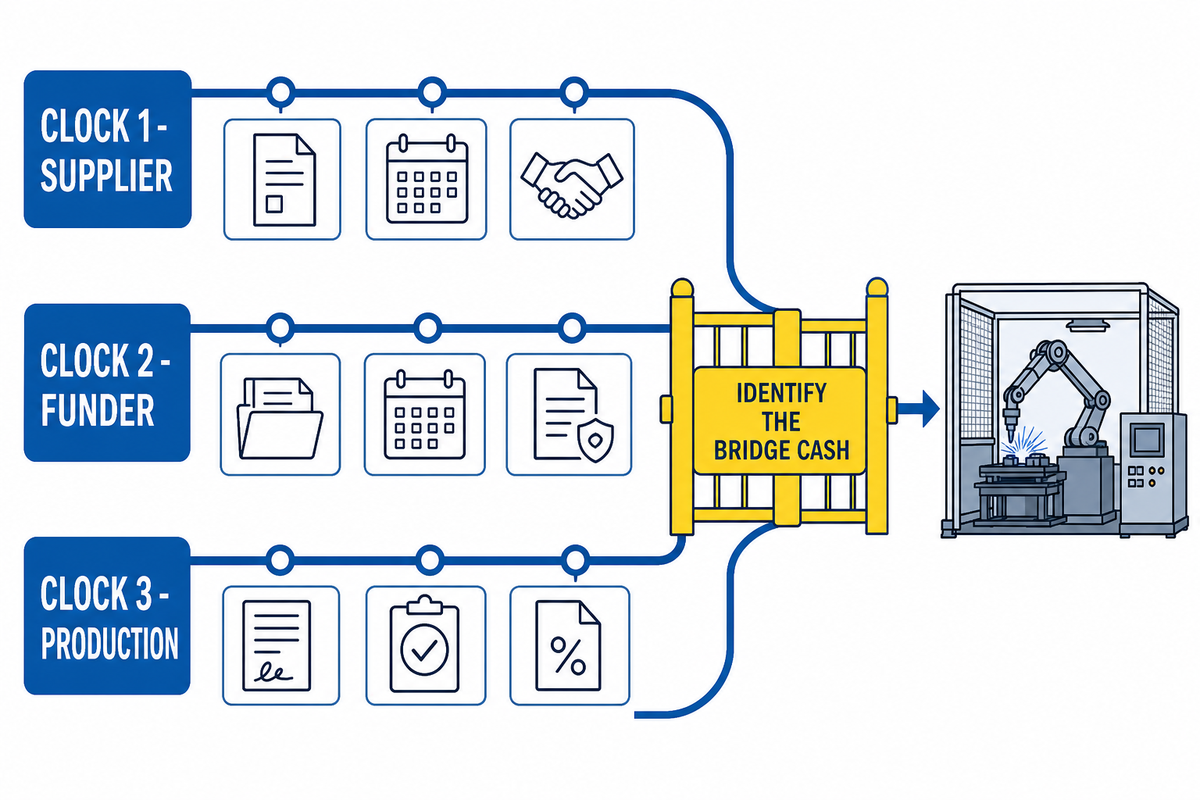
The Three-Clock Funding Model aligns supplier cash calls, funder release or payment triggers, and the date when the cell begins producing dependable cash benefit. Capex freezes often appear when the first two clocks run before the third.
Clock 1, Supplier: deposit, design release, fabrication, factory test, shipment, site work, commissioning, and final retention.
Clock 2, Funder: approval, documentation, vendor payment, progress draw, interim rent if any, acceptance, and regular payment start.
Clock 3, Production: utilities ready, staff trained, process approved, usable output, stable cycle, and forecast savings realized.
Put exact proposed dates and evidence beside each event. That welding robot commissioning timeline owns the technical sequence; the financing model only imports the milestone names needed to reveal pre-production cash exposure.
Timing test: if the supplier needs a 30% deposit now, the lender funds only after delivery, and regular payments start on signed acceptance while production savings begin later, the buyer must identify the bridge cash explicitly. Replace the example percentage with the actual supplier and lender documents.
Stress-Test the Payment Against a Slow Ramp
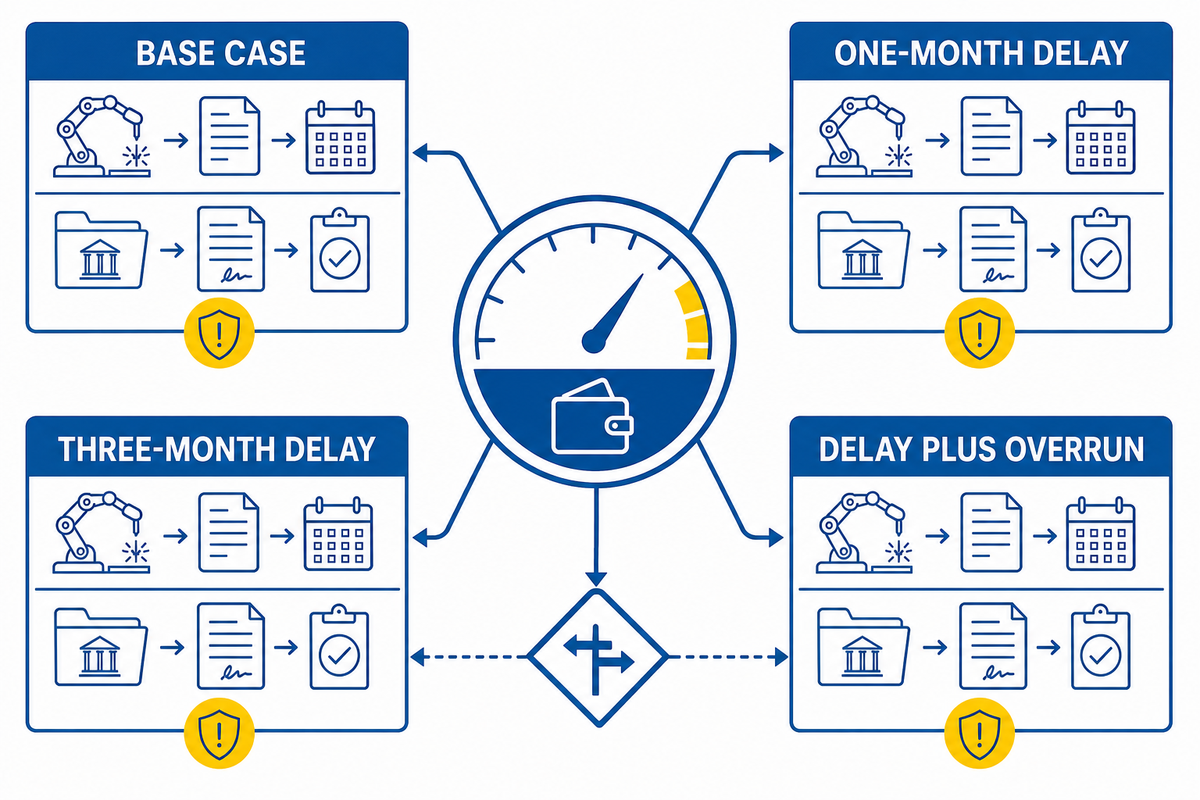
A funding structure is resilient when the business can service it before the sales-case savings arrive. Build a monthly cash test with the actual deposit, lender fees, progress draws, payment start, maintenance, additional labor during ramp, and excluded project costs. Use the robotic welding cell cost guide for component-cost inputs; this guide only determines when and how those costs become cash calls.
| Case | Ramp assumption | Question to answer |
|---|---|---|
| Base | Approved operating plan | Does monthly net cash remain positive? |
| One-month delay | Savings move one month later | Which reserve pays the installment? |
| Three-month delay | Training, qualification, or demand takes longer | Is liquidity still above the agreed floor? |
| Delay plus overrun | Ramp slips and one excluded cost appears | Can the project continue without starving operations? |
Illustrative cash bridge: a $500,000 project with a 10% deposit creates a $50,000 cash call. Add $12,000 in excluded site work, a $6,000 fee, $9,000 monthly payments, a 3-month delay, and a 15% contingency: the worksheet must show at least $27,000 of pre-benefit payments plus the other cash uses. A second offer might use a 5% deposit, retain 20% until a milestone, defer regular payments for 90 days, or spread them over 36 months; model its $18,000 and $45,000 cash events on the same calendar. These are sample inputs, not a supplier price, lender term, recommended reserve, or customer result.
Use the existing robotic welding ROI calculation for detailed savings and payback inputs, including labor costs. In this guide, those outputs become cash-timing assumptions; they are not repeated as a competing ROI model.
Compare offers with total cash before stable production, lowest monthly liquidity, total scheduled payments, end-of-term exposure, and the cost of an exit or upgrade. Lower payments can still consume more working capital when it hides a larger deposit, excluded scope, interim rent, fees, or return obligations.
Package the File the Way an Underwriter Sees It
A lender-ready file connects the borrower, project, cash flow, collateral, supplier, and completion plan. It should let a reviewer see why the cell can be completed, accepted, operated, and repaid without relying on an unsupported productivity promise.
A useful public standard is 7 CFR 5001.202, which addresses repayment capacity, capitalization, security, management, technical feasibility, integrated equipment, completion, and backed-up projections in its own program. It isn’t an all-encompassing underwriter checklist, but it illustrates why a brochure for a welding robot and a monthly payment price quotation are inadequate.
- Borrower file: ownership, management experience, financial statements, debt schedule, tax records requested by the lender, and authorization for credit review.
- Project file: complete quote, bill of materials, supplier contracts, facility scope, implementation responsibilities, and insurance requirements.
- Cash file: sources and uses, deposit and draw schedule, operating forecast, downside case, and contingency ownership.
- Completion file: schedule, factory and site evidence, training plan, open-item process, and responsible signers.
Ask each lender for its written requirements and definitions. Credit standards, guaranties, collateral, financial covenants, notification rules, and missing-document handling differ by transaction and applicant.
During the application process, separate the approval process from a marketing prequalification. Reviewers may examine a detailed business plan, business credit record, credit history for your business, personal credit where lawfully requested, and cash reserves; each lender may weigh the overall credit profile differently. “Strong credit history” is not a universal cutoff, and businesses of all sizes should insist that conditional requirements appear in writing.
Create a Transaction-Specific Acceptance-to-Payment Firewall
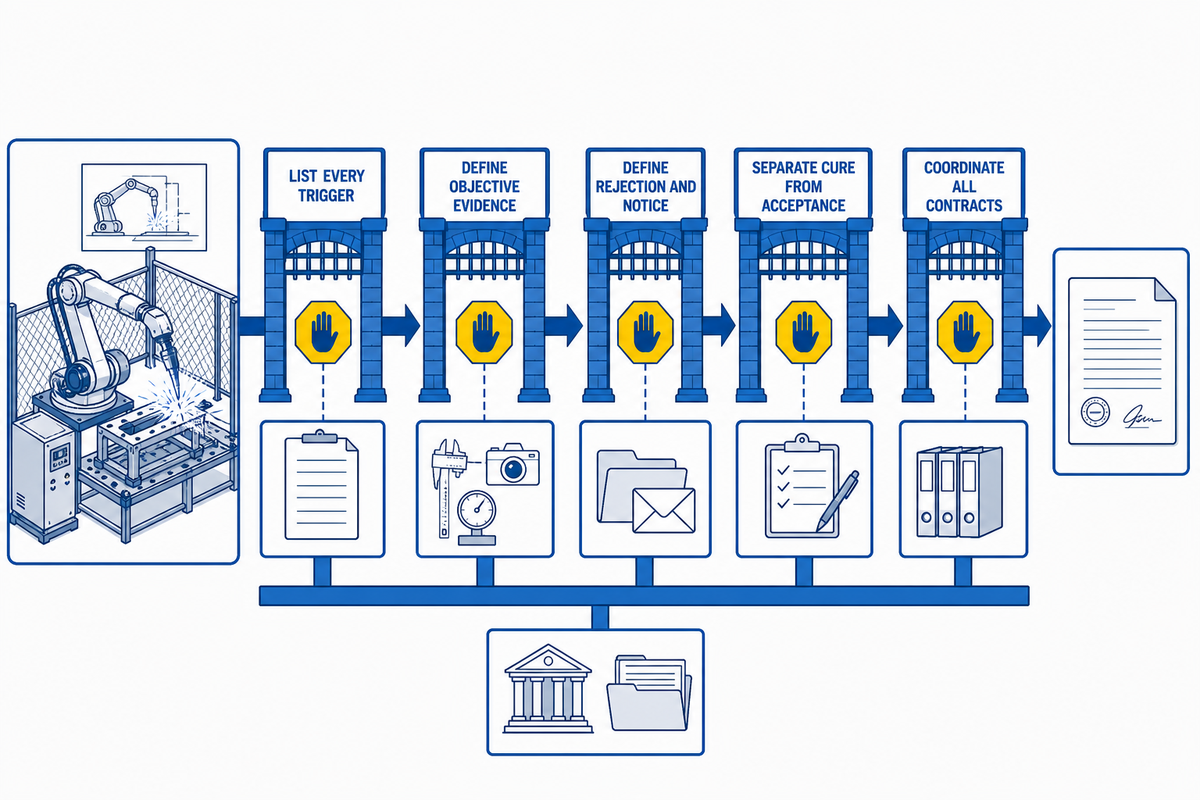
The Acceptance-to-Payment Firewall is a coordinated set of inspection, notice, signoff, and cure rules. Its purpose is to prevent a project team from triggering funding or an unconditional payment obligation before the agreed evidence and open-item treatment are understood.
ELFA’s equipment-acceptance guidance explains that delivery-and-acceptance documentation can confirm inspection and suitability, may start an unconditional payment stream, and may be required before a lessor funds. However, not every funding route gives acceptance the same consequence.
UCC 2A-407 addresses irrevocable and independent promises in non-consumer finance leases; it should not be generalized across loans or every arrangement called a lease. UCC 2A-515 also shows that acceptance can involve conduct or failure to make an effective rejection after a reasonable opportunity to inspect, so the signature page may not be the only relevant event.
- List every trigger — delivery, installation, factory test, site test, beneficial use, acceptance, funding, interim rent, and regular payment.
- Define objective evidence — identified configuration, agreed test, measurement method, documents, training, and material open items.
- Define rejection and notice — who inspects, the allowed period, the required notice method, and what constitutes an effective response.
- Separate cure from acceptance — state which defects block signoff and how nonblocking punch-list items are documented, secured, and closed.
- Coordinate all contracts — supplier, integrator, lender, lease, site contractor, warranty, and insurance documents must not use conflicting milestones.
Have qualified counsel review the actual transaction and governing law. No checklist can determine whether acceptance occurred, whether payment is irrevocable, or which remedies survive in a specific dispute.
Read the Lease Beyond the Monthly Payment
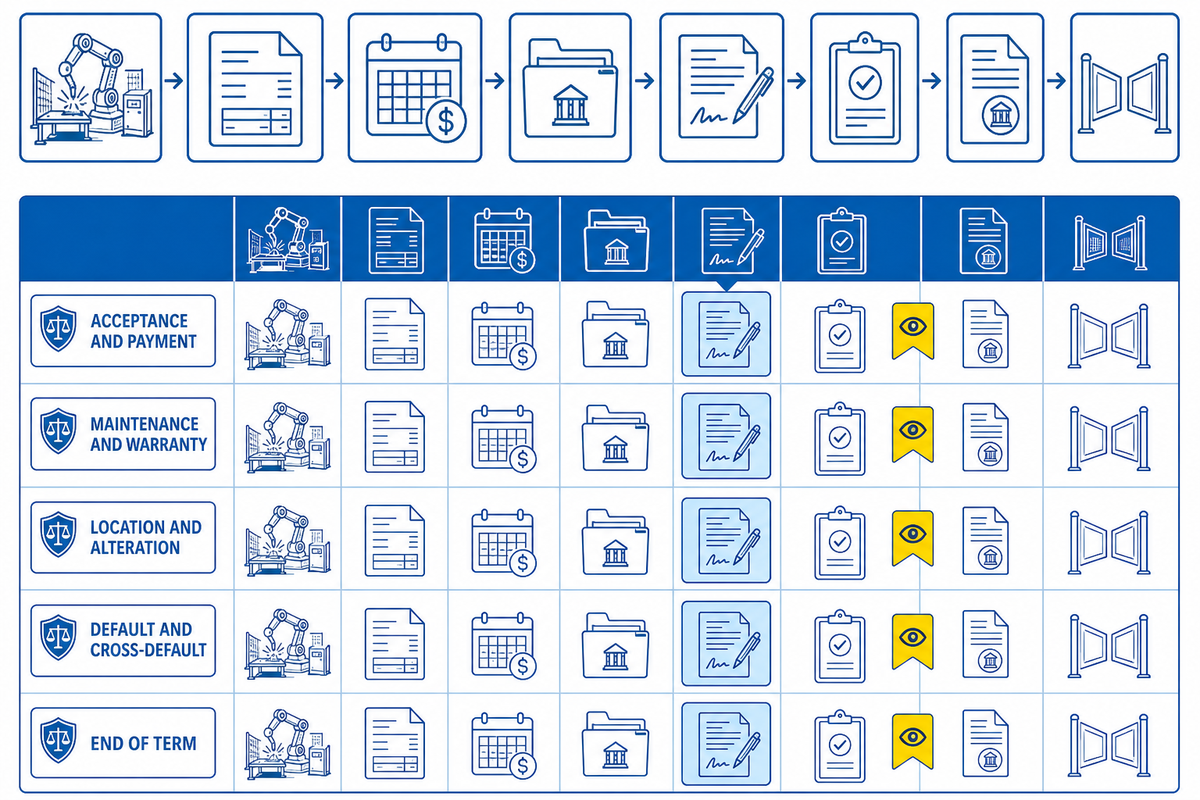
Lease comparison is incomplete until the buyer prices its duties during use, default, upgrade, purchase, and return. Headline payment says little about risk if maintenance, taxes, insurance, location, alterations, software, accessories, or return logistics sit elsewhere in the document. Confirm the transaction’s legal substance under UCC 1-203 instead of relying on the lease label.
| Clause | Question | Evidence to retain |
|---|---|---|
| Acceptance and payment | Which event starts interim or regular rent? | Signed schedule and milestone evidence |
| Maintenance and warranty | Who pays, and does a supplier dispute suspend payment? | Service records and remedy matrix |
| Location and alteration | Can the cell, tooling, software, or safety system change? | Consent process and configuration record |
| Default and cross-default | What accelerates obligations or reaches other agreements? | Default, cure, and remedy summary from counsel |
| End of term | What must be purchased, renewed, removed, packed, shipped, restored, and documented? | Notice calendar and return-condition checklist |
ELFA’s review of essential lease provisions highlights acceptance, maintenance, warranty disclaimers, security interests, expenses, landlord or mortgagee waivers, and default topics. Convert each obligation into a responsible owner and cash line before comparing an FMV lease with a fixed-purchase route.
Check the US Tax and Accounting Treatment
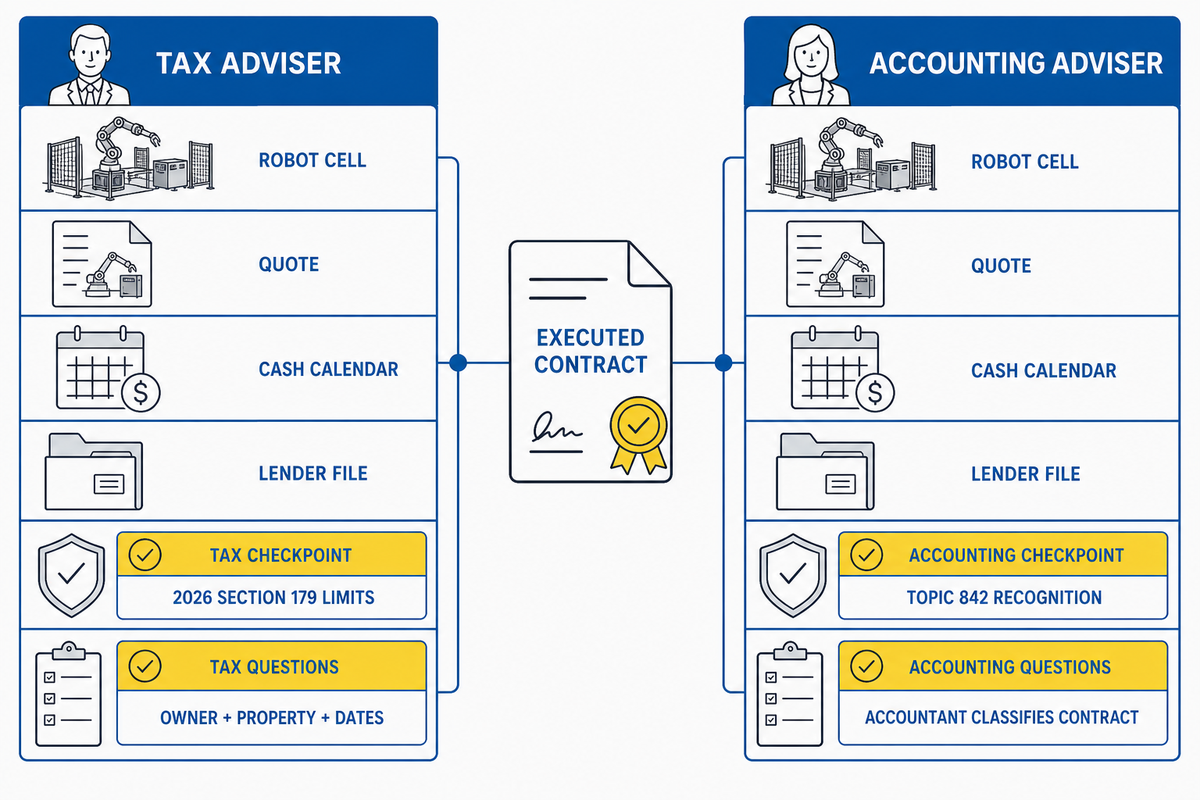
Tax and accounting follow the property, taxpayer, contract, dates, and elections, not the marketing label. Ask the tax adviser and accountant to review the executed documents before the buyer treats depreciation or balance-sheet presentation as a funding benefit.
Current IRS Publication 946 states a 2026 Section 179 maximum deduction of $2,560,000 and a phaseout threshold of $4,090,000. Those dated amounts do not create an automatic saving: qualifying property, ownership, business use, acquisition, placed-in-service timing, taxable-income limits, aggregation, and the taxpayer’s facts still control.
Under FASB Topic 842, lessees generally recognize a right-of-use asset and lease liability for operating and finance leases longer than 12 months. Qualifying leases of 12 months or less may use an elected short-term recognition and measurement exception, while expense and cash-flow presentation differ by classification.
Do not accept a web claim that a buyer can “deduct lease payments,” record all lease payments as operating expenses, or automatically take advantage of Section 179. Tax advisers must analyze the agreement, and an accountant must decide whether the arrangement is a lease, financing, service contract, or combination.
Ask the tax adviser
- Who is treated as owner?
- Which components are qualifying property?
- When is each asset placed in service?
- How do Section 179 and other depreciation rules interact?
Ask the accountant
- Is the contract a lease, financing, service, or mixed arrangement?
- Does the short-term election apply and has it been made?
- How are lease and nonlease components handled?
- What are the covenant and cash-flow effects?
Use the Capex Freeze Decision Grid
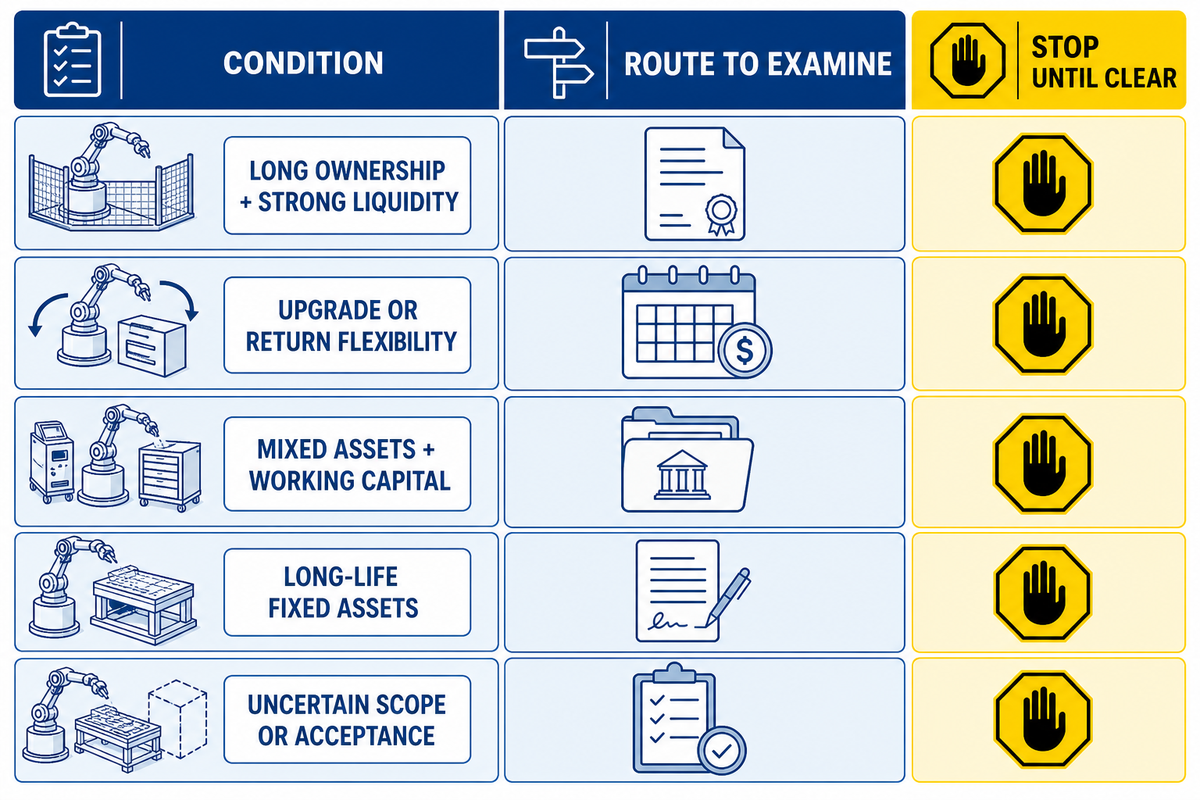
The Capex Freeze Decision Grid converts the research into a shortlist. It does not score credit quality or select a lender; it asks which route remains viable after ownership, project maturity, cash timing, technical acceptance, upgrade risk, and exit obligations are made explicit.
| Condition | Route to examine first | Do not proceed until |
|---|---|---|
| Long ownership horizon; strong liquidity | Cash, conventional loan, or ownership-oriented equipment financing | Downside liquidity and opportunity cost are compared |
| Upgrade or return flexibility matters | FMV lease or available service arrangement | Return, maintenance, option, and data duties are priced |
| Mixed fixed assets and working capital | SBA 7(a) or a blended structure | Every use is confirmed eligible by the lender |
| Qualifying long-life fixed assets dominate | SBA 504 and conventional fixed-asset alternatives | Useful life, soft costs, timing, and working-capital gap are resolved |
| Scope, acceptance, or ramp remains uncertain | Pause commitment; improve quote and milestone evidence | The Three-Clock model and acceptance rules can be signed coherently |
Eliminate any offer that depends on an unfunded deposit, undefined acceptance, unsupported savings, or an exit obligation the operating team cannot perform. Send the surviving routes through tax, accounting, legal, insurance, and technical review before approval. If an SBA route remains, check it against the current 7(a) or 504 program rules rather than treating the grid as proof of eligibility.
Build a Lender-Ready Application Packet
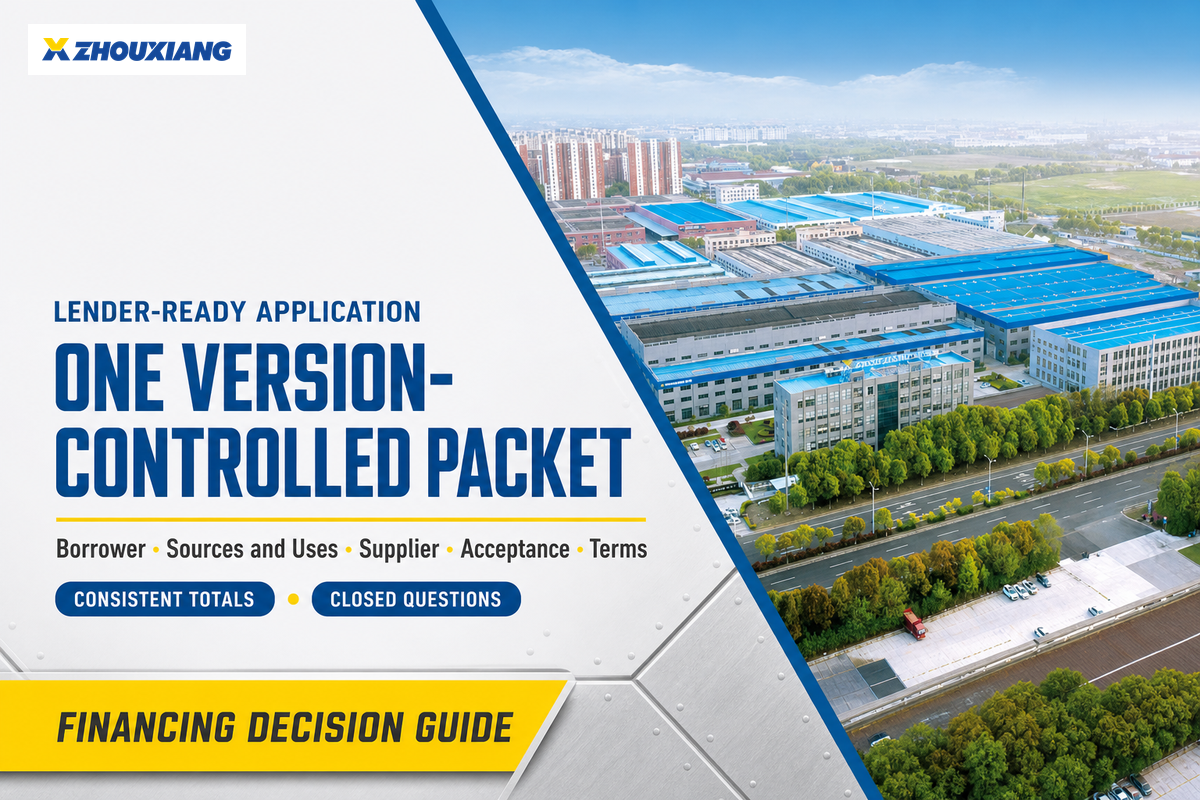
A compact application packet reduces preventable back-and-forth when every document uses the same project amount, supplier names, milestones, responsible parties, and forecast assumptions. Version-control it so a revised quote or scope change does not silently invalidate the financing request.
Application packet — confirm these eight bundles:
| Bundle | Minimum content | Consistency check |
|---|---|---|
| 1. Borrower | Entity, owners, management, financial package requested | Names and obligations match applications |
| 2. Sources and uses | Equipment, services, site work, fees, tax, reserve | Every dollar has a source and timing |
| 3. Supplier | Quote, bill of materials, contracts, deposit and draw schedule | Totals, dates, legal names, and payees agree |
| 4. Project | Layout, responsibilities, facility readiness, insurance | No unfunded prerequisite is hidden |
| 5. Cash flow | Base forecast, three-month delay, overrun case | Payment dates match lender draft |
| 6. Acceptance | Test evidence, notice, signers, cure and open-item process | Supplier and finance documents use compatible triggers |
| 7. Advisers | Open legal, tax, accounting, and insurance questions | All decisions are closed before execution |
| 8. Term approval | Final term sheet, conditions, fees, options, and notice dates | Approved terms match the documents submitted for signature |
Zhouxiang designs industrial robotic welding systems and automated production lines; the Zhouxiang company background provides first-party context. Buyers, lenders, integrators, advisers, and insurers remain responsible for the financing and contract decisions.
Frequently Asked Questions
Is leasing or financing better for a welding robot?
Financing often fits long ownership; leasing can suit upgrade or return flexibility, but full contract economics, cash timing, and end-of-term duties—not the product label—should decide.
Compare the complete payment stream, ownership expectation, useful life, upgrade need, acceptance trigger, maintenance duty, purchase option, return condition, and accounting or tax treatment. Lease labels do not by themselves create off-balance-sheet treatment or a flexible exit. Loans do not automatically cover integration, facility work, or ramp cash. Run both through the Financeable Cell Boundary, Three-Clock model, and downside cash test before selecting a route.
Can installation, fixtures, safety guarding, and commissioning be financed?
Installation, fixtures, safety guarding, and commissioning may be financed when the provider accepts an itemized whole-cell scope, but eligibility and required cash contributions vary by lender and structure.
Give the lender a bill of materials, supplier and integrator contracts, facility scope, milestones, and separate values for equipment and services. Ask for written confirmation of every included line. SBA 504 has a fixed-asset boundary and excludes working capital; another route may treat soft costs differently. Keep a cash source beside every excluded or conditional line so the project cannot stall after the robot is ordered.
When should payments start on a built-to-order robotic welding cell?
Payments should start according to negotiated funding and acceptance milestones, after the buyer maps supplier draws, interim rent, inspection, site testing, regular payments, and production readiness.
Map supplier deposits and draws, lender funding, interim rent, acceptance, regular payments, site testing, and stable production on one timeline. Define what each event means and which document controls. Because acceptance consequences differ by contract and governing law, counsel should coordinate the supplier and finance documents. Where applicable, the process should require timely inspection and an effective rejection or notice; a signature is not necessarily the only way acceptance can arise.
What credit score or down payment is required?
No universal credit score or down payment applies to welding robot financing; lender, borrower, collateral, project scope, guaranty, and broader credit-file requirements determine the actual terms.
Requirements vary with the lender, applicant, time in business, financial performance, owners or guarantors, collateral, project amount, equipment, supplier, structure, and broader credit file. Request a written term sheet that separates deposit, lender contribution, fees, third-party costs, collateral, guaranty, covenants, and conditions. Treat a marketing prequalification as provisional until underwriting and documentation are complete.
Can a startup finance a welding robot?
A startup may finance a welding robot, but limited operating history raises the evidence burden for management capability, owner liquidity, repayment capacity, supplier scope, and downside forecasts.
Prepare sources and uses, management experience, customer or production evidence, supplier scope, owner liquidity, and a downside forecast. An asset alone does not prove repayment capacity, and no program guarantees approval.
Does Section 179 apply to a financed or leased welding robot?
Section 179 may apply when a taxpayer is treated as the owner of qualifying property and satisfies current acquisition, business-use, placed-in-service, income, and election rules.
Payment method alone does not answer the question. Ask a tax adviser to review ownership, equipment type, business use, acquisition, placed-in-service date, taxable-income limits, aggregation, and the executed purchase or lease terms. Financed purchases may support ownership while a true lease may leave ownership with the lessor, yet labels are not decisive. Confirm which party may claim depreciation, whether each component qualifies, how later additions are treated, and whether the business has enough taxable income for the desired election. The 2026 values cited in this guide are dated and can change; they are not a promise that the buyer can claim the maximum deduction or any potential tax benefit.
How This Financing Guide Was Built
The financing guide separates program rules, contract practice, tax and accounting questions, first-party product scope, and author-developed decision tools. Its Financeable Cell Boundary, Three-Clock Funding Model, Acceptance-to-Payment Firewall, and Capex Freeze Decision Grid are planning aids, not underwriting standards, legal opinions, or approval promises.
References & Sources
- 7(a) Loans US Small Business Administration
- 504 Loans US Small Business Administration
- Publication 946: How to Depreciate Property Internal Revenue Service
- Leases, Topic 842 Financial Accounting Standards Board
- UCC 1-203: Lease Distinguished from Security Interest Cornell Legal Information Institute
- UCC 2A-407: Irrevocable Promises in Finance Leases Cornell Legal Information Institute
- UCC 2A-515: Acceptance of Goods Cornell Legal Information Institute
- Equipment Acceptance Is Important Equipment Leasing and Finance Association
- Ten Essential Lease Provisions Equipment Leasing and Finance Association