Get in Touch with Zhouxiang

★★★★★
Since 1991 · Global Industry Leader
AGV Mobile Welding Robot
AGV Mobile Welding Robot — Industrial Steel Machine
Intelligent agv mobile welding robot carts for beam production line work, heavy steel fabrication, and shipyard operations.
0.1 mm
Vision Accuracy
6-Axis
Robot Arm
Self-Driving
Mobile Platform
Certified Excellence
ISO 9001
ISO 14000
ISO 45001
200+ Patents
High-Tech Enterprise
What Is an AGV Mobile Welding Robot — and How Does It Work?
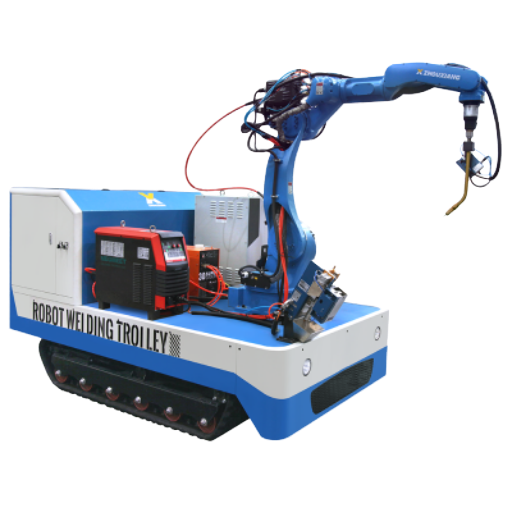
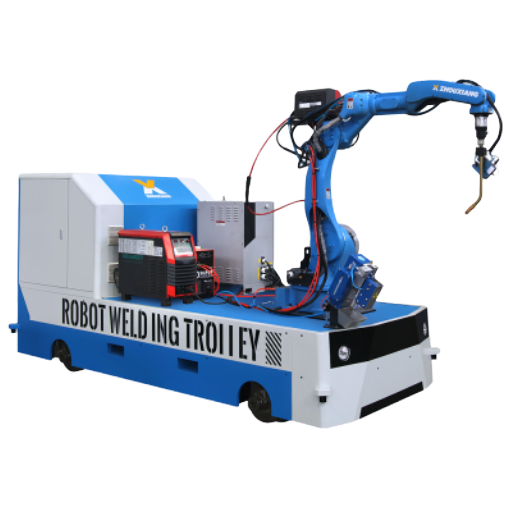
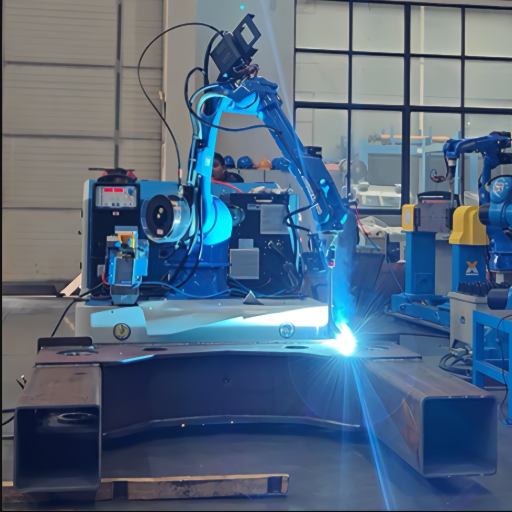
A self-driving cart that brings a robotic arm to your workpiece.Most shops do it backwards (move the part to the robot). An AGV mobile welding robot flips that sequence — the machine goes to the part. It runs on a steering-wheel drive at 2.2 km/h, carrying a 6-axis manipulator directly to large weldments.
System Anatomy
Base
Automated guided vehicle (AGV) built for factory floors.
Arm
CRP2010A 6-axis manipulator + Aotal NBC500RP Plus power source.
Brain
TracerStudio vision (0.1 mm accuracy) for seam finding & path planning.
Day-to-Day Workflow
01
Job Assignment
Operator loads a weld program. The system identifies workpiece location via map sensors.
02
Navigation
Self-driving guidance (magnetic/laser/SLAM) moves cart to target. Obstacle detection active.
03
Alignment
Vision system scans joint point-clouds. Syncs with positioners to orient part before welding.
04
Weld & Move
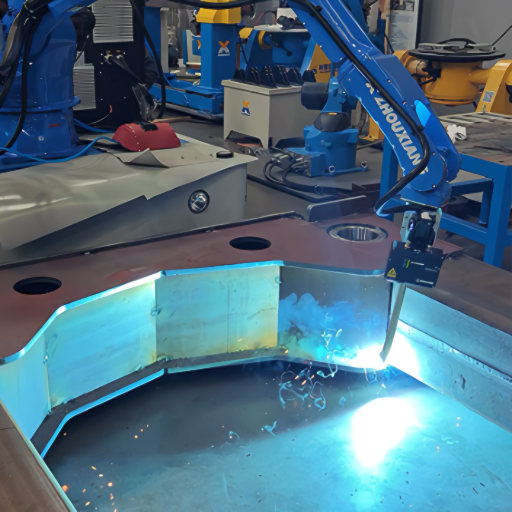
6-axis arm executes path. Cart repositions for next segment. Auto-charging during idle times.
Mobile Welding Robot Product Line — Models and Configurations
Look, most people searching for this kind of setup are not buying a bare AGV and bolting on parts later. They need the whole thing — the arm, the welding machine, detectors, charge management, and floor-level guidance — a complete system ready to weld on arrival. That is the service we deliver. Our automated welding carts ship turnkey.
ZX-MWR Standard
Standard
Drive base + CRP2010A + NBC500RP Plus. Indoor use. Coil cable power. 2.2 km/h. Best for repetitive weld paths in fabrication shops and warehouse layouts.
ZX-MWR Heavy Payload
Heavy Duty
Reinforced platform for extra gear. Dual wire feeders, positioner interface, extended torch reach. Built for large assemblies in beam production line environments.
ZX-MWR Tracked
Tracked
Chain-driven tracked base for rough-terrain conditions including uneven ground and soft surfaces. Wider turn circle but higher ground clearance for outdoor yards.
ZX-MWR Laser
Laser Hybrid
Fiber laser head with MIG backup. Fast thin-sheet work. Pairs with our cutting software for a unified production flow.
ZX-MWR Multi-Unit
Fleet
Multiple units run by central logistics software. Automatic charge scheduling, path coordination, and real-time monitoring across the floor.
ZX-MWR Custom
Custom OEM
Full customization — footprint, detector array, weld process, PLC integration, control software. Built to spec with on-site commissioning by our engineers.
Core Technical: The core uses a CRP2010A articulated arm mounted on a drive base. Total power draw: 50KVA. The welding machine is an Aotal NBC500RP Plus (MIG/MAG), the package weighs about 2,500 kg. Dimensions: 3,000 by 1,500 by 2,400 mm.
AGV Mobile Welding Robot Selector
Answer 4 questions about your application and we’ll recommend the right platform configuration.
Start Selector →
AGV Welding Robot Technical Specifications & Performance Analysis
Capacity and Performance Characteristics
Real numbers from real machines. These are the specs for the standard ZX-MWR unit. The tracked variant trades top speed for ground clearance and rough-terrain stability.
| Parameter | Value | Notes |
|---|---|---|
| Total Power | 50 KVA | 3-phase 380V/50Hz input |
| Power Supply | 3×380V 50Hz 3P 5-wire | Coil cable supply |
| Weight | 2,500 kg | Full setup including arm |
| Dimensions | 3,000 × 1,500 × 2,400 mm | Standard footprint (L×W×H) |
| Arm | CRP2010A (6-axis) | Repeatable ±0.05 mm |
| Power Source | Aotal NBC500RP Plus | MIG/MAG 500A rated |
| Camera Accuracy | 0.1 mm | 3D seam detection |
| Imaging Software | TracerStudio | Real-time path correction |
| Drive | Steering-drive type | Differential on tracked |
| Operation | Remote control | Autonomous optional |
| Travel Speed | 2.2 km/h | 0 to 2.2 under load |
| Temp Range | 0°C to +45°C | Extended enclosure available |
| Humidity | ≤90% RH | Non-condensing |
Quick note on the camera system
The 0.1 mm accuracy is measured under controlled lighting at 500 mm standoff. In a real shop with arc flash and fume, effective accuracy runs closer to 0.2–0.3 mm. Still sufficient for single-pass MIG on structural metal.
Operational Reach
The arm covers joints within a 2-meter envelope from center. For larger structures we pair two units or add a linear rail.
Wheeled vs. Tracked AGV Comparison
Two drive systems, very different trade-offs. Here is how they compare in real shop conditions.
| Factor | Wheeled AGV | Tracked AGV |
|---|---|---|
| Best ground | Flat, smooth factory floors — concrete, epoxy | Rough or mixed surfaces, uneven ground |
| Speed | Faster — 2.0-3.0 km/h typical | Slower — 1.0-1.8 km/h typical |
| Turning radius | Tight turns, works in narrow aisles | Larger turning radius, needs more room |
| Payload | Moderate — good for standard cells | Heavier cargo, distributed pressure |
| Terrain | Struggles on muddy ground or gravel | Handles mud, soft dirt, metal grating |
| Maintenance | Lower — wheel + bearing replacement | Higher — track tension, roller wear |
| Vibration | Lower vibration = steadier arc | More vibration from track drive |
| Cost | Lower entry price | 15-30% premium over wheeled |
The practical breakdown
If your shop floor is poured concrete — go wheeled. Period. You get better speed and efficiency, tighter maneuvering, and lower maintenance costs.
Tracked is the right call for outdoor steel yards, shipyards, or any site where the cart has to roll across unprepared surfaces. It is slower and costs more, but it won’t get stuck in gravel.
Zhouxiang — Your AGV Mobile Welding Robot Manufacturer and Supplier
Wuxi-based since 1991 — full-line welding equipment manufacturer
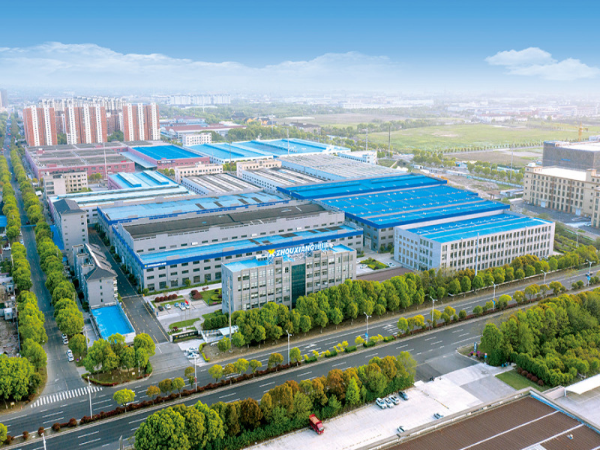
We started in 1991. Small shop in Wuxi, about 100 kilometers from Shanghai. Back then it was manual jigs and basic positioners. Thirty-plus years later, the company covers 160,000 square meters and employs over 500 people — more than 100 engineers.
Here is what matters to a user evaluating this category of gear. We hold over 200 patents (close to 50 invention patents). The zhouxiang complete set of welding line spans CNC cutting, welding manipulator, welding rotator, welding positioner, H-beam production lines, milling machine, shot blasting machine, plate rolling machine, and laser cutting.
So "complete set of welding equipment" is not marketing fluff — it is literally what we build and ship.
1991
Founded
160K m²
Factory Area
200+
Patents
60+
Countries
Certifications & Global Industry Impact
Certifications: ISO 9001, ISO 14000, ISO 45001, ISO 50001. We were the first in our segment in China to get that ISO 9001 stamp.
The government tagged us as a "National Specialized, Fine, Special, New Little Giant Enterprise" — a feature of their high-tech enterprise program. Products sell across Europe, the Americas, Southeast Asia, and the Middle East. Sixty-plus countries so far.
LW
Written by Li Wei, Senior Automation Engineer
18 years in welding automation · CWI / AWS Member · R&D Division
Understanding AGV Technology & Agv Welding System Integration
Automated guided vehicles (AGVs) have long been used in warehouses. Learn how this technology has evolved from simple carts to mobile welding cells..
Types of AGV Used in Welding
Load-Carrying Carts
The workhorse category. The cart carries the entire welding cell — arm, power source, wire spool, gas bottle. Our ZX-MWR sits here. Moves the whole setup to the workpiece.
Towed Platforms
A separate tug pulls a trailer loaded with equipment. Good for very heavy power sources or multi-process rigs. Less common in welding but used in shipyard applications.
Vision-Guided / Laser-Guided
No floor tape or magnets needed. These use SLAM or LiDAR to map the environment. More flexible if your floor layout changes often — but the navigation hardware adds cost and complexity.
Hybrid Processing Platforms
Fiber laser head plus conventional MIG on the same cart. Switch between processes without driving back to the cell. Mostly used for thin-sheet work followed by structural tack welds.
Recommendation for Steel Fabrication
The choice comes down to what you are welding, how big the pieces are, and how often your layout changes. For most steel fabrication — beam production line, tank farms, frame assembly — a load-carrying cart with magnetic guidance is the safest bet. The technology is mature, the price is lower, and maintenance is straightforward. Fancy LiDAR is nice in theory but adds failure points you probably do not need.
AGV Mobile Welding Robot Wholesale — OEM, Fleet, and Supplier Programs
For Integrators, Distributors, and Fleet Buyers
OEM / ODM
Custom branding, modified dimensions, proprietary detector integration. We handle mechanical build, electrical layout, software, and testing. Turnkey delivery.
Fleet Pricing
Multi-unit orders get volume breaks. Fleet coordination software — central dispatch, docking schedules, path planning — included free for 5+ orders.
Logistics
FOB Wuxi or CIF to your port. Shipped to Houston, Rotterdam, Jebel Ali, Singapore. Transit: 25–35 days by sea.
After-Sales Service
12-month warranty. Remote diagnostics via VPN. Spares shipped within 48 hours. On-site commissioning available worldwide.
State-of-the-Art Manufacturing Base


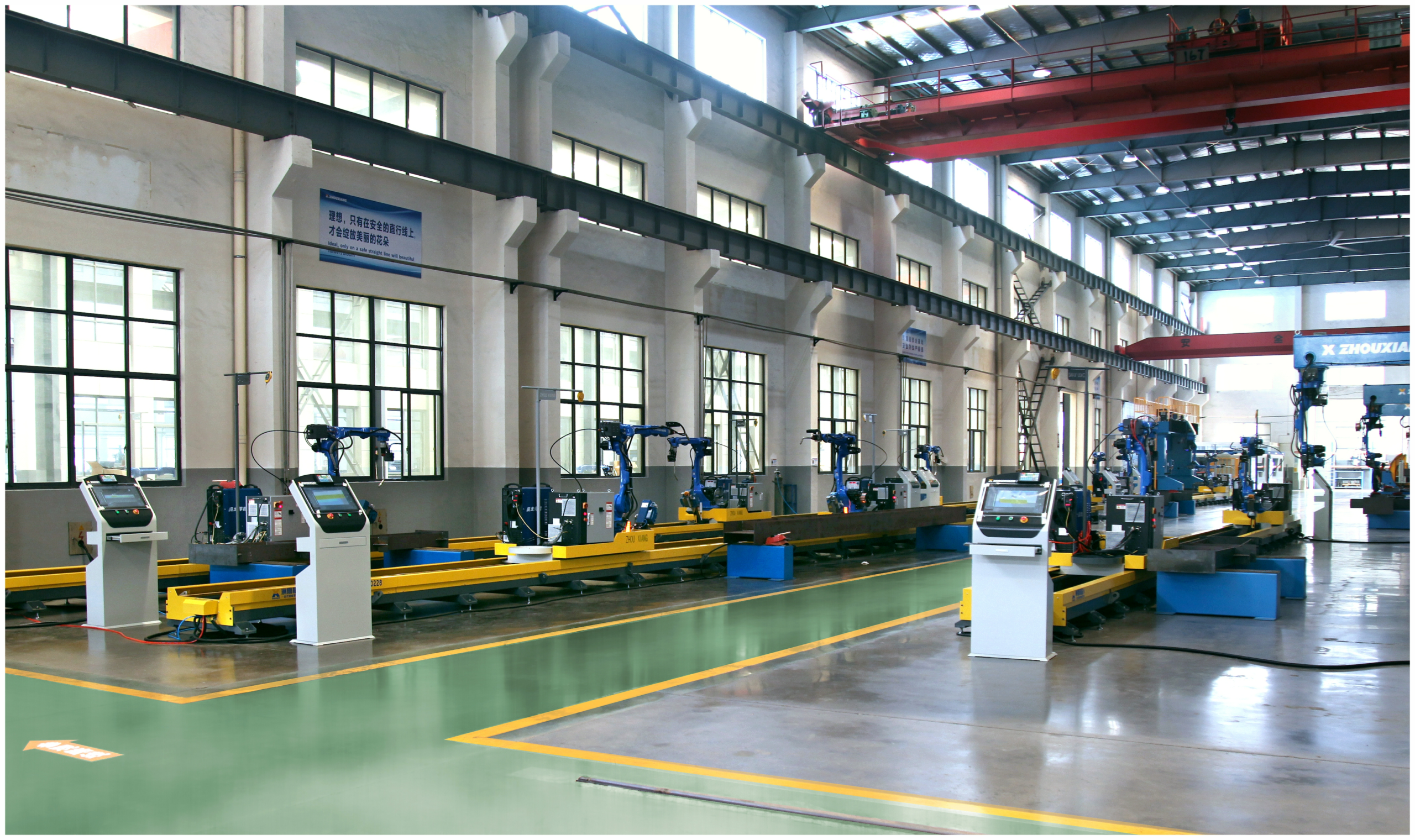
Zhouxiang AGV Mobile Welding Robot Production Facility
Real Problems, Real Fixes — Why Shops Switch to Robotic Welding Automation
Based on actual deployments and customer conversations
The Challenge
01
Your workpieces are too big to move to a fixed cell
This is the number-one reason people call us. Metal frames, hull sections, bridge girders — they sit where they are. A fixed cell is useless if the part does not fit. The mobile robot drives to the workpiece, replacing crane moves and forklift shuffling.
Project — Gulf Coast Shipyard, 2024
Moving 12m long double-bottom panels was impossible. We shipped two units with extended torch reach. Once calibrated, each unit averaged 14 panels per shift compared to 6 manually (12% reject rate).
"We stopped arguing about crane schedules..."
The Labor Crisis
02
You cannot find enough welders — and the ones you have are burning out
AWS data says the U.S. needs 330,000 new welding professionals by 2028. If your shop relies on 4–5 skilled hands and two leave, production falls off a cliff. This setup multiplies welders: one operator supervises multiple units.
Project — Steel Fabricator, Ohio, 2023
After losing three welders in six months, they had a massive backlog. We set up one intelligent AGV robot. Output went up 40%, recovering the backlog in seven weeks.
"I am not going to pretend it is as good as Gary..."
Consistency
03
Weld quality changes shift to shift
Morning shift welds look different from night shift due to human fatigue and parameter variance. The robotic arm uses the same parameters on every joint, keeping consistency within 0.3 mm of the programmed path.
Project — Pressure Vessel Plant, Shandong
They were facing an 8% failure rate on X-ray inspections. By pairing our unit with a welding rotator, the RT reject rate dropped to under 1.5% in two months.
Flexibility
04
Your layout changes and fixed automation does not flex
Fixed cells are a nightmare to tear down if production changes seasonally. A self-driving unit simply drives to the new station. Reprogram the path, update the guidance map, and you are done in a weekend.
Technical Advantage — Connectivity
Integration headaches? The controller supports Modbus TCP, EtherNet/IP, and PROFINET. It synchronizes with your welding positioner and rotator in real time. No middleware needed.
ROI Calculator
Robot vs Manual Welding Cost Analysis
See the real numbers. Adjust inputs below to match your production line and estimate your annual savings.
Manual Welding
Labor Costs
Base Salaries$220,000
Benefits & Overhead (30%)$66,000
Recruitment & Training$18,000
Operational Costs
Consumables$24,000
Rework & Scrap (8%)$24,320
Safety Costs$12,000
Total Annual Cost$364,320
AGV Robot Welding
Labor Costs
1 Robot Operator$49,500
Benefits & Overhead (30%)$14,850
Equipment Depreciation$18,750
Operational Costs
Consumables (Optimized)$14,400
Rework & Scrap (1.5%)$4,560
Maintenance & Energy$11,700
Total Annual Cost$113,760
Annual Savings with AGV Robot
$250,560
Switching to an AGV mobile welding robot saves approximately $250,560 per year compared to a 4-welder manual setup. The robot system pays for itself within 8 months.
Get Instant QuoteWelding Automation Solutions Customer Case Study
Evaluating mobile Welding Robots for cost savings, throughput improvements and consistent quality welding. Documented ROI from leading manufacturers.
Replacing 12 Manual Welders with 3 AGV Robots
How Nordic Marine Engineering AB eliminated welding bottlenecks and achieved 62% cycle time reduction.
The Challenge
Facing a labor crisis with 8 senior welders retiring, training replacements took 24+ months. Rework rates were 11% due to fatigue-induced defects.
Our Solution
Integrated 3 AGV-WR600 robots with laser seam tracking (+/- 0.15mm). The system performs multi-pass SAW on hull panels autonomously.
62%Faster Cycle
0.8%Defect Rate
€1.4MSaved/Yr
11moPayback
"The AGV system provides a higher level of consistency than our best Class A welders."
— Lars Eriksson, VP Manufacturing
Key Takeaway: Shipbuilding workpieces are too large to move. Our AGV navigates steel decks autonomously to bring the robot to the weld.
Automating High-Mix Steel Beam Welding
Processing 85+ different beam structures per week with a single mobile welding robot cell.
The Challenge
Handling 85+ unique beam configs weekly. Fixed automation failed because programming took 45+ mins per joint. Manual welders were scarce.
Our Solution
Deployed robots with AdaptVision™ 3D scanning. It scans, plans, and welds in under 90 seconds without manual programming.
340%Throughput
3minChangeover
$890KSaved/Yr
97%Pass Rate
"We went from dreading new project specs to welcoming variety — the robot adapts faster than our best programmers."
— Mike Hernandez, Foreman
Key Takeaway: Adaptive vision eliminates the programming bottleneck, making robotics viable for high-mix/low-volume shops.
120-km Desert Pipeline Project
Welding 4,800 pipe joints in 9 months in extreme desert conditions.
The Challenge
4,800 critical girth welds needed in 48°C heat. Missing the deadline meant $180k/day penalties. Human welders could not sustain the pace.
Our Solution
IP65-rated AGV-WR320P robots with built-in cooling. Each completes a weld in 55 mins (vs 4.5 hrs manual) consistently in heat.
6 WksEarly Finish
98.6%Pass Rate
$4.2MSaved
79%Labor Cut
"The mobile welding robots changed the definition of field welding. We booked them for our next three contracts."
— Khalid Al-Mahmoud, Director
Key Takeaway: Robots deliver compliant welds regardless of heat or fatigue, essential for critical pipeline timelines.
Zero-Defect Excavator Boom Production
Cutting weld defect rates from 9% to 0.3% to capture a Caterpillar OEM contract.
The Challenge
OEM contract required <0.5% defect rate on complex Q690D steel booms. Manual welding averaged 9.2%, failing the audit.
Our Solution
Heavy-duty AGVs with WeldEye™ monitoring. It tracks voltage/current in real-time, enforcing 100% digital traceability.
0.3%Defect Rate
100%Traceable
¥18MContract
210%Throughput
"The real-time monitoring and traceability features won us the contract – competitors couldn't offer that level of data."
— Dr. Wei Zhang, Quality Director
Key Takeaway: Tier-1 OEM contracts demand digital proof of quality. Automated monitoring exceeds industry acceptance criteria.
Welding Robot ROI Calculator
Estimate your payback period and annual savings by switching from manual welding to an AGV mobile welding robot.
Frequently Asked Questions
It is a self-driving unit — an automated guided vehicle — that carries a 6-axis arm right to the workpiece. Ours uses TracerStudio vision with 0.1 mm accuracy to find the seam, align the torch, and weld. Runs on a steering-wheel drive at about 2.2 km/h.
Standard wheeled units suit flat floors. For an applicable environment with muddy ground or including uneven ground, get a tracked base. Trade-off: slower speed, larger turning radius, but better stability for outdoor steel yards.
Standard weighs 2,500 kg and carries the full setup. Can carry heavier cargo with reinforced axles. Industry range: 500 kg to several tons.
Base ships with Aotal NBC500RP Plus for MIG/MAG. Modular: swap in TIG, fiber laser, or submerged arc for beam production line jobs.
Base: $80K–$150K. Add advanced vision, laser, or customization and price can exceed $250K. Most buyers see payback inside 18 months factoring in labor savings.
Wheeled is faster (2.2 km/h), more agile, better indoors. Tracked handles rough terrain but is slower with a larger turning radius. For most shops, wheeled wins.
Yes. Controller talks to your positioner and rotator through Modbus, EtherNet/IP, or PROFINET. Real-time coordination. We have run this from 6-inch pipe spools to 3-meter vessels.
That is what we do. 200+ patents, 160,000 m² in Wuxi. Custom dimensions, sensors, integration with milling machine stations. Manufacturing lead time: 90–120 days for fully custom.