Get in Touch with Zhouxiang

Laser Beam Processing Line for Steel
Industrial Laser Beam Processing Line for Steel — ±0.05mm Precision, 24-Meter Capacity
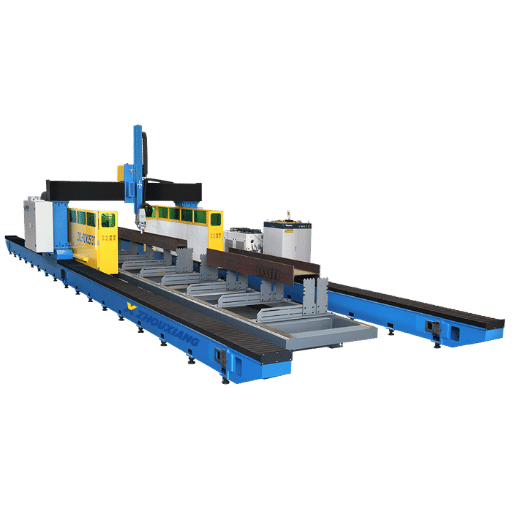
Five CNC axes. 20,000 watts. Cuts, bevels, drills, copes, and marks H-beams, I-beams, channels, and angles in one automated cycle. Built by Zhouxiang — 30 years of structural steel fabrication equipment, shipped from Wuxi, China.
Five CNC axes
20,000 watts
Zhouxiang Built
20kW
Laser Power
±0.05mm
Repeat Accuracy
24m
Max Beam Length
6+/hr
Beams Processed
How A Laser Beam Processing Line For Steel Works
People ask us this a lot, so here’s the actual workflow. Nothing magical about it — just good engineering and a 20kW beam fiber laser doing what it does best.
-
0101
3D Model Import & Nesting
Your detailing team exports the structural model from Tekla, SolidWorks, or UG. The BOCHU FSCUT9200 nesting software reads the file, identifies every beam profile and cross-section, and generates efficient cutting paths. No manual re-entry. Setup drops from hours to minutes.
-
0202
Automatic Material Loading & Alignment
Raw H beam, I-beam, channel, or angle stock feeds onto the roller conveyor. Laser sensors detect the profile geometry and auto-align the workpiece. No manual clamping or datum setting — the CNC handles positioning to ±0.2mm.
-
0303
Five-Axis Laser Cutting
The gantry-mounted cutting head moves at up to 50 m/min across the 3500 × 24000mm working envelope. The A and B axes tilt ±90° each — which means straight cuts, compound bevels, cope profiles, slots, and holes all happen without repositioning the steel beam.
-
0404
Marking, Engraving & Scribing
After the cuts, the same laser head engraves part numbers, weld symbols, assembly marks, and match lines directly onto the steel. Your welders and fitters get clear instructions burned into the metal — no paint markers that rub off during transport.
-
0505
Weld-Ready Output
Parts come off the line with clean edges, precise bevels, and zero burr. They go straight to downstream assembly — whether that’s a submerged arc welding station, our robotic welding workstations, or manual fit-up tables. No grinding step. No secondary finishing.
Structural Steel Laser Cutting Machine Models and Configurations
One beam line handles cutting, beveling, hole-making, marking, and scribing. Pick the configuration that fits your shop floor and daily workload.
ZX-FCM35240-20000W Gantry Laser Beam Line
Our flagship model. 20kW Raycus fiber laser, five-axis cutting head (±90° A/B swing), 3500×24000mm effective range. Handles H-beam, I-beam, channel, and angle profiles up to 1200mm wide × 500mm tall. Processes 6+ twelve-meter beams per hour at 600×200mm cross-section. This is the machine for high-volume structural fabrication where throughput and high precision both matter.
Laser + Robotic Welding Integration
Pair the laser cutting machine with our cantilever or gantry robotic welding workstations for a complete beam-to-assembly workflow. The laser line feeds weld-ready parts — beveled, coped, marked — directly to downstream beam welding stations. That cuts your fabrication cycle by about 35-40% compared to running separate processing stations with manual handoffs between them.
Full Steel Structure Production Line
For shops that process steel from raw plate to finished structural elements: our H-beam assembly machine, submerged arc welding station, straightening machine, shot blasting line, and laser secondary processing line work as an integrated system. CNC controls coordinate the entire flow — from plate alignment to final cut. Think of it as intelligent manufacturing for steel structures, not just a laser cutter sitting in a corner.
Laser Beam Processing Line For Steel — Capacity & Performance Data
Real numbers from our production floor. Not estimates — tested and verified on structural steel under actual cutting conditions.
Parameter
ZX-FCM35240-20000W
Effective Cutting Range
3,500 × 24,000 mm
X-Axis Stroke
3,500 mm
Y-Axis Stroke
24,000 mm
Z-Axis Stroke
1,000 mm
Max Cutting Width (H-Beam)
1,200 mm
Max Cutting Height (H-Beam)
500 mm
Max Cutting Length
24,000 mm
X/Y Positioning Accuracy
± 0.2 mm
Repeat Positioning Accuracy
± 0.05 mm
Maximum Traverse Speed
50 m/min
A-Axis Swing
± 90°
B-Axis Swing
± 90°
Maximum Acceleration
0.5 G
Laser Source
20,000 W Raycus Fiber
Cutting Head / Torch
Boci BLT462P
Control & Nesting Software
BOCHU FSCUT9200
Cooling System
Hanli Industrial Chiller
Power Supply
380V / 50Hz, 3-phase
Protection Level
IP54
Operations
Cutting, holes, slots, beveling, engraving, marking, scribing
Throughput (600×200mm H-beam)
6+ pieces/hour (12m sections)
Specifications based on standard conditions. Throughput varies by profile complexity, material grade, and cutting pattern. Custom laser power (12kW–30kW) and working lengths available on request. The gantry frame is built with high-rigidity welded steel construction — reliable and durable enough for continuous three-shift operation.
Common Steel Fabrication Problems Solved By A Laser Beam Processing Line
These aren’t hypotheticals. Every problem below came from actual project inquiries we received — and each one had a real deadline attached to it.
✕ Problem
Plasma Can’t Hold Bevel Tolerances On Long Spans
CNC plasma cutting on structural steel drifts ±0.5mm or worse — especially on long beams where heat buildup warps the workpiece. Every bevel needs hand grinding before weld fit-up. That’s labor costs and downtime you’re paying for twice.
✓ Solution
Five-Axis Precision Laser With Real-Time Height Tracking
The laser beam line holds ±0.05mm repeat accuracy across the full 24-meter span. Automatic edge detection compensates for beam camber. No secondary finishing needed downstream. Weld pass rates jump from around 78% to 97%.
✕ Problem
8-Person Crew For Manual Beam Processing
Flame cutting, manual coping, hole-drilling, marking — each step needs a different operator at a different station. You’re paying eight skilled workers to produce 15 beams a shift. Good luck hiring replacements when they retire.
✓ Solution
Automate To Two Operators, 50+ Beams Per Shift
The laser beam processing line handles cutting, beveling, drilling, coping, marking, and scribing in a single automated pass. Two operators run the full system. The six workers you redeploy can go where you actually need them — assembly, welding, QC.
✕ Problem
Project Delays From Multi-Station Processing
When your beam line is three separate machines — a saw, a drill, a coper — every handoff adds time and error. Material handling alone eats 30% of the shift. Miss a deadline on structural steel and the penalty clauses are brutal.
✓ Solution
One Machine, One Pass, All Operations
The gantry laser does it all without repositioning: slot cuts, cope profiles, bevel preparation, hole patterns, engraving, marking. Automatic material alignment means zero manual setup between beams. Feed the steel in, weld-ready parts come out.
✕ Problem
Software Incompatibility Causes Rework
Your engineers design in Tekla. Your cutting machine doesn’t read Tekla files. Someone manually re-enters dimensions. Mistakes happen. Beams get cut wrong. Material waste adds up. Sound familiar?
✓ Solution
Direct Tekla / SolidWorks / UG File Import
BOCHU FSCUT9200 imports 3D model files directly. Reads the profiles, identifies cut positions, generates nesting layouts. No manual re-entry, no transcription errors. Setup time drops from hours to minutes per batch.
✕ Problem
Flame Cutting Distorts Load-Bearing Beams
High heat input from flame cutting warps load-bearing structural elements. That means straightening, stress-relief, rework. On high-strength steel, the heat-affected zone can compromise material properties entirely.
✓ Solution
Low Heat Input From 20kW Fiber Laser
The concentrated beam fiber laser cuts with a narrow kerf and minimal thermal spread. Heat-affected zones stay tight — critical for heavy beams and steel structure applications. No straightening step. No metallurgical compromise.
✕ Problem
Inconsistent Quality From Operator-Dependent Processes
When you’ve got six different torch operators, you get six different cut qualities. Monday morning cuts look different from Friday afternoon cuts. Your welders downstream never know what they’re going to get.
✓ Solution
CNC Repeatability — Every Cut Identical
The laser runs on programmed paths. First cut of the day is identical to the last. ±0.05mm. Every time. Doesn’t matter if it’s a Monday or a Friday, the machine doesn’t get tired, distracted, or decide to take a shortcut. That consistency is what drives the competitive edge over manual methods — especially when your downstream processes depend on tight tolerances.
laser beam processing line for steel factory
Factory Image Gallery & Technical Stations
Main Overview of Processing Line

Detailed Station Views
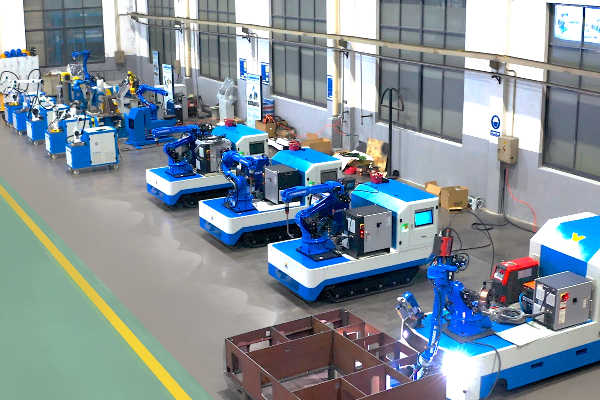


Robotics & Material Handling


Automated Stacking Solutions

×
❮
![Enlarged Factory View]()
Industries That Depend On Laser Beam Processing Lines For Steel Structures
Our machines show up in some expected places — and a few you might not guess. Here's where laser-processed steel beams end up.
Commercial & High-Rise Construction
Steel-frame office towers, shopping centers, warehouses. H-beam columns, floor beams, and bracing members — all requiring precise cope and bevel work for moment connections. High-volume, tight-deadline projects where the productivity of a laser line beats manual methods by 3-4x.
Bridge & Infrastructure
Bridge girders, pier caps, cross-bracing. Where ±0.05mm bevel accuracy isn't a luxury — it's a specification requirement. We've processed beams for highway overpasses, railway bridges, and pedestrian spans. The structural engineer signs off faster when they know the edges are laser-cut.
Shipbuilding & Marine
Hull frames, deck beams, bulkhead stiffeners. Shipyard fabrication demands consistency across hundreds of identical sections. Our laser lines run alongside welding stations on shipyard floors from Changxing Island to Dalian.
Energy & Petrochemical
Pipe racks, equipment skids, platform frames for oil and gas installations. Refinery turnarounds with tight shutdown windows — where every day of downtime costs six figures. The speed of laser processing has saved more than one project manager's deadline.
Automotive & Manufacturing Plants
Structural frames for automotive assembly plants, manufacturing facilities, and logistics centers. Clean, precise connections matter when the building houses precision equipment. Some automotive OEMs now spec laser-cut steel for their factory structures.
Aerospace & Defense Facilities
Hangars, test facilities, launch structures. High-strength steel and demanding tolerances. Not high-volume, but zero tolerance for errors on load-bearing connections. Laser processing for aerospace structural applications — it's a growing niche.
Automation, Software & CNC Integration In Our Laser Beam Processing Line For Steel
The laser does the cutting. But the software and automation are what turn it from a tool into a production line. Here's what runs under the hood.
BOCHU FSCUT9200 Nesting & Control Software
Imports directly from Tekla, SolidWorks, and UG. Reads 3D structural models, auto-identifies every profile and cut location, generates tight nesting patterns that keep material waste below 5%. The software handles path planning, speed tuning, and collision avoidance. Your detailer exports the model, the machine starts cutting. That's real automation — not a buzzword.
Five-Axis CNC Motion Control
Three linear axes (X/Y/Z) plus two rotary axes (A/B) at ±90° each. The controller interpolates all five axes simultaneously for complex compound bevels. Maximum traverse speed: 50 m/min. Acceleration: 0.5G. The CNC system maintains precision across the full 24-meter working envelope — no accuracy degradation at the extremes of travel.
Automatic Edge Detection & Height Tracking
Capacitive and laser sensors map the workpiece surface in real time. The system compensates for material camber, surface irregularities, and thermal expansion during cutting. On a 24-meter span, even 2mm of bow would throw off bevel geometry on a lesser machine. Our sensors catch it and the CNC adjusts on the fly.
Material Handling & Conveyor Integration
Motorized roller conveyors feed raw stock into the cutting zone and transport finished parts out. Automatic centering and datum positioning eliminate manual alignment. The system handles beam changeover in under 60 seconds — no crane lifts, no forklift shuffling. That's where a lot of the production efficiency comes from in practice. Handling time used to eat 30% of the shift; now it's under 5%.
Integration With Downstream Equipment:
The laser line communicates with our submerged arc welding stations, assembly machines, and robotic welding workstations via a shared CNC network. Part data, cut reports, and quality logs transfer automatically. This kind of modern manufacturing connectivity is what we mean by "intelligent manufacturing" — it's not about AI, it's about machines talking to each other so your operators don't have to carry clipboards between stations.
After-Sales Support, Spare Parts & Operator Training for Your Laser Beam Line
We know the biggest concern overseas buyers have about equipment from China. Here's exactly what we do about it.
24/7 Remote Diagnostics
Video-link troubleshooting with our Wuxi engineering team. Most issues — software glitches, parameter adjustments, alarm codes — get resolved within an hour without anyone getting on a plane. The CNC system has remote access capability built in, so our engineers can see exactly what your machine sees.
Spare Parts Inventory
We maintain spare parts stock for key regional markets. Consumables — nozzles, protective lenses, gas fittings — ship from local warehouses. Wear parts typically arrive within 3-5 business days. For critical components (cutting head, laser source modules), we keep buffer stock at our factory for express dispatch. Downtime costs money. We get that.
On-Site Service & Training
Engineers available for field service visits. Annual maintenance programs. Refresher training for new operators. Software updates and firmware upgrades as they come out from BOCHU. The India story on our website — where we spent three months getting a visa just to install one customer's welding robot — that actually happened. That's the level of commitment we're talking about. One year standard warranty, extendable.
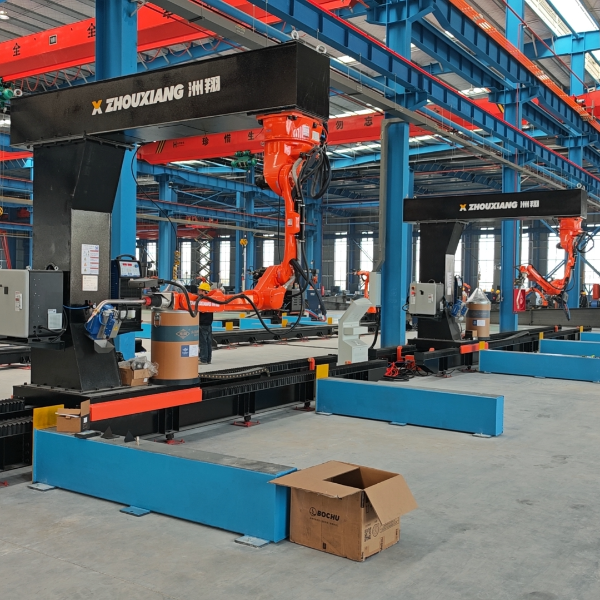
Laser Beam Processing Line for Steel: Evaluation Tools
Use these interactive calculators to estimate ROI, compare cutting efficiency, and determine power requirements for your production setup.
Frequently Asked Questions
How Does a Laser Beam Line Weld and Cut Steel in Modern Manufacturing?
It doesn't weld — let's clear that up first. The laser beam processing line handles all the pre-weld operations: cutting to length, bevel preparation, cope profiles, hole patterns, slot creation, and marking. The five-axis CNC head switches between these operations without repositioning the workpiece. In a modern manufacturing setup, the laser line feeds weld-ready parts to downstream beam welding or submerged arc welding stations. Some of our customers pair the laser line with our robotic welding workstations for a complete automated flow — but those are separate machines working in sequence, not one unit doing everything. The precision laser cuts mean less rework at the welding stage, which is where the real time savings come from.
What's the Real Difference Between Laser Cutting and Plasma Cutting for H-Beams?
Edge quality, basically. Our laser holds ±0.05mm repeat accuracy — a CNC plasma cutting machine typically drifts ±0.5mm at best. That gap matters because it determines whether your weld joints fit up clean or need grinding. The laser also cuts a narrower kerf, so material waste drops 15-20%. And heat input is lower, which means less distortion on long beams. That said — plasma cutting still makes sense for very thick plate above 50mm where laser power hasn't caught up economically. For structural steel beam processing in the 6mm to 40mm range, though? Laser wins on speed, accuracy, and total cost per cut. We've seen shops reduce their flame cutting and plasma cutting stations by 60-70% after installing a beam line.
What Steel Profiles Can the Beam Line Process?
H-beams, I-beams, channels, angles, T-sections, and custom structural profiles. Maximum cross-section dimensions: 1200mm wide × 500mm tall. Maximum length: 24 meters. On the operations side: straight cuts, bevel cutting up to ±90°, hole drilling, slot creation, cope profiles, engraving, marking, and scribing. All in one pass. One machine handles what used to require a saw, a drill press, a coper, a beveling torch, and a marking station. The versatility is what makes it a true cutting solution for structural fabrication rather than just a laser cutter that happens to process beams.
Is Laser Processing Suitable for Heavy Beams and Load-Bearing Steel?
Short answer: yes, and it's actually better than the alternatives for this application. The 20kW high power fiber laser cuts heavy beams with minimal thermal distortion — the heat-affected zone stays narrow because the energy is concentrated and the cut speed is fast. That matters for load-bearing structural elements where you can't afford to compromise the steel's mechanical properties. High-strength steel grades that are sensitive to heat — the kind used in bridge girders, high-rise columns, and demanding structural applications in aerospace and automotive — actually benefit more from laser than from flame cutting or plasma cutting, which dump a lot more heat into the workpiece. We've processed beams for bridge projects where the structural engineer specifically required laser-cut edges. That's becoming more common.
What Benefits Do Laser Beams Provide When Welding Heavy Beams and Load Bearing Steel?
Laser welding provides deep penetration and creates small zones where heat is affected, making for strong, reliable, and durable joints in heavy beams and load bearing steel elements. This makes for less need for secondary finishing and post weld machining, quickens large scale production, and allows for the use of intelligent manufacturing processes in the construction and infrastructure industries.
Is Laser Cutting a Good Substitute for Traditional Flame Cutting for Beam Steel Cutting, and When Would Polishing/Secondary Finishing Still Be Required?
A laser beam cutting can be more productive than flame cutting in that it can handle precise cutting with better material utilization and is less heat affected than flame cutting. Nevertheless, flame cutting may still be required for specific alloy chemistries. Also, secondary finishing such as grinding and deburring may still be required for cosmetic surfaces and tight tolerances required for assembly in automotive and aerospace applications.
What Is the Productivity Advantage of Incorporating a CNC Plasma Cutting Machine With a Laser Beam Line?
The combination of a CNC plasma cutting machine with a laser beam line allows for more flexible processing of a broader spectrum of thicknesses and materials. The combination also allows for the first time a cost and speed optimization of the cutting process: plasma cutting is best for the thicker and less precise cuts, whereas laser cutting is best for the thin to medium and more precise cuts. This optimization of the cutting process allows for a better throughput and a more improved competitive advantage in the field of metal fabrication.
What Are the Quality Controls and High-Precision Features That Are Expected From an Intelligent Laser Beam Line for Steel?
High-precision features of intelligent laser beam line for steel include closed-loop position feedback, adaptive power control, and automated parameter adjustments based on material conditions. Consistent quality of cuts and welds in all production runs of aerospace and automotive manufacturing are guaranteed as these features support intelligent manufacturing principles and reduces scrap and rework.
How Reliable and Durable Are Laser Beam Processing Lines for Large-Scale Production?
Modern beam line systems come with a large-scale operational grade optics, robust cooling, and protective enclosures making the beam lines reliable & durable. These systems also have an uptime that is predictable and are easily serviced. In fact, many beam line suppliers offer a full suite of after sales support and service as well as, preventative maintenance programs to maximize the operational life.
What Considerations Are Most Important When Using a Beam Line to Do Beveling of Thick Steel for Fabrication?
Important considerations are: the selection of the proper laser power and focal optics, selection of the correct beveling pattern and angle, heat control fixturing, and coordination with the CNC motion control systems. These corrects parameters will minimize thick section distortion as well as minimize secondary finishing. This will improve the fit-up of welding in heavy fabrications and load-bearing assemblies.
Are Laser Beam Processing Lines Applicable for Manufacturing Aerospace and Automotive Components, and What Type of After Sales Service Should Be Offered?
Certainly. Laser beam processing lines are applicable for manufacturing aerospace and automotive components, given the level of precision and repeatability needed in such industries. After sales services that offer training, spare parts, remote diagnostics, and on-site service are critical. Such services ensure long-term reliability, and offer manufacturers the support necessary to remain competitive in the industry.