Get in Touch with Zhouxiang

Ground Rail Welding Robot Station
Ground Rail Welding Robot Station for Steel Structure Fabrication
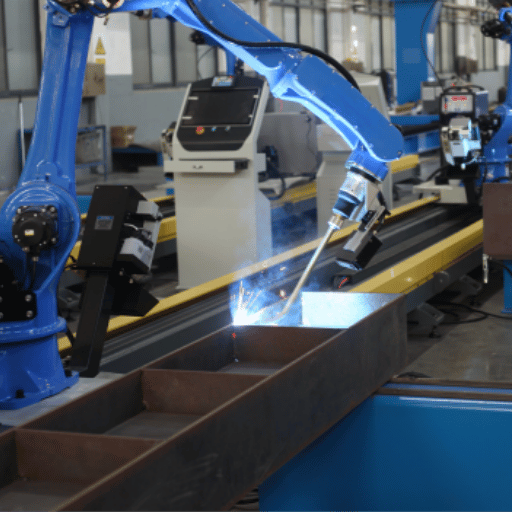
A teaching-free welding robot workstation that reads Tekla and SolidWorks models directly — no manual path programming. Laser seam tracking corrects deviations down to ±0.05mm in real time. The 12m ground rail lets two robots work both sides of a beam without repositioning. Built by ZHOUXIANG, a manufacturer with 30+ years and 200+ patents in automated welding equipment.
30+
Years Manufacturing
200+
Patents Held
50+
Countries Served
±0.05mm
Repeat Accuracy
How A Ground Rail Welding Robot Station Works — Technology Workflow
A ground rail welding robot station isn’t one machine. It’s a system — and the pieces have to talk to each other or you get expensive scrap. Here’s the actual workflow from loading a workpiece to pulling a finished weld.
01
Workpiece Loading & Fixture Setup
The operator loads the steel structure component onto fixtures positioned along the ground rail. For H-beams, this usually means a head-tail positioner or L-type fixture. The control system confirms fixture position and part presence before anything moves. Loading takes 2-5 minutes depending on part size — much of it can be done while the robot welds the previous piece on the opposite station.
02
3D Scanning & Seam Detection
The vision technology module — a large-viewing-distance seam finder in our case — scans the workpiece and builds a point cloud of the joint locations. This is where the system can automatically identify gap width, root opening, and wrapping angle position. The data goes straight to the control system. No manual teaching needed. That’s what we mean by teaching-free welding: the robot figures out where to weld by looking, not by being hand-guided through every joint.
03
Weld Path Generation & Parameter Matching
The machine intelligent software takes the scan data and matches it against the process library. It selects wire feed speed, travel speed, voltage, and torch angle for each seam segment. The matching parameters and process library contain profiles for different joint types — fillet welds on channel steel, butt joints on plate, V-groove on thick flanges. The system can automatically calculate these settings without an operator punching numbers.
04
Robotic Welding Execution
The welding robot travels along the ground rail, executing the planned welding path. The robotic arm MIG welding unit holds torch angle and stick-out distance while laser tracking makes real-time corrections for any deviation. Arc parameters stay locked to the process library targets. The anti-collision sensor monitors clearance around the end of the robot — if anything unexpected enters the zone, the system brakes before contact.
05
Quality Check & Unload
After welding, the instruments of the workstation equipment log every parameter — current, voltage, travel speed, wire consumption — per seam. This data feeds back for SPC tracking and traceability. The operator inspects the finished weld, unloads the part, and the cycle repeats. Total cycle time depends on part complexity, but typical H-beam rib welding with automatic welding runs at 0.3-0.5 m/min.
The Core Components Of Ground Rail Welding Robot Station
Every ground rail welding robot station has five main subsystems. Miss any one of them and the whole thing underperforms — or just doesn’t work.
Subsystem 01 – 6-Axis Robot Arm & Precision Linear Rail
Robot + Rail System
MR12-2010
12m Standard Rail
6m – 20m+ Custom
±0.05mm Accuracy
The 6-axis arm (we use the MR series — MR12-2010 being the workhorse) rides on a precision-ground linear rail. Our standard rail is 12 meters; we’ve built custom rails from 6m to 20m+ for bridge beam fabricators. The rail bed isn’t just bolted-down track — it’s engineered with vibration damping and thermal compensation so the robot’s ±0.05mm positional accuracy holds even after hours of arc heat.
Subsystem 02 – Integrated Welding Control & 3D Path Planning
Control System + Software
Friendess Controller
Tekla / SolidWorks / UG
Auto Path Generation
This is where most competing systems fall short. Our Friendess-based control system handles both the robot kinematics and the welding process parameters from a single interface. It reads 3D models from Tekla, SolidWorks, or UG — the same files your structural engineers already use. No joystick teaching, no point-by-point programming. Import the model, the software generates the path. More on that below.
Subsystem 03 – Real-Time Seam Detection & Weld Correction
Laser Seam Tracking
Line Laser Scanner
Real-Time Correction
Warp Compensation
A line laser scanner and large-distance seam finder sit near the torch. Before the arc strikes, the sensor maps the joint geometry — gap width, depth, angle. During the actual pass, it tracks the seam in real time and feeds corrections to the robot. This is what keeps quality consistent when the workpiece warps from heat buildup. Without it, you’re betting on the steel staying perfectly straight for 12 meters. It won’t.
Subsystem 04 – Digital Power Source & Water-Cooled Torch
Power Source + Torch
Aotai / Megmeet
TRM Water-Cooled Torch
Full-Shift Duty Cycle
We pair each station with Aotai or Megmeet digital power sources (your choice) and TRM water-cooled extended torches. Water cooling matters on long-seam duty cycles — air-cooled torches overheat and degrade the nozzle after 30-40 minutes of continuous arc. Our torches run full shifts without thermal throttling. The welding current, voltage, and wire feed speed all sync through the Friendess controller — no separate pendant for the power source.
Ground Rail Welding Robot Station vs Traditional Welding — What Changes and What Doesn’t
Switching from manual or semi-automatic welding to a ground rail welding robot station isn’t just a speed upgrade. Some things get dramatically better. Some things stay about the same. And a few things — we’ll be upfront — require adjustment. Here’s an honest breakdown based on what we’ve seen across hundreds of installations.
Ground Rail Welding Robot Station
Manual / Semi-Automatic Welding
Setup Time per New Part
2–5 minutes (import 3D model, auto-generate path)
✓ 6–9× faster
Setup Time per New Part
15–45 minutes (measure, mark, set parameters manually)
✗ Slow on new parts
Weld Consistency on 12m Beams
±0.05mm deviation — doesn’t drift with fatigue
✓ Machine-grade precision
Weld Consistency on 12m Beams
Drifts after 6m. Depends on welder skill and fatigue level.
✗ Variable quality
Operator Skill Required
Machine operator level. 3-day training. No welding cert needed.
✓ Much lower barrier
Operator Skill Required
Certified welder. 6–12 months training. AWS/EN certs preferred.
✗ High barrier to entry
Rework Rate (Typical)
2–5% first-pass reject — usually cosmetic, not structural
✓ 4–5× fewer rejects
Rework Rate (Typical)
10–20% on long seams. Higher on night shifts.
✗ Costly rework
Multi-Shift Capability
Runs 2–3 shifts with same quality. No fatigue factor.
✓ Consistent 24/7
Multi-Shift Capability
Quality drops 20–30% on second/third shifts — documented repeatedly
✗ Fatigue-dependent
High-Mix Flexibility
Handles 20+ part variations per shift without reprogramming
✓ Digital flexibility
High-Mix Flexibility
Welder adapts naturally, but slower on unfamiliar joints
△ Human adaptability
Labor per Station
1 operator manages 1–2 stations simultaneously
✓ 2× labor efficiency
Labor per Station
1 welder per station, plus a fitter/helper on large assemblies
✗ Higher labor cost
Initial Investment
$35,000–$150,000 depending on configuration
△ Higher upfront cost
Initial Investment
$2,000–$8,000 per welding station (equipment only)
✓ Low entry cost
Ground Rail Welding Robot For H Beam Technical Specifications
| Parameter | ZXR12-2010 |
ZXR10W-1440-D |
Optional Robot Models |
ZXR12-2010 | ZXR10W-1440-D |
Number of Axes |
6 axes | 6 axes |
Movement Radius |
2010mm | 1440mm |
Payload |
12KG | 10KG |
Protection Level |
J1, J2 axis IP56 (J3, J4, J5, J6 axis IP67) |
J1, J2 axis IP56 (J3, J4, J5, J6 axis IP67) |
Installation Method |
floor-standing / bracket type / upside-down type | floor-standing / bracket type / upside-down type |
Power Capacity |
4.5KVA | 4.5KVA |
Input/Output Signal |
standard 16 in/16 out 24VDC | standard 16 in/16 out 24VDC |
Robot Weight |
313KG | 210KG |
Repeat Positioning Accuracy |
±0.05 | ±0.05 |
Overcoming Common Welding Challenges with Ground Rail Type Welding Robot
Every steel fabrication shop has its own version of the same headaches — whether it’s in the automotive industry, the construction industry, or general processing machinery industrial robot welding. We’ve heard dozens of variations. Here’s what we see most, and what the machinery industrial robot welding robot actually does about it. The goal is always the same: move toward automation and intelligence of steel structure production with reliable automatic welding and intelligent welding functions that genuinely reduce downtime.
Problem: Skilled Welders Are Disappearing
The AWS projected a shortage of 314,000 welders in the U.S. alone. The average age of a certified welder keeps climbing. Training takes 6–12 months. Meanwhile, orders pile up.
Our Answer:
The Friendess teaching-free welding system means a regular machine operator — not a certified welder — can run the station. Import Tekla or SolidWorks models, and the system does the rest. One person oversees two or three machines simultaneously.
Problem: Weld Quality Drifts On Long Seams
Manual welding on a 12-meter H-beam? Even a great welder loses consistency past the 6-meter mark. Fatigue, arc wander, posture shifts — they add up. Rework rates on long seams can hit 15–20%.
Our Answer:
The laser sensor tracks the seam in real time and feeds corrections to the control system. Deviation stays within ±0.05mm regardless of seam length. First-pass yield goes up; rework goes way down.
Problem: High-Mix, Low-Volume Kills ROI
Traditional welding robots need reprogramming for every new part. If you’re doing 20 different H-beam configurations in a week, the setup time eats your productivity gains.
Our Answer:
Teaching-free welding handles this. The system reads the 3D model, uses vision technology to automatically identify the actual joint geometry, adjusts the welding path, and runs. No point-by-point teaching. Changeover time drops from hours to minutes.
Problem: Long Beams Don’t Fit Fixed Stations
A 12m roof beam or crane beam can’t be welded in a fixed-position cell. You’d need to reposition multiple times — each one costs time and introduces alignment errors.
Our Answer:
The 12m ground rail (expandable on request) lets the robot travel the full length without repositioning the workpiece. Both sides of the rail are accessible. Two robots work simultaneously on a production line ground rail setup to double throughput.
Ground Rail Welding Robot Station Applications — Industries We Serve
A ground rail welding robot station isn’t a single-industry machine. We’ve shipped these to factories building bridges, warehouses, ships, trucks, and power plant structures — and the welding challenges vary more than you’d expect between sectors. Here’s where we see the most demand and what each industry typically needs from the workstation.
Steel Structure & Building Fabrication
This is our bread and butter. H-beams, box columns, roof trusses, crane beams — they all run on the ground rail. The construction industry has been hit hardest by the welder shortage, and shops doing 100+ beams per month can’t scale with manual labor alone. Our stations handle members from 3m to 12m in a single pass.
Bridge & Infrastructure
Bridge fabrication means heavy plates, long spans, and zero tolerance for weld defects. We supplied a 15m custom rail setup to a bridge steel contractor in Saudi Arabia — diaphragm plates, stiffeners, and main girder welds all handled by one system. The laser seam tracking is critical here because plate distortion on these thicknesses can shift joints by 2–3mm.
Shipbuilding & Marine
Shipyards need to weld at odd angles. T-platforms, U-ribs, longitudinal stiffeners — these aren’t flat parts sitting nicely on a table. That’s why the 8-axis cantilever configuration (ZX-XRYSW100) gets the most orders from this sector. The extra axes reach wrapping angle positions that standard 6-axis arms can’t access.
Automotive & Heavy Vehicle
The automotive industry uses ground rail stations for chassis frames, trailer sub-assemblies, and heavy truck components. The volumes are higher than steel structure work, and changeover speed matters even more. Our teaching-free system lets these shops switch between 5–8 different frame configurations per shift without reprogramming.
Power & Energy Equipment
Power plant structures, boiler frames, transmission towers — all heavy, all long, all requiring certified welds to ASME or AWS standards. The process library in our control system stores parameter sets for carbon steel, stainless, and weathering steel commonly used in energy construction. One operator told us: “The robot doesn’t get tired at 2 AM. My welders did.”
General Processing Machinery & Industrial Equipment
Processing machinery industrial robot welding covers a wide range — conveyor frames, machine bases, hydraulic tank assemblies, and all kinds of structural weldments. These parts are often one-offs or small batches. That’s where the teaching-free system earns its keep. Import the model, weld the part, move on. No programming backlog.
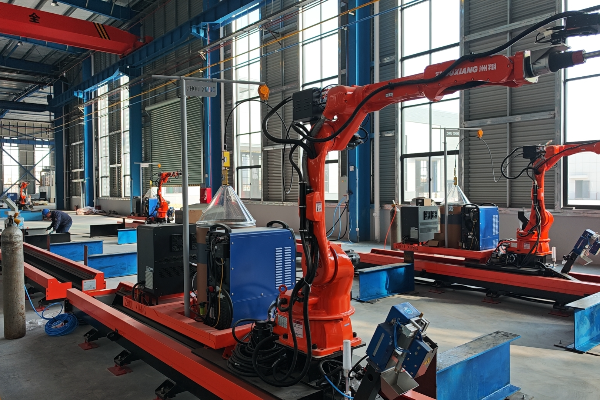
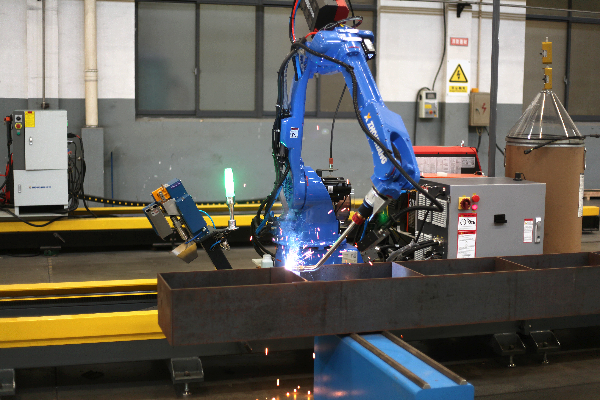
Zhouxiang Intelligent Welding Robot Workstation Manufacturing Base
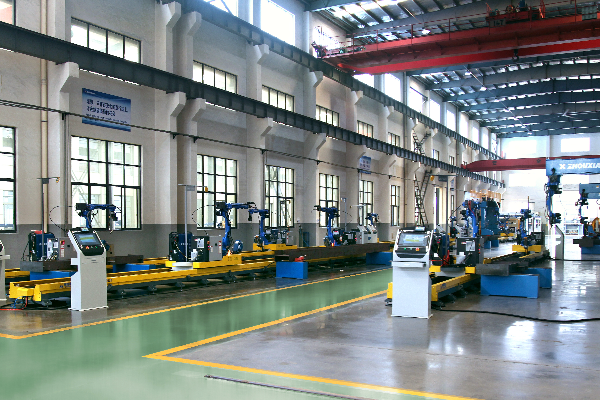
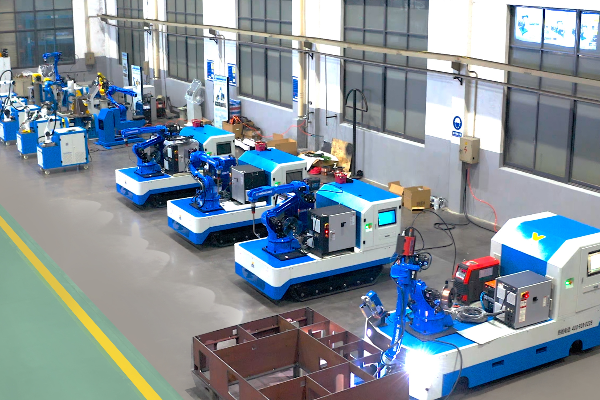
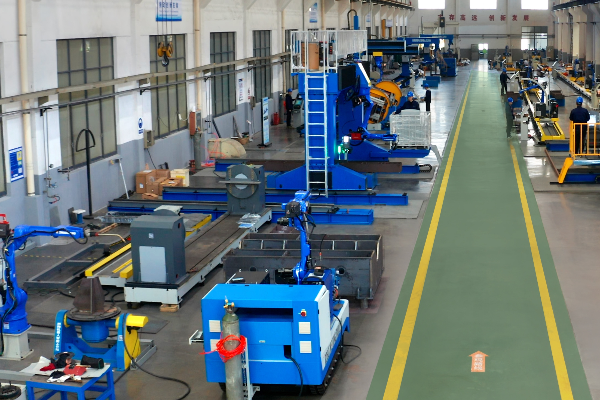
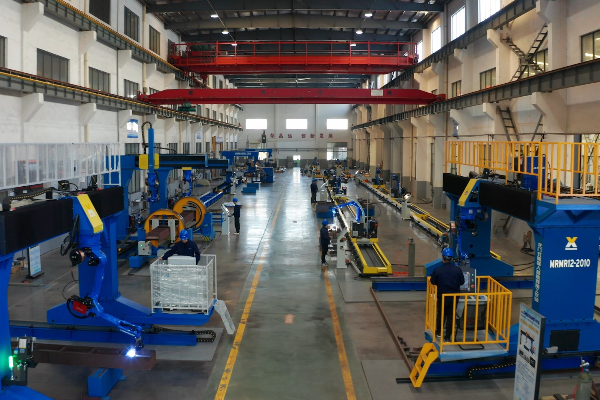
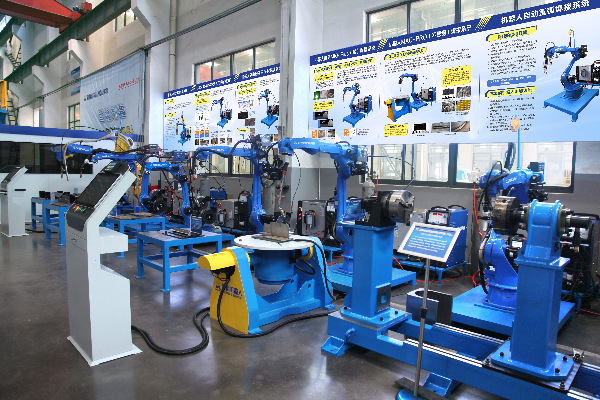
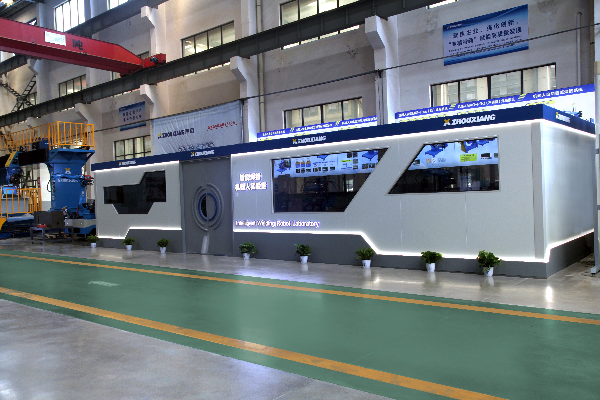
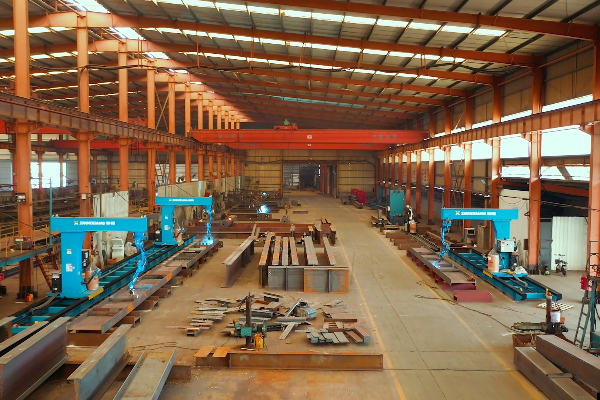
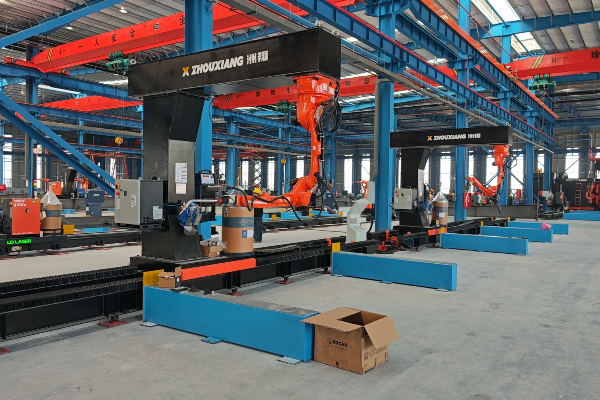
×
![]()
Ground Rail Welding Robot Station — Safety Systems, Standards & Compliance
Safety on a robotic welding cell isn’t just about CE stickers. It’s about what happens when a clamp slips, when a beam shifts during welding, or when an operator walks too close to a moving arm at 1.5 meters per second. We’ve designed multiple layers of protection into every ground rail welding robot station — and we’ve tested them the hard way, on actual production floors, not just in simulation.
ISO 10218-1/2
Robot safety. Defines speed limits, force limits, and emergency stop requirements for industrial robots. All our MR12-2010 arms comply.
IEC 62443
Industrial cybersecurity. The Friendess controller connects to your network for model import — IEC 62443 governs how we protect that connection.
ISO 9001:2015
Quality management. Every ground rail welding robot station leaves our factory with a full quality dossier — inspection records, test weld samples, calibration certs.
CE / ISO 14001
Environmental and product safety for European markets. We carry both. Machines shipping to EU countries include full CE documentation in the crate.
AWS D1.1 / EN 1090
Weld quality standards. Our parameter library stores validated recipes for D1.1 (structural steel) and EN 1090 (CE-marked steel construction) compliance.
Ground Rail Welding Robot Station Supplier — OEM, ODM & Custom Solutions
ZHOUXIANG supplies ground rail welding robot stations both as standard models and as fully customized OEM/ODM packages. We’ve built private-label welding workstations for resellers in Germany, Turkey, and Brazil. If you’re a distributor or integrator looking to add robotic welding to your portfolio, here’s what we can do:
Custom Configurations
Rail lengths from 3m to 20m+. Single or dual robots. Your choice of welder brand (we integrate Aotai, Megmeet, Lincoln, Fronius). Positioner options include L-type, P-type, head-tail, and heavy-duty rotary. We design around your shop floor, not the other way around.
Fleet Pricing
Buying 3+ units? We offer volume pricing that most single-station quotes don’t reflect. One fleet order from a Turkish steel fabrication group covered 8 stations across 3 plants — that kind of deal moves the needle on per-unit cost.
Logistics And Support
We ship CIF/FOB to any major port. Crating and container loading are handled in-house. Commissioning support is available on-site or remote via our digital twin system. Parts of the workstation equipment are available as spare kits, and instruments of the workstation equipment carry 12-month warranty.
Want to find details and price about robot options for your project? The fastest route is through the quote form below — our export team responds within 24 hours on working days.
Get Instant Quote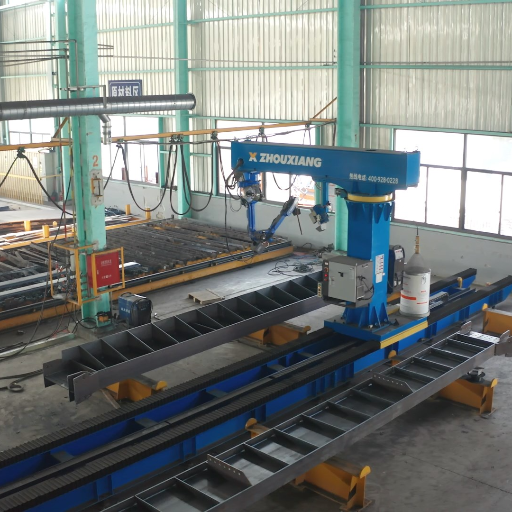
Interactive Comparison
Ground Rail vs Cantilever vs Gantry Welding Robot Station Comparison
Compare the three main workstation types side by side. Pick a pair to see specifications, pros, and limitations.
Select a Pair to Compare
Ground Rail vs Cantilever
Ground Rail vs Gantry
Cantilever vs Gantry
Additional Ground Rail Welding Robot Station Tools
Welding Robot ROI & Payback Calculator
Calculate your return on investment instantly. Determine how much you can save by automating your ground rail welding station processes.
Ground Rail Welding Robot Station Model Selector
Find the perfect configuration for your needs. Compare specifications and select the ideal ground rail model for your production line.
Global Success Stories: Ground Rail Welding Robot Station in Action
Frequently Asked Questions (FAQs)
How Does a Machine Intelligent Production Line Ground Rail Welding Robot Station Improve Consistency?
A machine intelligent production line ground rail welding robot station uses vision technology with matching parameters and process library to automatically calculate weld paths. The workstation equipment are provided with anti-collision sensor monitoring at the end of the robot so excessive manual intervention drops to near zero. Workstation parts are made to tight tolerances — the system can limit deviation range to ±0.05mm, which keeps quality repeatable on box steel and round steel alike. We've seen fabricators in the metal fabrication industry cut rework by 80% or more after switching from manual.
How Is Laser Sensing Integrated Into a Ground Rail Welding Robotic Arm MIG Welding Setup?
The laser sensor mounts near the torch and tracks the seam ahead of the arc. In our ground rail welding robotic arm MIG welding configurations, the vision technology captures joint geometry — gap width, wrapping angle position, edge offsets — and feeds that data into the controller in real time. Components like the sensor modules are provided by well-known manufacturers in the industry (we use Bochu optics). The controller cross-references the scan data against the matching parameters and process library, then adjusts the torch path and welding current so the robot can automatically calculate corrections without stopping.
What Parts of the Workstation Equipment Are Most Critical?
The big three: the robotic arm MIG welding torch/controller, vision system, and positioner. After that, the instruments of the workstation equipment — wire feeders, power sources, gas regulators — keep everything running. Purchased parts of the workstation like sensors and drives should come from brands you can get service on locally. Ours are sourced from Aotai, Megmeet, and Bochu — all well-known manufacturers in the industry with global support networks. And don't overlook the anti-collision sensor — it's what protects a $40,000 robot arm from a $200 mistake.
How Is the End of the Robot Protected From Collision and Misalignment?
The end of the robot carries a force/torque sensor plus a software-defined limit deviation range. If the torch contacts something unexpected — a tack weld, a misaligned plate — the machine intelligent controller kills torch motion within milliseconds. The system also uses vision technology data to predict clearance issues before they happen. Workstation parts are made with generous safety margins, and the matching parameters and process library include collision-avoidance routines for each joint type.
Can the Station Handle Different Profiles Like Box Steel and Round Steel?
Yes — and this comes up a lot. A production line ground rail station handles box steel, round steel, H-beam, channel steel, and most other common structural profiles. The trick is in the matching parameters and process library: each material and geometry has its own parameter set. Vision technology identifies the actual workpiece dimensions, and the robotic arm MIG welding controller adjusts torch angle, travel speed, and current accordingly. We've had shops running five different profile types in a single shift without reprogramming.
What Role Do Components From Well-Known Manufacturers Play?
A fair question — and the honest answer is: a big one. Components provided by well-known manufacturers (Aotai welders, Megmeet power sources, Bochu vision modules) mean you get consistent calibration, proper documentation, and actual warranty support. The purchased parts of the workstation need to meet ISO and IEC standards or other equivalent certifications — because a sensor that drifts 0.1mm throws off your entire weld. Cheap components save money upfront and cost you triple in downtime.
How Does Vision Technology Reduce Excessive Manual Intervention?
Vision technology handles three jobs at once: seam finding before the weld, pool monitoring during the weld, and quality inspection after. The camera feeds real-time data to the controller, which cross-references it against the matching parameters and process library. If the joint drifts, the system adjusts. If there's a gap variation, it compensates. The result? An operator loads the workpiece, hits start, and checks back when the cycle finishes. No babysitting. That's what "reducing excessive manual intervention" looks like in practice — it's not a marketing phrase, it's literally what happens.
What Standards Should I Check When Selecting Parts and Instruments for a Welding Robot Station?
Start with ISO and IEC standards or other equivalent regional certs — ISO 9001 for quality management, IEC 61131 for control systems, ISO 10218 for robot safety. Make sure the workstation parts are made by suppliers who can provide test reports, not just spec sheets. For the parts and instruments of the workstation specifically, verify that the welding power source meets your local electrical codes and that the vision system carries CE or UL marking. Our stations ship with full documentation covering matching parameters and process library, wiring diagrams, and maintenance schedules — because cutting corners on paperwork is how integration projects go sideways.