Get in Touch with Zhouxiang

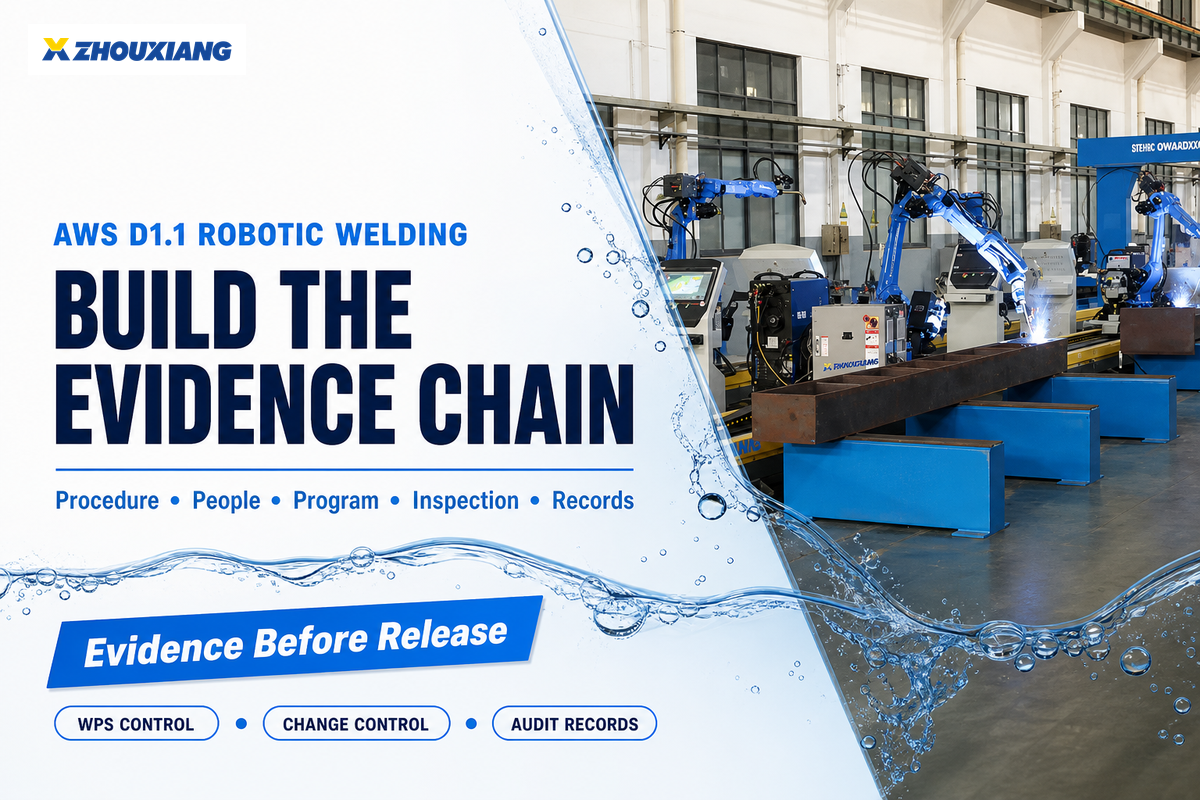
There’s a hard boundary with AWS D1.1: just because robotic welds are repeatable doesn’t mean the robot is compliant. An effectively defensible program for robotic welding cells bridges governing project quality requirements to an approved welding procedure for the selected arc welding processes, qualified personnel, a robot program that’s within specified limits, verified production output, inspections, and an unaltered change history.
Scope note: This guide explains a practical evidence system for structural-steel robotic welding. It does not reproduce the code. Confirm every normative requirement in the purchased controlling edition, currently identified by AWS as D1.1/D1.1M:2025-AMD1, and in the contract documents.
Can a Robotic Cell Comply With AWS D1.1?
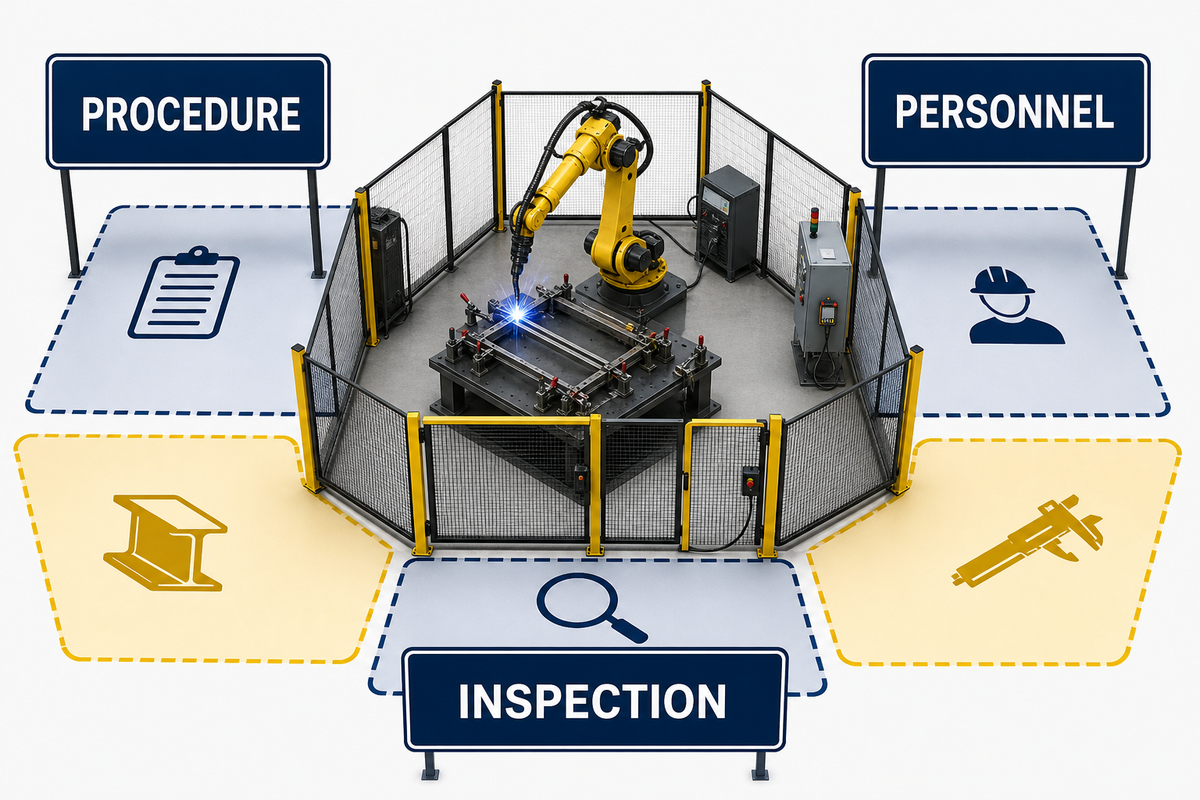
Yes, but compliance is with the welding work, and its controlled execution, not with the robot arm as a stand-alone product. The cell must produce welds within the boundaries of the procedure, personnel, fabrication, inspection, and acceptance frameworks invoked for the project. The AWS D1.1 publication page is the primary source of the current designation and scope.
A useful boundary is simple: the AWS D1.1 welding standard addresses structural-steel welding quality in structural steel fabrication; robotic safety standards address cell hazards; and a professional credential such as CRAW addresses a person’s demonstrated robotic-welding knowledge and welding experience. One doesn’t silently substitute for another.
Code basis
Which edition and project documents govern this weld?
Which edition and project documents govern this weld?
Execution basis
Which approved procedure and qualified operator released this program?
Which approved procedure and qualified operator released this program?
Acceptance basis
Which inspection plan and criteria accepted the finished weld?
Which inspection plan and criteria accepted the finished weld?
The AWS D1.1 Robotic Welding Evidence Chain
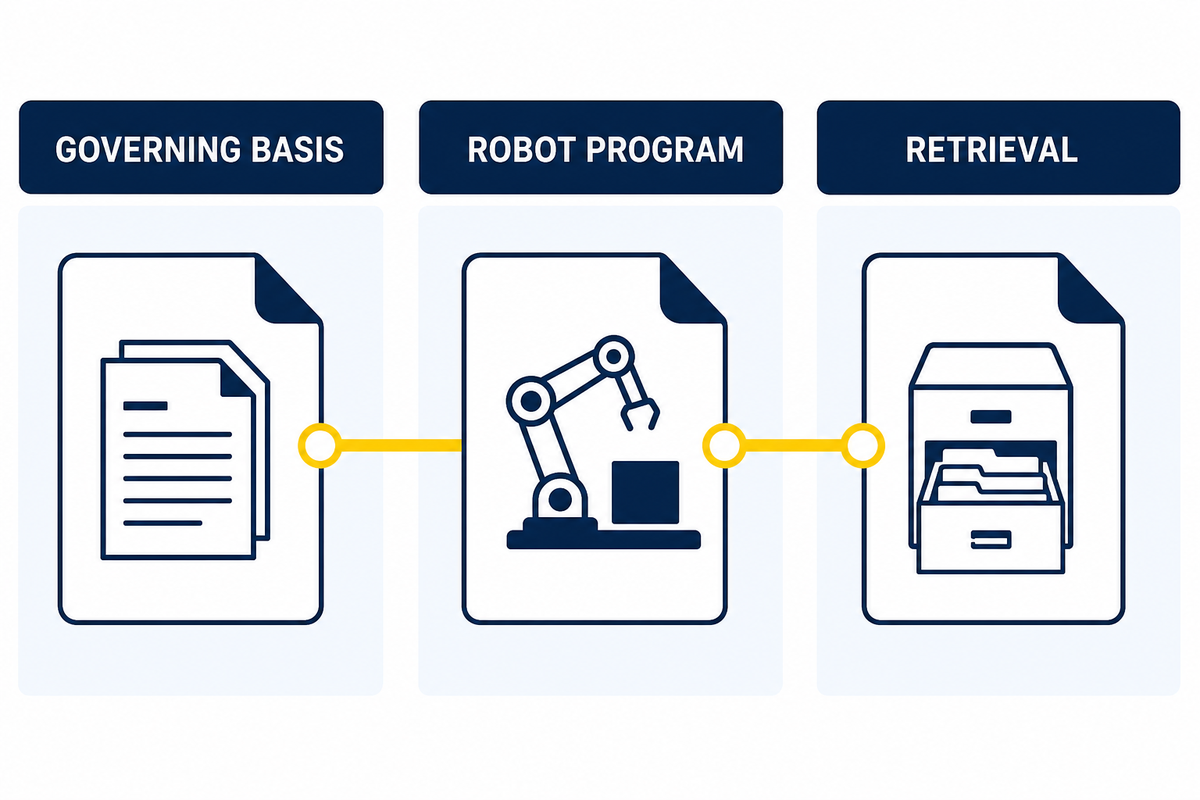
The fastest audit test is retrieval: choose one production weld and ask the team to rebuild its history without relying on memory; this traceability exercise is separate from a welder performance test, performance qualification, or welder qualification. If there’s a missing link between operators and technicians, quality control, and the retained history, the gap is operational, not cosmetic.
The official AWS D1.1 overview separates procedure and personnel qualification, fabrication, inspection, and acceptance within the code’s scope; the evidence chain below organizes those responsibilities for retrieval without replacing the controlling code.
| Evidence category | Control question | Minimum proof | Owner |
|---|---|---|---|
| 1. Governing basis | What code, amendment, drawing, and contract apply? | Code matrix and approved drawing revision | Engineering |
| 2. Procedure | Is the WPS prequalified or supported by qualification testing? | Released WPS and its qualification basis | Welding engineer |
| 3. Personnel | Who was authorized to set up, run, and change the cell? | Qualification, continuity, training, authorization | Quality |
| 4. Program | Which approved recipe produced the weld? | Program ID, checksum, backup, WPS crosswalk | Automation |
| 5. Release | What proved the part family was ready for production? | First-article packet and release signature | Quality + production |
| 6. Acceptance | What inspection accepted this weld? | VT/NDT records, weld map, disposition | Inspector |
| 7. Change history | What changed after release, and who assessed it? | Change request, impact decision, new release evidence | Engineering + quality |
| 8. Deviation control | What stopped suspect work from moving forward? | Hold, containment, disposition, and affected-part list | Quality + production |
| 9. Retrieval | Can the team reproduce the evidence for one shipped weld? | Indexed record pack and retention rule | Quality systems |
This chain is a management framework and isn’t an interpretation of AWS mandating the use of these file names specifically. It provides code and contract duties in a way that customer, inspector and/or internal auditors can retrieve it.
Choose the Procedure Route Before Programming
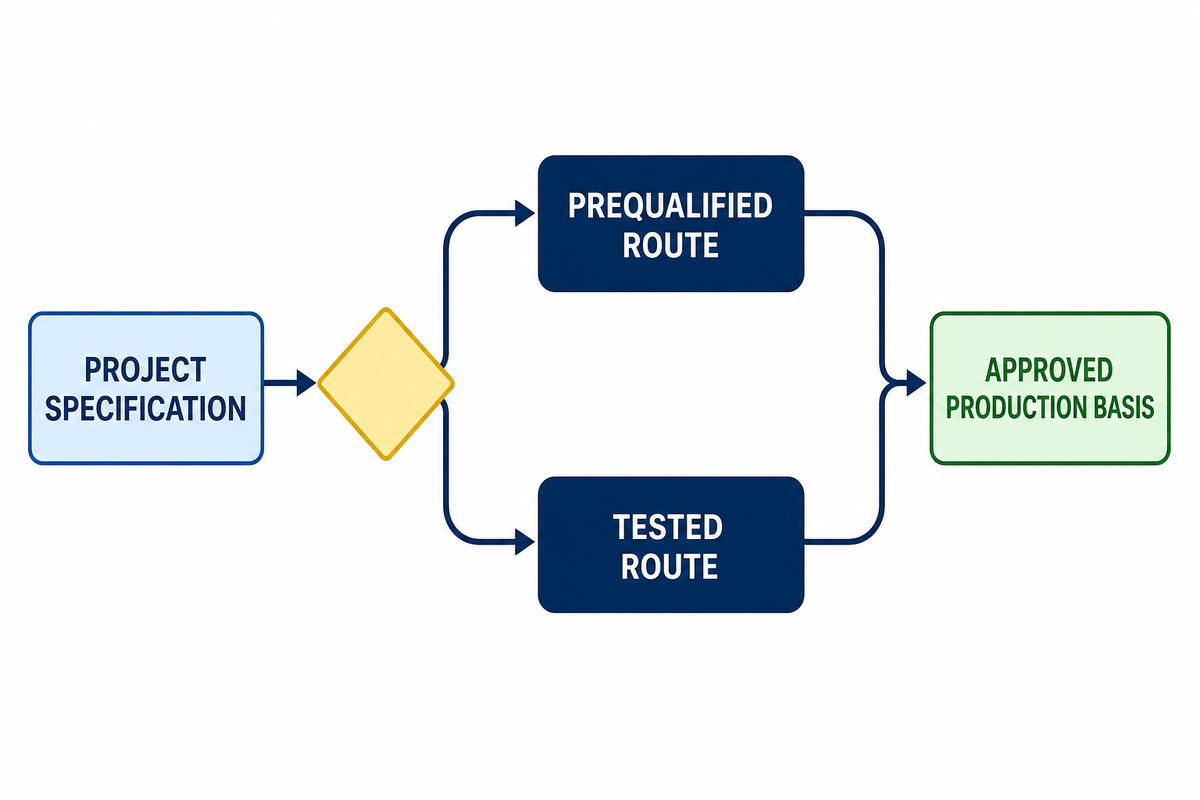
Every production weld requires a welding procedure specification. The first step is to determine if the work supports a prequalified route and, therefore, does not require a procedure qualification record. Verify that route in the purchased edition identified through the official AWS D1.1 page.
Don’t base that determination on a blog table. Verify the joint geometries, base metal, filler metal, welding process and mode, position, thickness, preheat and interpass temperature controls, and all other variables in the code and project specification before assigning the weld inspection plan.
Stop point
If the team cannot show the exact code basis for prequalification, treat the route as unresolved, regardless of what a supplier’s robotics parameter library, a legacy WPS, or an attractive test bead suggests.
For a tested route, including a selected gas tungsten arc welding process when applicable, keep a record of the approved range of use, the PQR, coupon identity, WPS, WPS-to-PQR link, and test results. For a prequalified route, keep a control sheet that states the tables and figures used by the responsible welding professional.
Build a WPS-to-Program Crosswalk
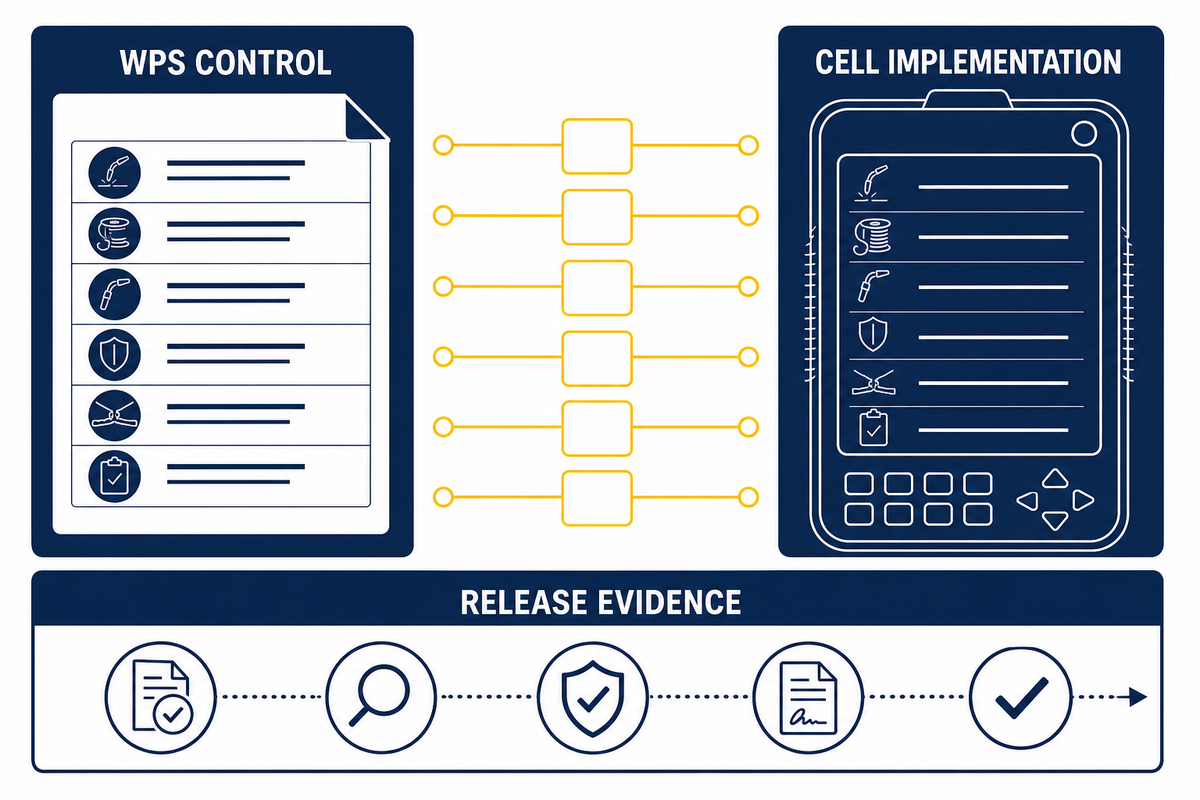
In a structural shop producing welded structural components under contract-invoked AISC requirements, the robot controller stores instructions; it doesn’t explain the basis for those instructions. The crosswalk shows how each control in the WPS is set, measured, locked, and/or verified in the robotic system.
| WPS control | Cell implementation | Release evidence | Drift signal |
|---|---|---|---|
| Process and transfer mode | Power-source job and waveform | Approved job ID and export | Job changed or firmware remapped |
| Wire and shielding gas | Feeder setup, consumable ID, gas supply | Lot and gas verification | Substitution or interrupted supply |
| Voltage/current or wire-feed range | Recipe limits and power-source feedback | Recorded setpoint and actual trace | Out-of-range alarm or offset |
| Travel speed and path | Motion instruction and seam-tracking correction | Program version and dry-run review | Path edit, speed override, tracking limit reached |
| Joint, position, and pass sequence | Fixture datum, positioner routine, pass logic | Fixture revision and first-article map | Fixture repair, orientation change, skipped pass |
| Preheat and interpass | Work instruction and measurement hold point | Recorded readings and instrument ID | Missing reading or exceeded limit |
For a steel-structure robotic welding system, the automation of parameter setting, seam tracking, and CAD import can reduce setup time. However, the fabricator still owns the approval that connects each released recipe to its governing WPS for a particular production run.
Qualify People, Not the Robot
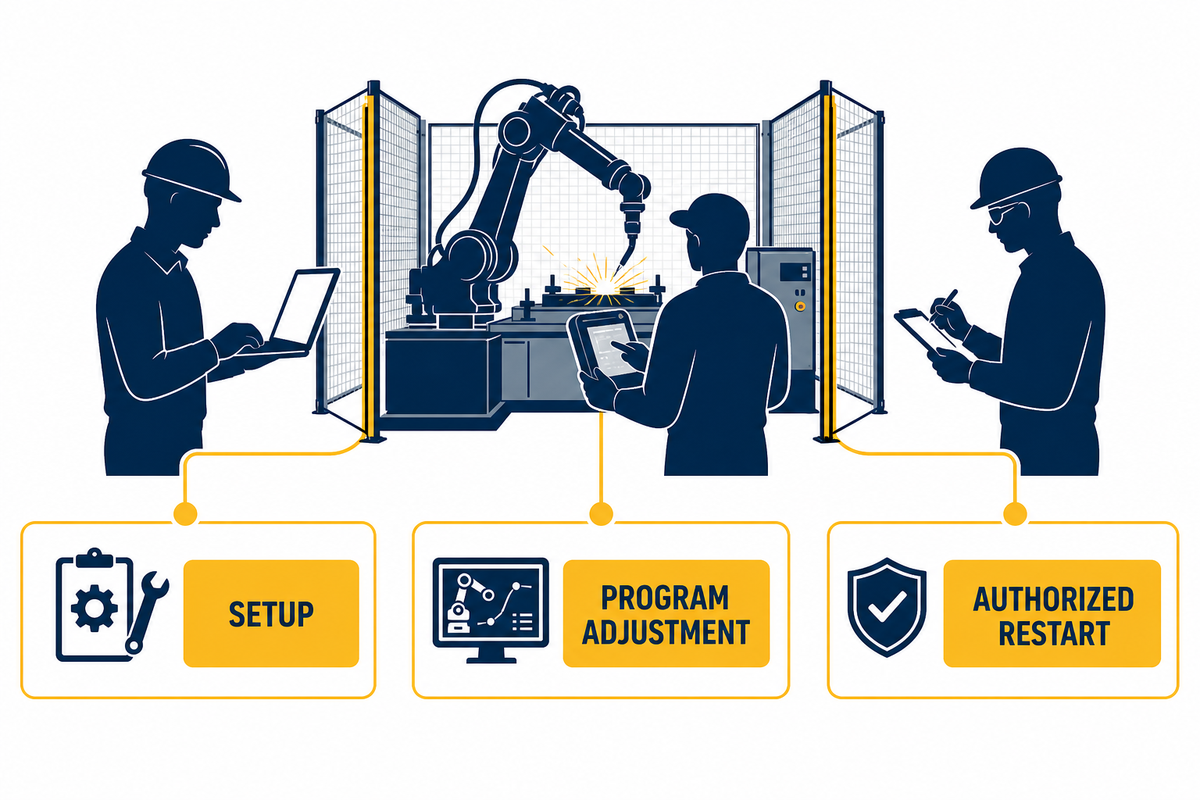
Automating movement of the torch doesn’t eliminate personnel responsibility. Identify who sets up the cell, selects and adjusts programs, responds to alarms, verifies consumables, and authorizes restart after a deviation.
Retain applicable welding-operator qualification and continuity evidence, plus employer training and authorization records. Confirm the qualification range and continuity provisions in the controlling code as opposed to copying a generic six month statement from secondary summaries.
A robot repeats a program. A qualified organization decides whether that program is permitted, whether the actual conditions stayed controlled, and whether the resulting weld is acceptable.
AWS’s Certified Robotic Arc Welding program can support workforce development, but this AWS-certified professional credential does not by itself approve weld parameters or a flux-cored arc welding procedure. Don’t state that CRAW automatically satisfies a project-specific D1.1 operator qualification requirement, or that a D1.1 qualification automatically proves robot-programming competence.
Release Each Part Family With First-Article Evidence
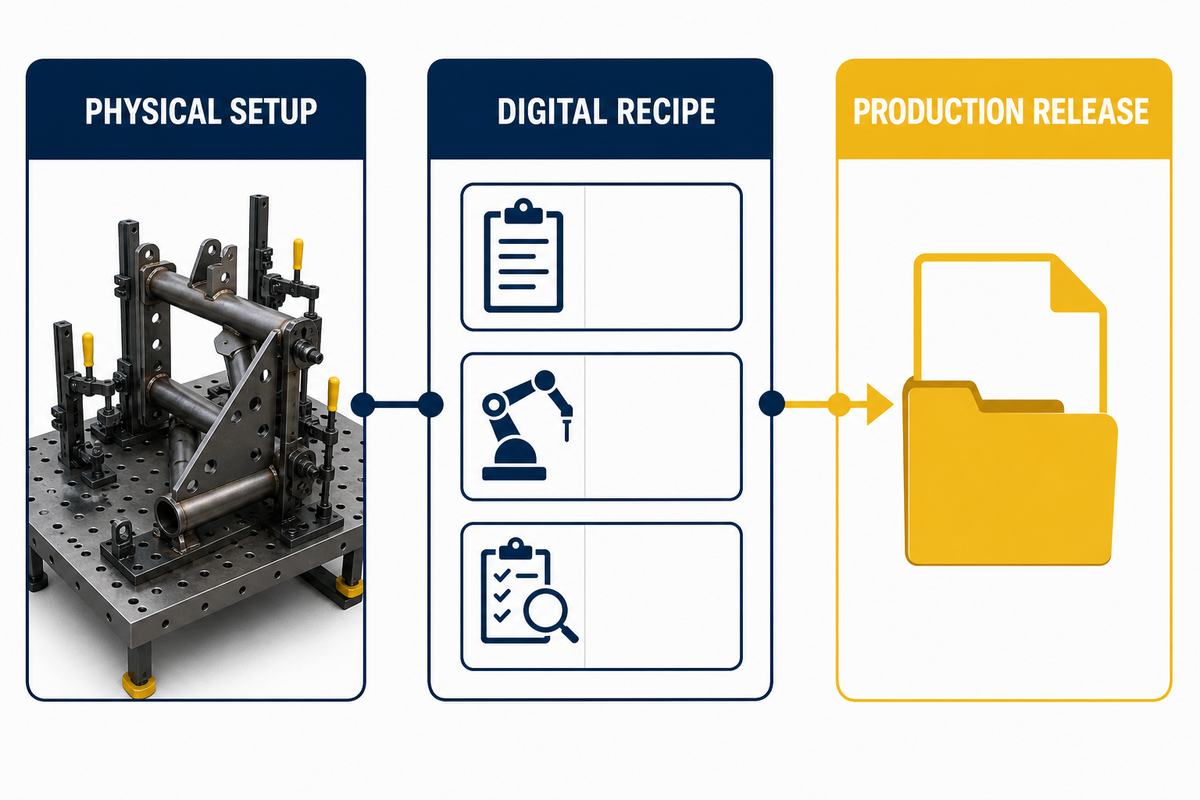
Conduct a representative first article before routine production of the released part family, joint, fixture, orientation, process mode, and robot program. The purpose of the first article isn’t for ceremonial approval, it’s to validate the physical setup and the digital recipe agree with the approved basis.
The NASA welding qualification standard provides independent public corroboration that procedure qualification, personnel qualification, and retained qualification records are separate controlled responsibilities; project-specific first-article acceptance still comes from the governing contract and code.
Before welding
Verify drawing and WPS revisions, material identity, consumables, joint preparation, fit-up, fixture revision, and temperature controls.
Verify drawing and WPS revisions, material identity, consumables, joint preparation, fit-up, fixture revision, and temperature controls.
During welding
Capture operator, program ID, power-source job, critical setpoints and actuals, alarms, interruptions, and pass identity.
Capture operator, program ID, power-source job, critical setpoints and actuals, alarms, interruptions, and pass identity.
After welding
Complete required visual inspection and assigned NDT, reconcile the weld map, disposition deviations, and sign the production release.
Complete required visual inspection and assigned NDT, reconcile the weld map, disposition deviations, and sign the production release.
Specific acceptance criteria are typically codified in the contract and underlying code. Here, a general first article evaluation procedure isn’t being claimed. This document provides one such procedure to prevent the first accepted bead from becoming undocumented tribal knowledge.
Separate Process Monitoring From Weld Acceptance
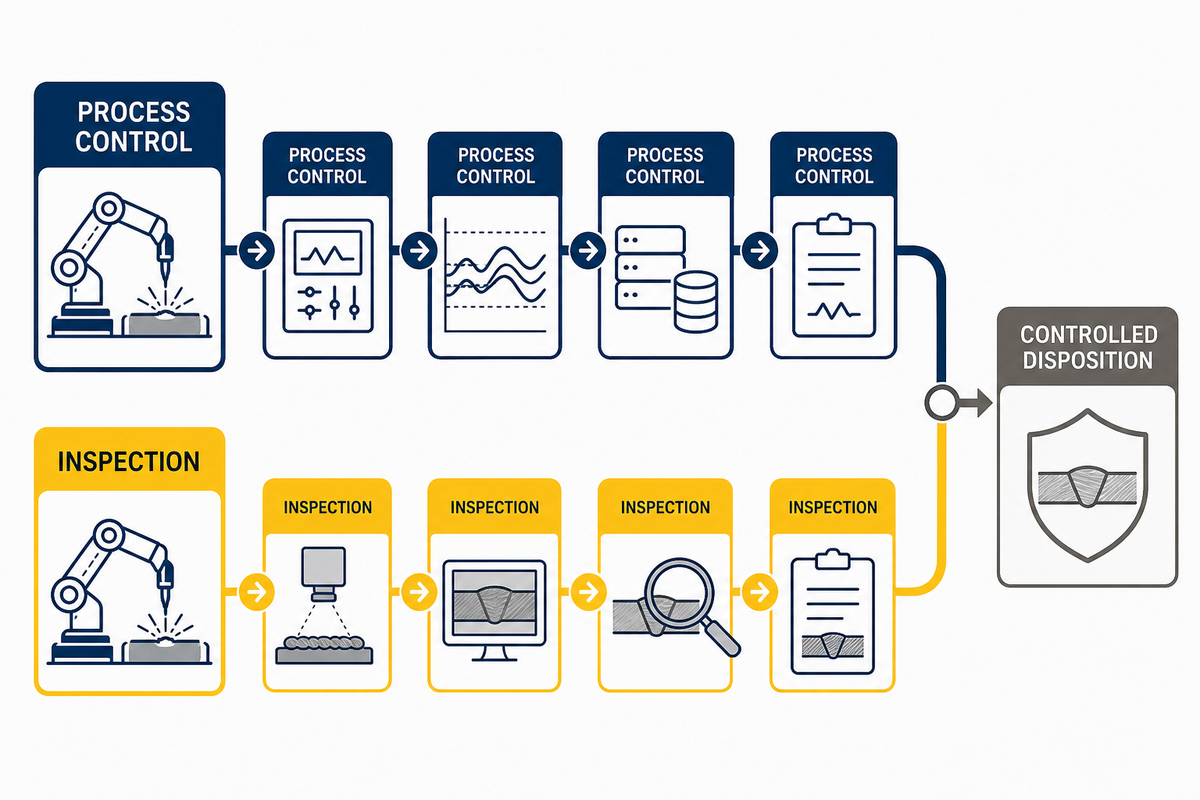
Controller logs can show that a program executed within configured windows. However, logs don’t prove joint preparation was correct, shielding was effective, the workpiece conformed to the drawing, or the weld was acceptable.
Establish two separate lanes: a process-control lane, and an inspection lane. The process-control lane documents what the cell performed. The inspection lane documents what qualified personnel observed, measured, tested, accepted, rejected, repaired and reinspected.
Useful hold-point rule
For an out-of-range alarm, missing temperature records, consumable substitution, lost seams, fixture damage or a program mismatch, controlled disposition is warranted. Just because the process closed doesn’t mean the product is acceptable; automatic completion is not automatic authorization to ship.
Reference the governing documents to assign inspection scope. Don’t post fixed percentages for VT or NDT, unless verified for the specific project. The public AWS overview confirms inspection and acceptance are within the scope of the code, however, it doesn’t reveal the complete normative tables.
Use the 4-Zone Robot Program Change Matrix
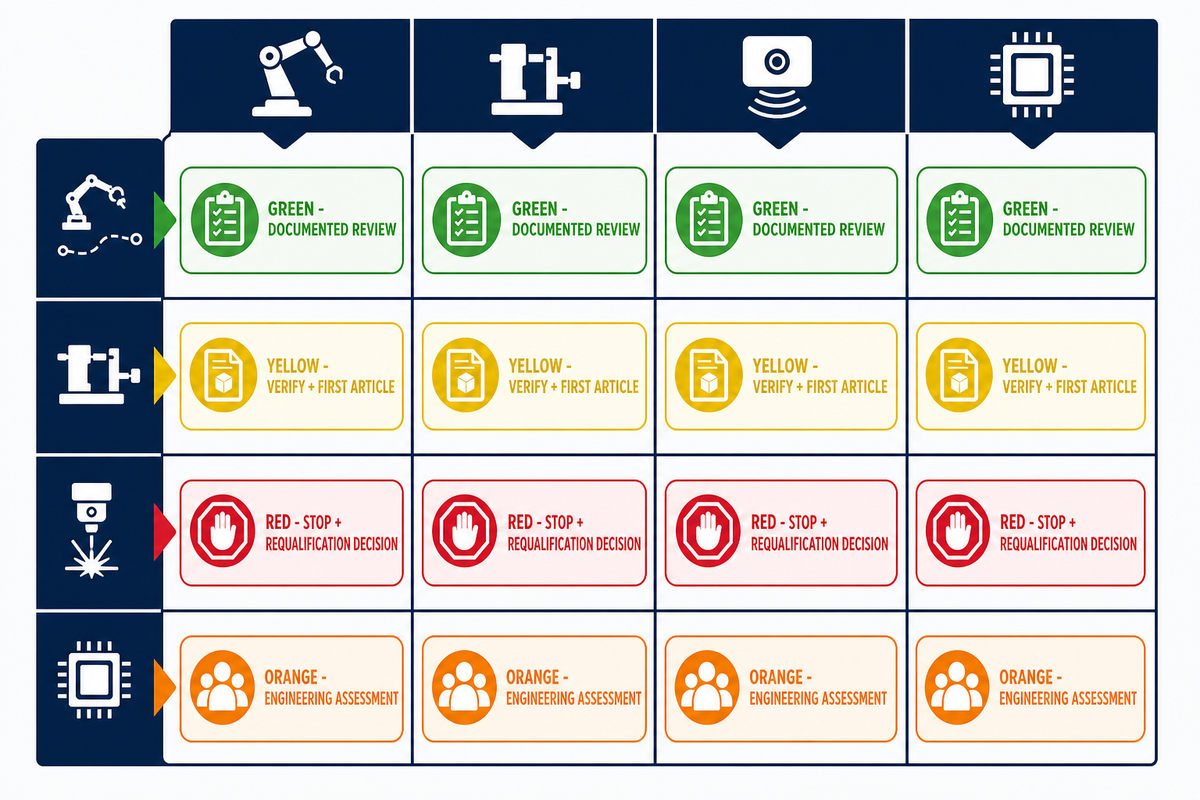
Robotic welding introduces change sources that a paper WPS doesn’t show. This includes changes to the path, seam and touch sensing, fixture offsets, power source firmware and software updates, controller recipe changes, and program changes. Every change is placed under review before anyone decides it’s harmless.
| Zone | Typical examples | Required response | Release evidence |
|---|---|---|---|
| Green | Comment, display label, backup location | Documented review | Change log |
| Yellow | Minor path or fixture correction inside an approved setup | Verification and focused first article | Before/after file plus inspection |
| Orange | Gas, wire, transfer mode, heat-input-related setting, joint or orientation change | Welding-engineering impact assessment | Written qualification-basis decision |
| Red | Change outside the approved procedure basis or unresolved code limit | Stop production and decide whether procedure requalification is required | New or revised approved basis before release |
The examples are prompting questions, not definitive classification. The responsible welding professional makes the final determination against the purchased code, WPS/PQR, and contract. Confirm the governing edition of the AWS code through the AWS code page before authorizing any change route.
Build an Audit-Ready Record Pack
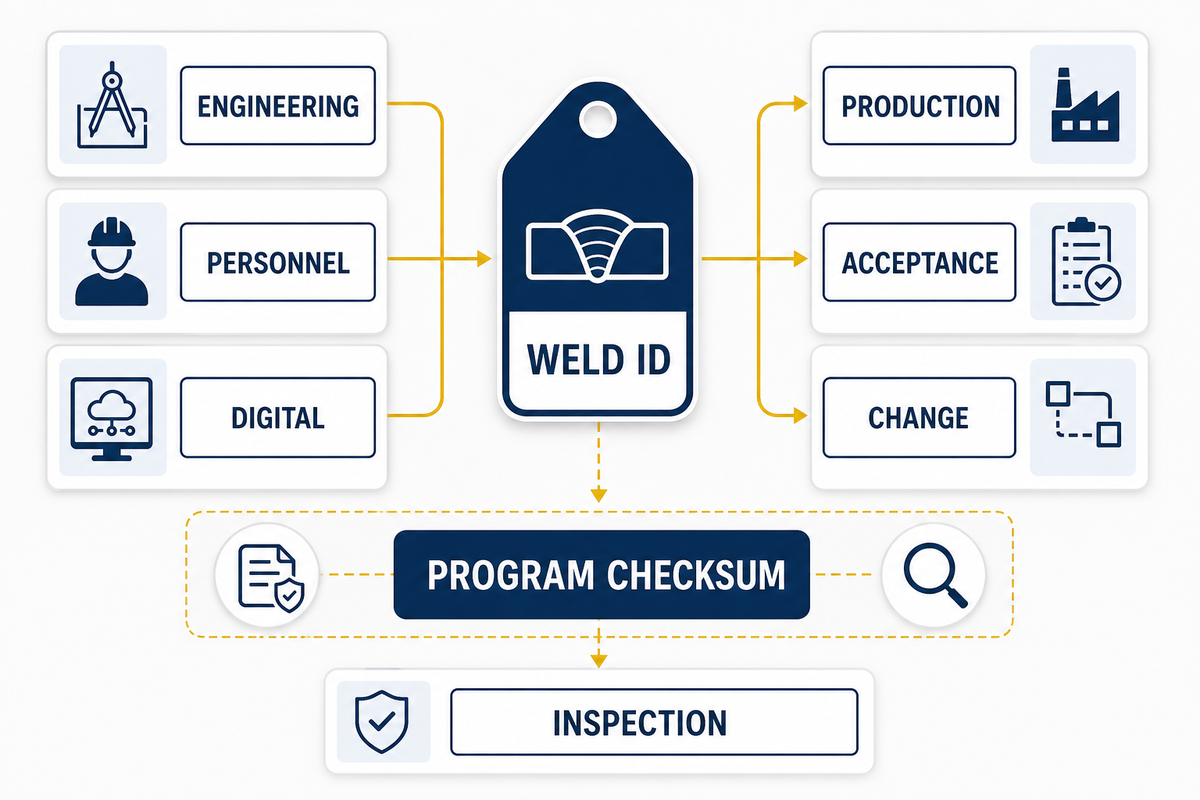
An audit-ready system can quickly retrieve a complete sample. Identify a weld ID on a shipped assembly and trace it to inspection, production log, program checksum, operator authorization, WPS revision, drawing revision, and the governing contract basis.
Record retention is also a distinct controlled responsibility in the NASA welding qualification standard; here, that public example supports the need for retrievable records but does not substitute NASA requirements for the project’s governing AWS documents.
This evidence can then be traced forward, to identify every part that was produced as a result of the change, the approval and verification records, and to show the previous, obsolete version couldn’t be used inadvertently.
- Engineering index: code matrix, drawings, weld map, WPS/PQR basis.
- Personnel index: qualification, continuity, training, and authorization.
- Digital index: Program ID, checksum, controller backup, and state of software and firmware.
- Production index: material, consumable, parameter, alarm, and interruption records.
- Acceptance index: VT/NDT, nonconformance, repair, reinspection, and release.
- Change index: Request, assessment, approval, verification, and range of affected serial numbers.
This structure reduces audit time, but its larger value is commercial: it allows the fabricator to answer a customer’s quality question with documented evidence instead of saying “the robot is consistent.”
AWS D1.1, AWS D16, and CRAW Answer Different Questions
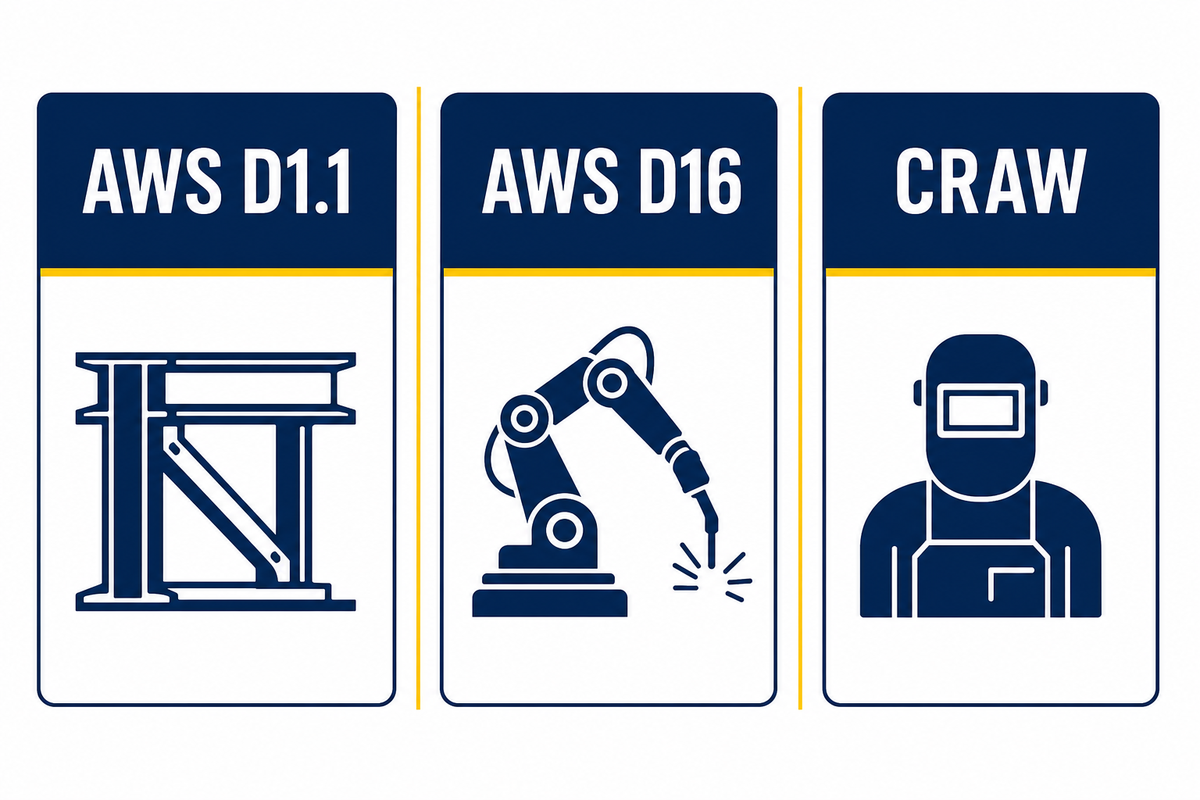
| Framework | Primary question | What it does not prove alone |
|---|---|---|
| AWS D1.1 | Was structural-steel welding qualified, executed, inspected, and accepted under the governing requirements? | Complete robot-cell risk reduction |
| AWS D16 family | How should robotic arc-welding installation, risk, and personnel topics be addressed? | Acceptance of a project weld under D1.1 |
| CRAW | Has an individual met AWS’s robotic arc-welding certification requirements? | Approval of the employer’s WPS, program, or finished weld |
For safety-related issues on the boundary, refer to the separate guide on welding robot safety standards. Keeping these issues separate avoids citing a safety file, personnel certificate, or equipment declaration as evidence of weld quality acceptance.
For supplier context and the company’s integration scope, see Zhouxiang’s company profile. Use it as first-party capability context, not as independent evidence of code compliance.
Frequently Asked Questions
Can robotic welding meet AWS D1.1 requirements?
Yes, if the governing application is in scope, and the fabricator controls the applicable procedure, personnel, production, inspection criteria, acceptance, and inspection records. The robot’s repeatability and consistency provide control, but don’t prove compliance. The actual test is to trace one completed weld to the governing documents, released WPS, qualified personnel, accepted program version, production record, inspection result, and every subsequent change. Exact qualification and acceptance rules must be verified in the purchased controlling code and project specification.
Does the robot itself need AWS certification?
Don’t approach this from the perspective of certifying the robot. Verify the project’s requirements for welding personnel and procedural qualifications, and address robot-cell and welding equipment conformity separately, including equipment used for shielded metal arc welding. Maintain evidence in distinct files. Keep evidence in separate lanes: A safety file supports risk reduction and safeguarding, a weld-quality file supports D1.1 work, and a personnel file supports individual qualifications and employer authorization. None of these records automatically substitute the other two. Procurement should name all required records.
Is a robot program the same as a WPS?
No. A program consists of machine language instructions, and a WPS defines an approved welding procedure. Crosswalks and release systems show that machine language instructions implement an approved WPS without unauthorized drift.
Does CRAW replace D1.1 welding-operator qualification?
Don’t make that assumption. CRAW is a professional certification program offered by AWS. The project production qualification should be determined by the controlling code and contract. A purchaser should ask who holds the project-required welding-operator qualification, who may edit production programs, how continuity and training are documented, and who signs the first-article release. Treat CRAW as one personnel signal within a larger employer-controlled evidence system, not as blanket approval of the WPS, robot, or finished weld.
References & Sources
- American Welding Society: AWS D1.1/D1.1M Structural Welding Code, Steel
- American Welding Society: Certified Robotic Arc Welding program
- (The Fabricator: What fabricators should know about AWS D1.1)
- OSHA: Robotics standards and directives
- TWI: Welding procedure qualification overview
Which robot changes require requalification?
There’s no safe universal list in a public summary. Review all robot-cell changes through engineering. Determine if the changes are out of scope and if additional qualification is needed.
What to Request Before Ordering a Robotic Welding System
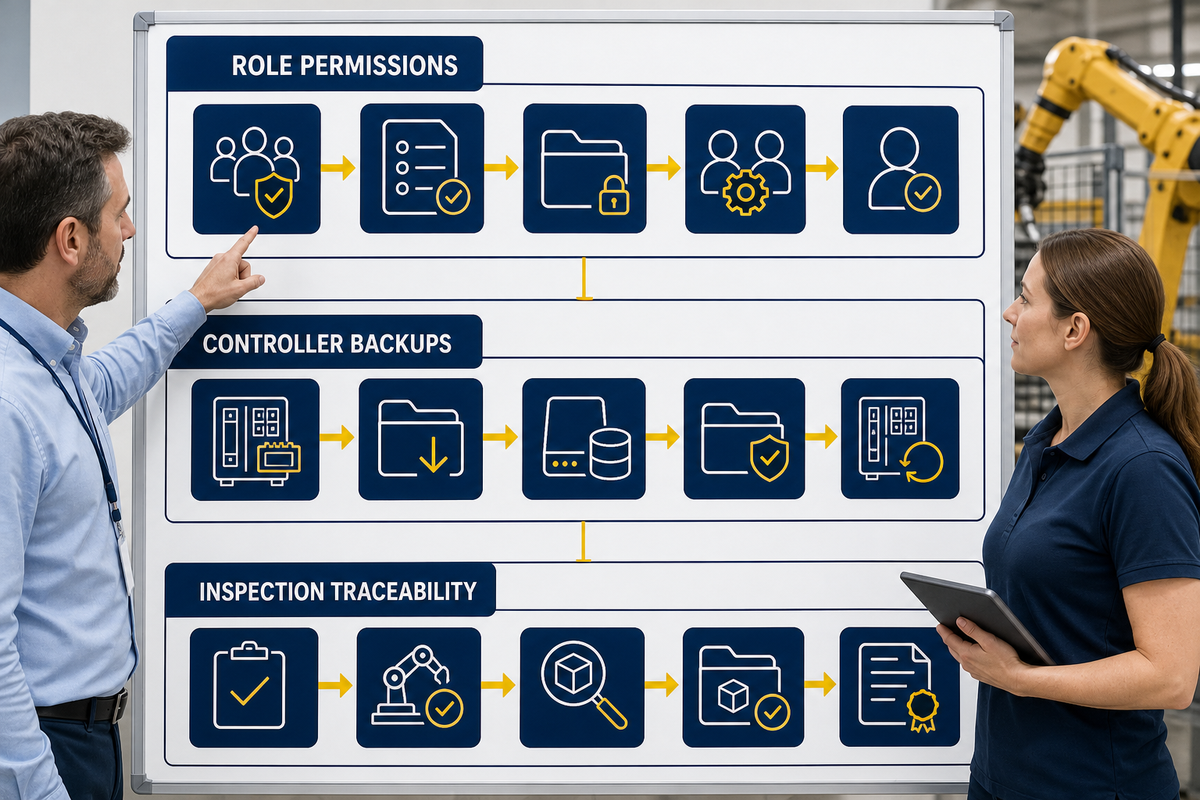
Ask the systems integrator how the proposed cell will satisfy the evidence chain for WPS-to-program mapping, role permissions, recipe versioning, and controller backups. Also ask how the cell will support parameter export, alarm management, first article inspection, fixture revision control, and traceability of inspection.
Provide representative sample drawings, materials, weld sizes and requirements, processes to be used, the production mix, and expected quality plan. A reputable supplier will distinguish what’s recorded by the equipment from what the welding engineer and inspector must approve.
Turn the compliance plan into a cell specification
Zhouxiang’s engineering team works to design a system for your part family, specific to your needs. The goal isn’t a generic “D1.1-ready” label; it’s a system design that can preserve your approved process and produce the records your quality team needs.
References and Use Limitation
Useful references in the orientation of this article include the American Welding Society (AWS) pages for AWS D1.1/D1.1M and Certified Robotic Arc Welding, and Zhouxiang’s broader structural welding guide.
This is an educational article describing an automated welding system and its welding automation controls. It isn’t intended to determine system compliance for a particular project. For final compliance decisions, refer to the purchased controlling code, project contract documents and requirements of the engineer-of-record, along with qualified welding and inspection personnel.