Get in Touch with Zhouxiang

Cobot Welding Setup for Small-Batch, High-Mix Production

Contents
show
HIGH-MIX WELDING AUTOMATION GUIDE
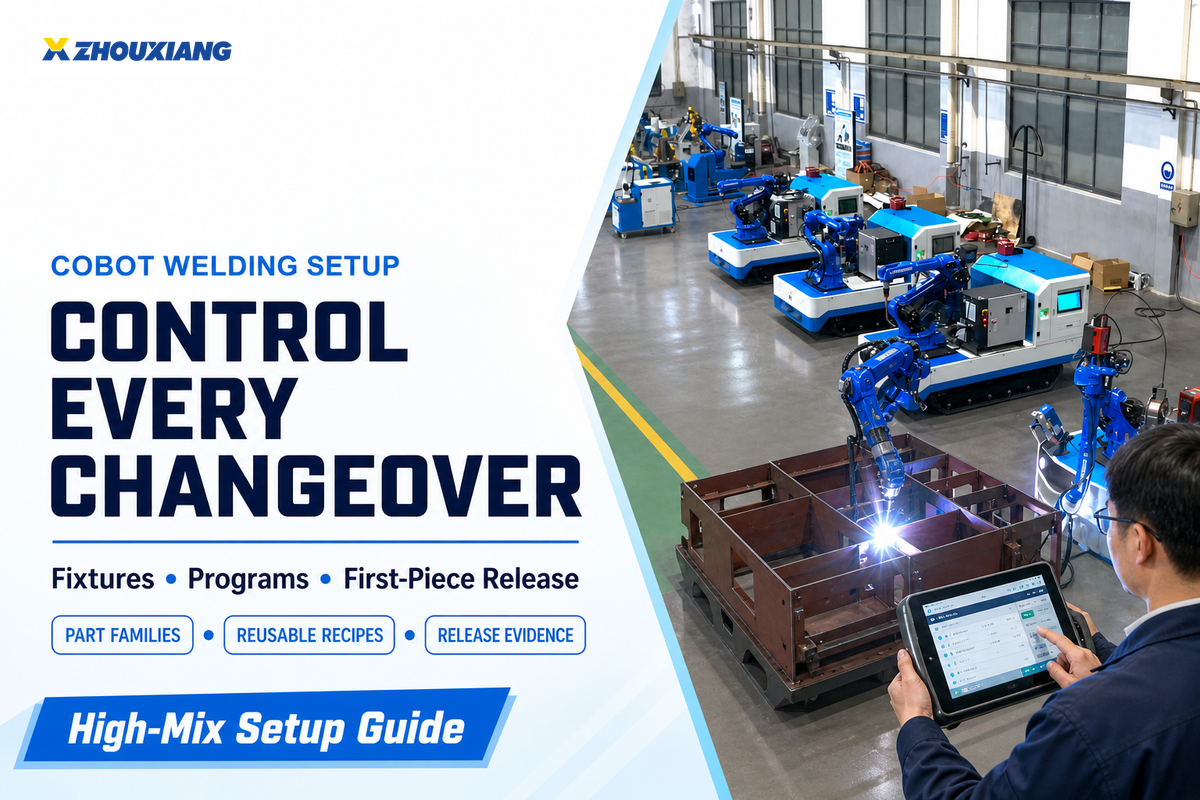
Cobot welding setup small batch high mix is a planning method that relies on repeatable changeover, not on the robot alone. First, identify part families, fixture datums, process limits, program ownership, and first piece criteria; then decide on the cell hardware from robotic welding to support the plan.
Scope of this guide: This article covers setup, fixtures, program reuse, changeover, and first-piece approval. For system configurations and product options, see our collaborative welding robot page.
Cobot systems can support automated welding where a robotic welding system must serve changing production needs. The goal is not to make every job smooth, but to build a controlled route to allow robotic systems to change jobs, while still maintaining traceability.
Cobot welding systems are often presented as an easy-to-use, purpose-built answer to labor constraints. Treat the market trend as a working hypothesis; the application still has to demonstrate compatibility with the parts, people, process, and acceptance plan to provide a solution.
Start With the Part Family, Not the Robot
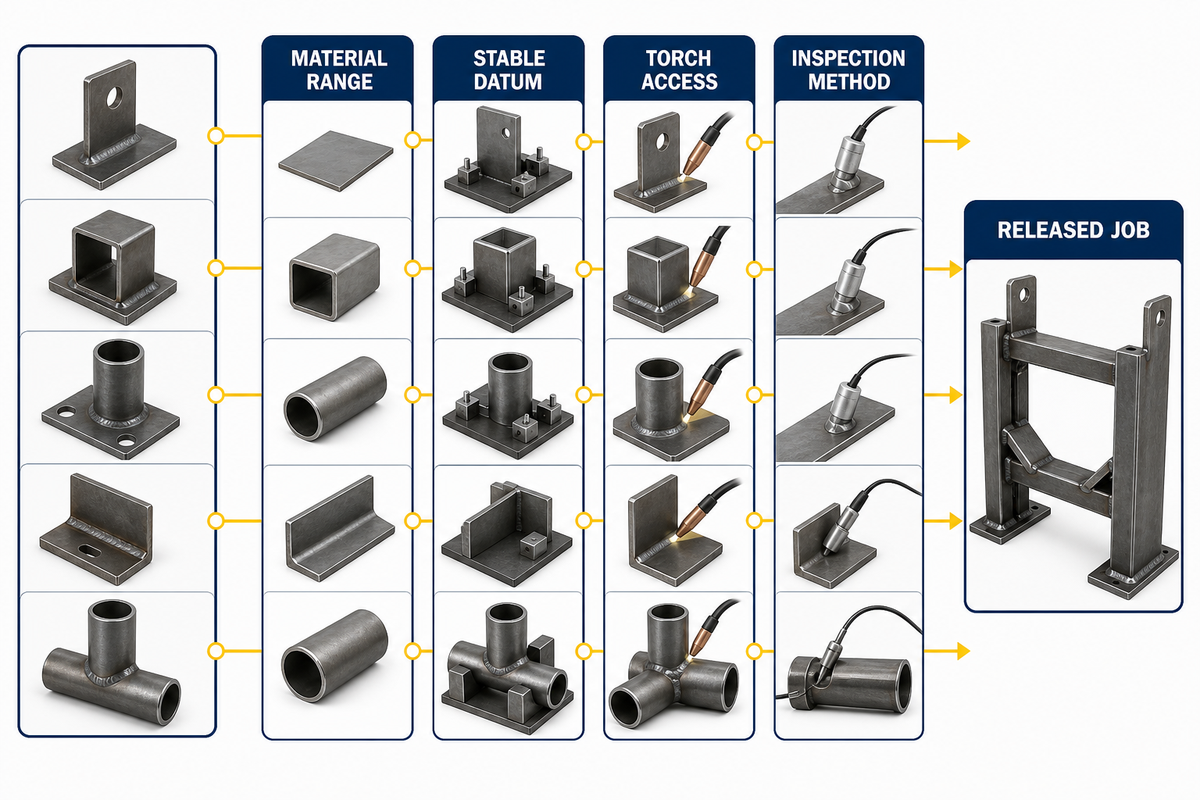
High-mix automation becomes practical when variation can be described and controlled. A batch of five repeat parts may be easier to automate than a batch of fifty assemblies, whose joint position, fit-up, or access changes from piece to piece.
Group together
- Common material and thickness ranges
- Similar joint types and weld positions
- Stable locating surfaces
- Comparable torch access
- Shared wire, gas, and procedure requirements
Separate or investigate
- Uncontrolled gaps or distortion
- Parts located by eye
- Joints hidden behind clamps
- Frequent consumable or process changes
- Acceptance rules that differ by contract
What makes a cobot practical when weld paths change frequently?
Frequent path changes become manageable when the shop can recall a released job, locate the new part from known datums, verify the tool and work frames, and prove the first piece before continuing. Easy teaching aids can help, but they cannot correct unstable parts or an uncontrolled fixture.
NIST describes high-mix, low-volume manufacturing as a potential fit for collaborative robots, but “fit” is still application-specific. Use a qualification card for every proposed part family: drawing revision, material, WPS, joint list, batch pattern, location method, expected variation, inspection method, and the person who can release the job.
Include the manufacturing functions around the first weld, not just the robot path. Material preparation, fit-up, inspection and exception handling determine if the cell can increase production or simply move the bottleneck.
When Does a Cobot Beat Manual Welding or a Conventional Robot?
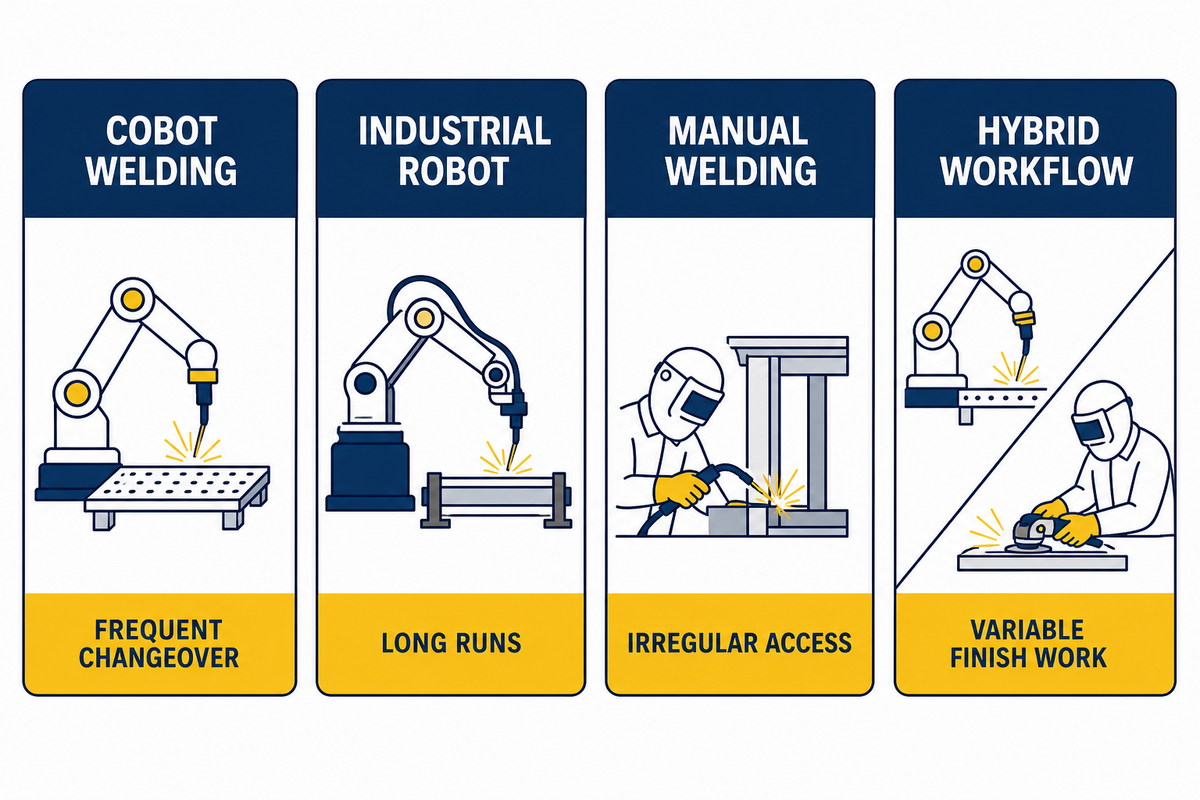
| Production condition | Likely route | Why |
|---|---|---|
| Many repeatable parts, frequent changeover, moderate speed requirement | Cobot welding | Programming and redeployment flexibility can outweigh lower peak speed. |
| One stable product, long runs, maximum throughput | Conventional industrial robot | A dedicated guarded cell may justify higher speed and integration effort. |
| Very low volume, irregular access, unstable fit-up | Manual welding or process improvement first | Automation may turn variation into stops, touch-ups, and rework. |
| Repeatable subassemblies plus variable finish work | Hybrid workflow | Assign consistent seams to the robot and retain human judgment for exceptions. |
Which automation route fits a low-volume, high-mix shop?
Choose by the combination of mix, repeatability, changeover burden, access and required speed. “Small batch” by itself is not enough evidence. A cobot earns its place when recurring jobs can be converted into controlled recipes and fixtures without making verification longer than the production run.
The Mix-Repeatability Route Map is a simple decision aid. If repeatability is weak, improve the part or the fixture first. If speed dominates, compare automation for high-volume work. Retain manual work for genuinely unpredictable joints. Use a cobot for repeat work and frequent changeovers. For a broader introduction before choosing a route, review these cobot welding fundamentals.
Human operators still own preparation, observation, inspection and exception decisions. High-volume production may favor traditional industrial automation when its speed and fixed layout justify the burden of additional integration.
Build the Cell Around Stable Datums and Torch Access
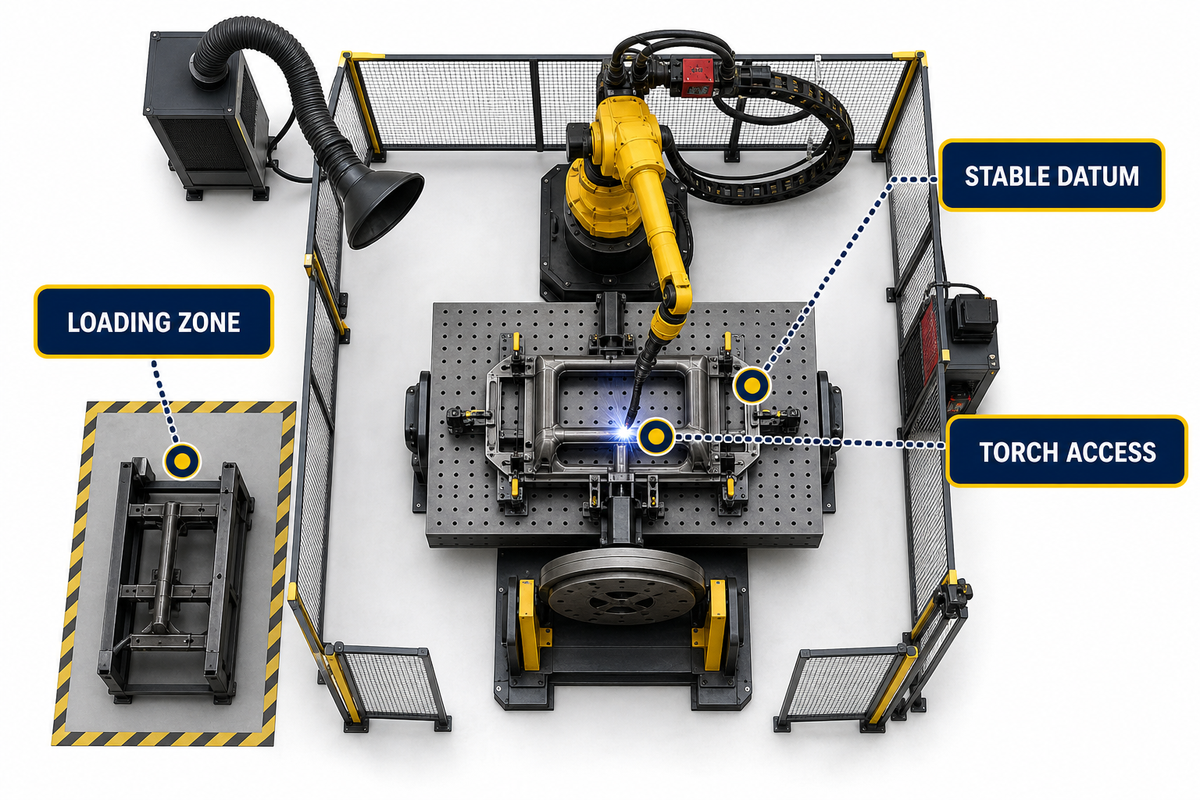
Lay out the cell from the weld backwards. Confirm the required torch work and travel angles, nozzle clearance, approach path, positioner motion, cable sweep, and access for loading and inspection, before finalizing the robot base location. NIST calibration and registration guidance explains why coordinate relationships and task accuracy require measurement rather than assumption.
- Plot representative joints and difficult approach angles.
- Define the fixture envelope and stable workpiece datums.
- Check reach and payload with the actual torch, dress pack, sensor, and adapter.
- Reserve clearance for clamps, extraction, service, and part removal.
- Define power, gas, wire, network, grounding, and fume-control interfaces.
- Validate the proposed arrangement with the integrator and responsible safety personnel.
Calibration boundary: Recalling the same program does not prove the physical path is still accurate. Tool center point, work frames, registration, collision events, maintenance, and equipment condition can change the result. Set verification and revalidation triggers appropriate to the process and controller documentation.
Control the Setup as One Shop-Floor System
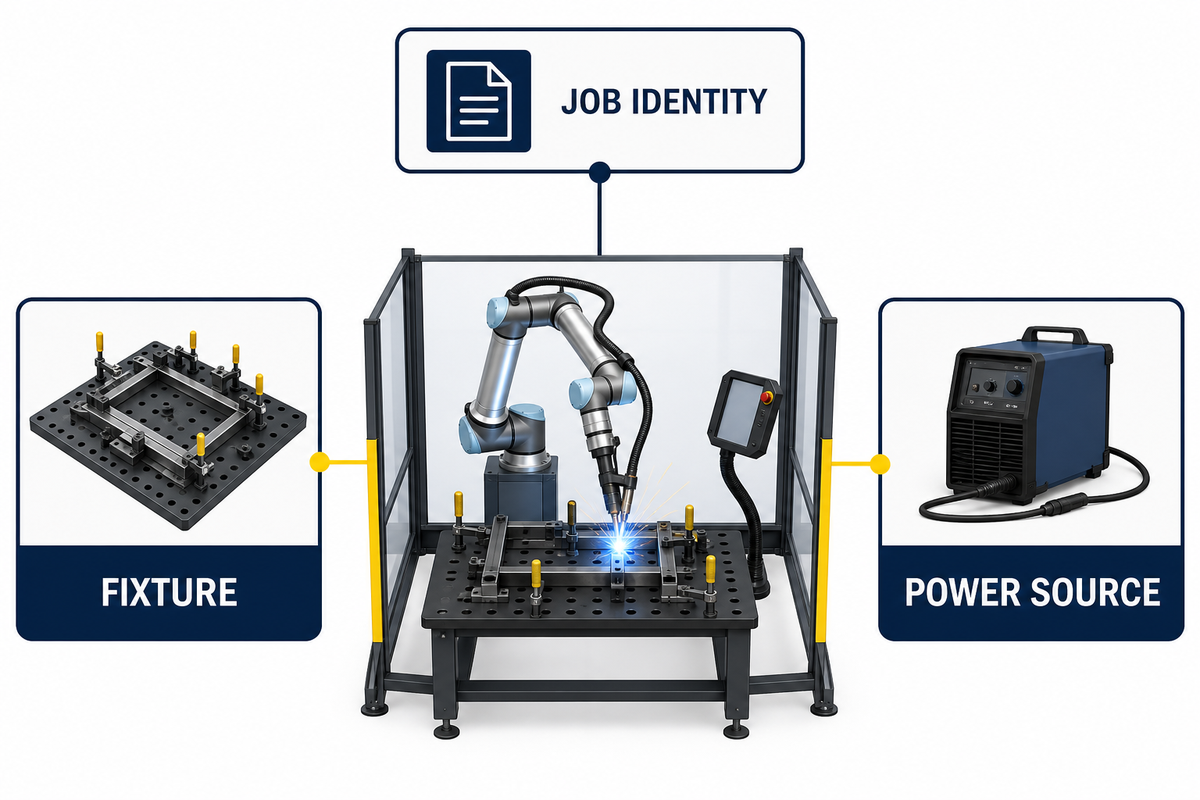
A welder or technician should not be required to reconstruct a setup from memory at the teach pendant. OSHA robot-application guidance supports treating integration, operation, maintenance, and environmental hazards as one lifecycle system. The following control matrix ties the cobot arm, welding process, fixture, power source, and release evidence to one job identity, helping the shop improve weld consistency without confusing repetitive motion with proven quality.
| Control cluster | Recorded setup input | Release evidence |
|---|---|---|
| Part family | Drawing, material, thickness, weld seam list | Correct revision and representative part confirmed |
| Fixture | Base, nest, datum, clamp sequence | Fixture ID, condition, and orientation verified |
| Robot and tool | Cobot arm, torch, TCP, work frame | Registration and equipment-state check completed |
| Program | Job, path, offsets, recovery points | Released version loaded and dry-run observed |
| Welding process | MIG mode, wire, gas, welding parameters | Approved WPS or process recipe matched |
| Power and services | Power source, grounding, extraction, utilities | Connections and fume capture checked |
| Cell layout | Footprint, loading zone, cable sweep, access | Clearance and protective measures validated |
| First piece | Inspection plan and acceptance criteria | Result recorded by authorized personnel |
| Handover | Backup, training, maintenance, open issues | Named owner accepts the production package |
This matrix also discloses the real programming process. Industrial automation software is only one layer. Production efficiency and operational costs depend on repeatable physical inputs, verified recipes, and trained operators, and a controlled response when the collaborative robotic application changes.
A cobot welder can repeat motion, but skilled operators and qualified welding personnel control what can improve weld quality. Improving quality means controlling variation and verifying product quality; it is not a guaranteed outcome of buying automation.
Design Fixtures for Fast, Repeatable Changeovers
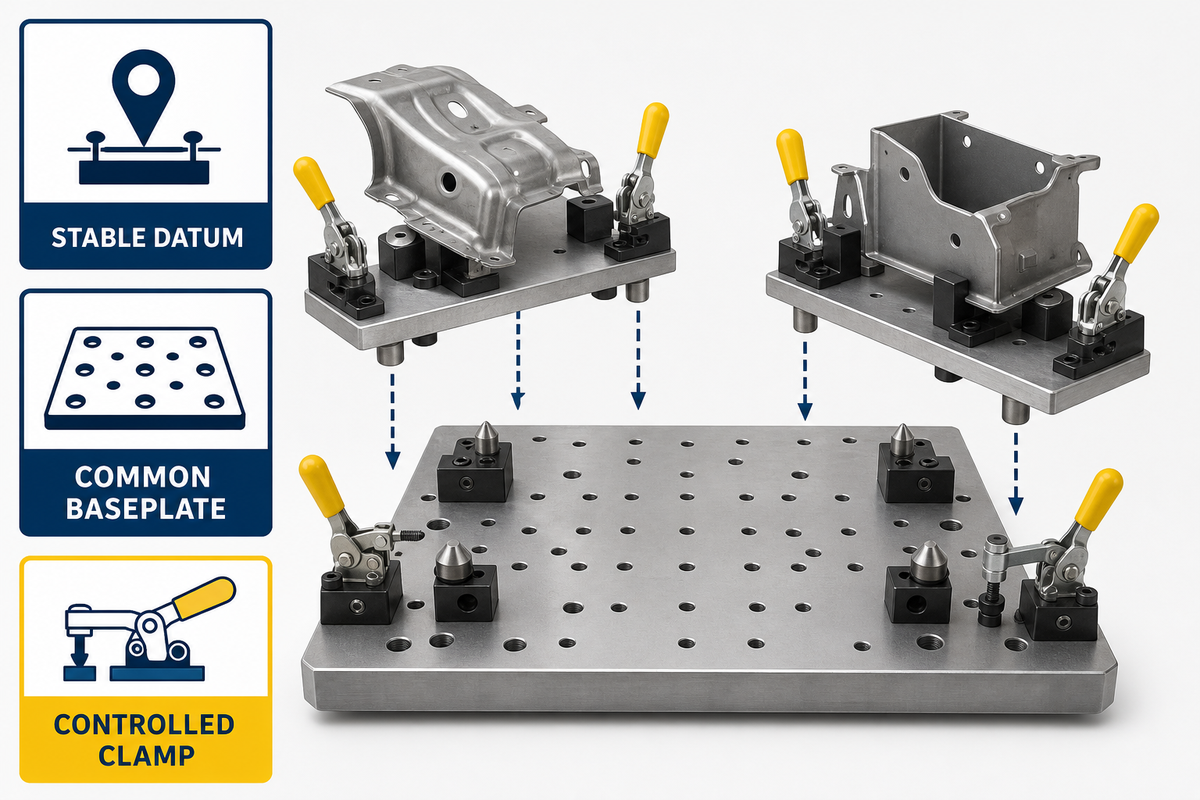
A good high-mix fixture standardizes the interface while allowing nests to change. A common baseplate, known datums, keyed orientation, positive stops and controlled clamp locations, give every program a stable physical reference.
Fixture readiness checklist
- Locators establish position; clamps hold the part against them.
- The part cannot be loaded in the wrong orientation without an obvious mismatch.
- Clamps and fixture members remain outside the torch and cable envelope.
- Heat and distortion have a planned restraint and release sequence.
- Fixture ID and revision are visible and paired with the released job.
- Wear points can be inspected and replaced without changing the datum scheme.
How do fixtures reduce setup time without losing repeatability?
Well-designed modular fixtures replace judgment-based positioning with a repeatable, verified interface. The goal is not a universal fixture for every SKU; it is a repeatable base and change method that allows different nests to establish the same cell coordinate logic.
The Fabricator describes high-product-mix operations using common tooling and sequences to improve flow and notes that consistent fixturing leads to more consistent setups. Take that as an operating principle, not as an assurance that one fixture design will meet every shop’s needs.
A cost-effective fixture is one that controls the required datums and completes its duty, not the one with the lowest purchase price. Good access can reduce labor spent on awkward loading and adjustment, while the release checks still remain.
Create a Reusable Program Architecture
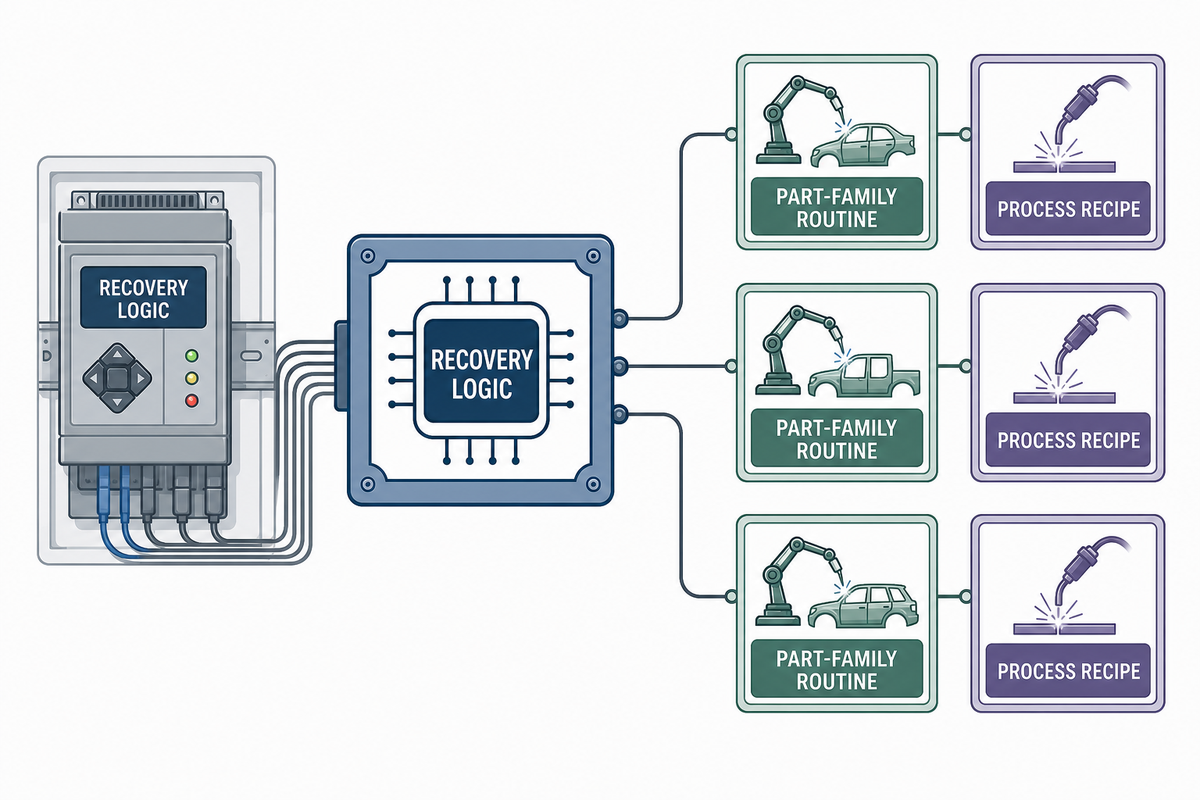
Store more than a path. NIST robot registration work reinforces the need to control coordinate relationships alongside the stored program. A released job should identify the drawing, fixture, WPS or approved process recipe, tool data, work frame, weld sequence, sensing options, and inspection plan that belong together.
| Layer | Control | Change trigger |
|---|---|---|
| Master routine | Readiness checks, safe start, recovery logic | Controller or cell-function change |
| Part-family routine | Sequence and shared motions | Joint order or access change |
| Part job | Points, offsets, weave and process calls | Drawing, fixture, or weld requirement change |
| Recipe | Approved welding parameters | Material, thickness, wire, gas, or procedure change |
| Release record | Verified revision combination and first-piece result | Any controlled input changes |
Separate evidence layers exist for coordinate registration and calibration. Research by NIST on robot registration and in-situ accuracy illustrates why a neat revision record by itself cannot prove task accuracy through the work envelope. Use controller and application specific checks instead of a universal check to determine calibration interval.
If the teach interface uses graphical job cues, those cues should match the controlled fixture and recipe identities. A job should not be described as loading smoothly when an operator must resolve an unaccounted for offset or equipment change.
Use the 6-Gate Changeover Loop
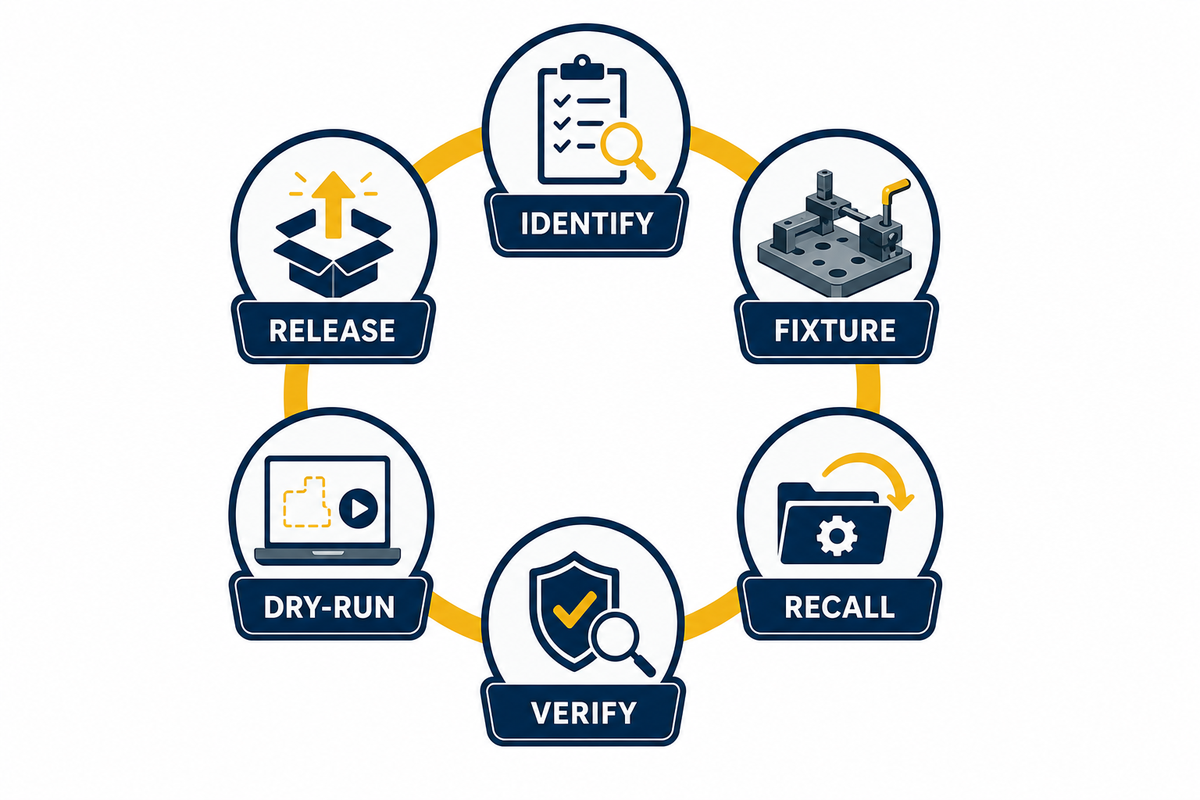
The 6-Gate Changeover Loop is the editorial basis for this guide to transform a job swap into an auditable release sequence. OSHA guidance calls for risk assessment across the robot-application lifecycle, which is why defined changes must trigger renewed checks.
1. IdentifyConfirm job, drawing, WPS, consumables, fixture, program, and recipe revisions.
2. FixtureInstall the correct nest and verify datums, stops, clamps, orientation, and condition.
3. RecallLoad the released job combination; do not mix an old path with a new drawing or fixture.
4. VerifyCheck TCP/work frame, wire, gas, utilities, extraction, sensing, and protective measures.
5. Dry-runUse an appropriate safe mode to verify clearance, sequence, approach, and recovery.
6. ReleaseWeld, inspect, document, and approve the first piece before the batch proceeds.
Define what changes to part, fixture, program, tooling, layout, or extraction require a new risk assessment, calibration check, process confirmation, or first piece approval.
Check arc ignition, bead start, and stop behavior during the process trial. Deposition rates and uninterrupted run time are production variables, not reasons to bypass a dry run or first-piece hold point.
Release the First Piece Before Starting the Batch
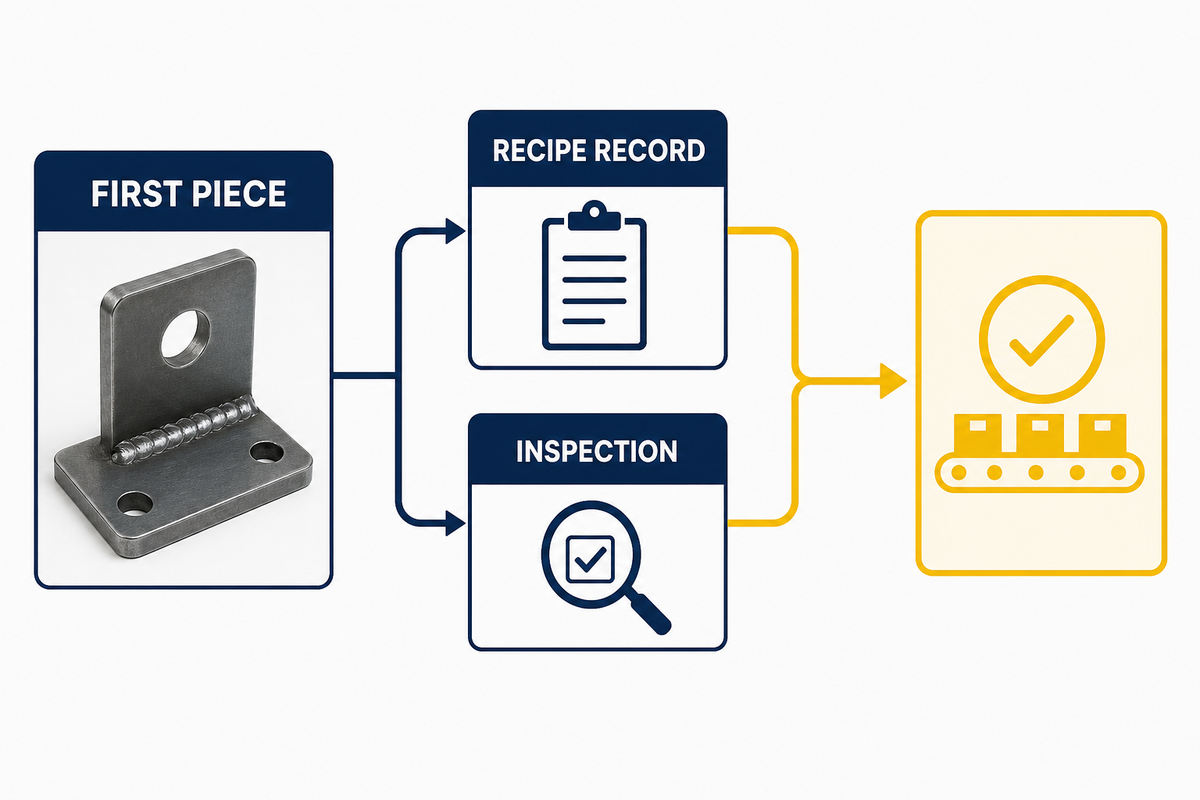
The first-piece hold point links setup to production. NIST research on robot accuracy degradation supports checking current equipment state instead of relying only on a previous good result. It should identify the exact job combination and show that the resulting weld meets the acceptance criteria that actually control the work.
First-Piece Release Card
- Part, drawing, fixture, program, recipe, and WPS identifiers
- Tool/work-frame verification and relevant equipment-state checks
- Material, wire, gas, fit-up, and joint identity
- Required visual, dimensional, NDT, or destructive checks
- Result, deviation, disposition, approver, date, and traceability
The information provided in this article does not address acceptance criteria. This would come from the contract, drawing, qualified welding procedure, applicable code and authorized personnel. A previous good part does not guarantee the equipment remains in the same condition following a collision, maintenance action, tooling change or other defined event.
Treat Collaborative Operation and Welding Safety Separately
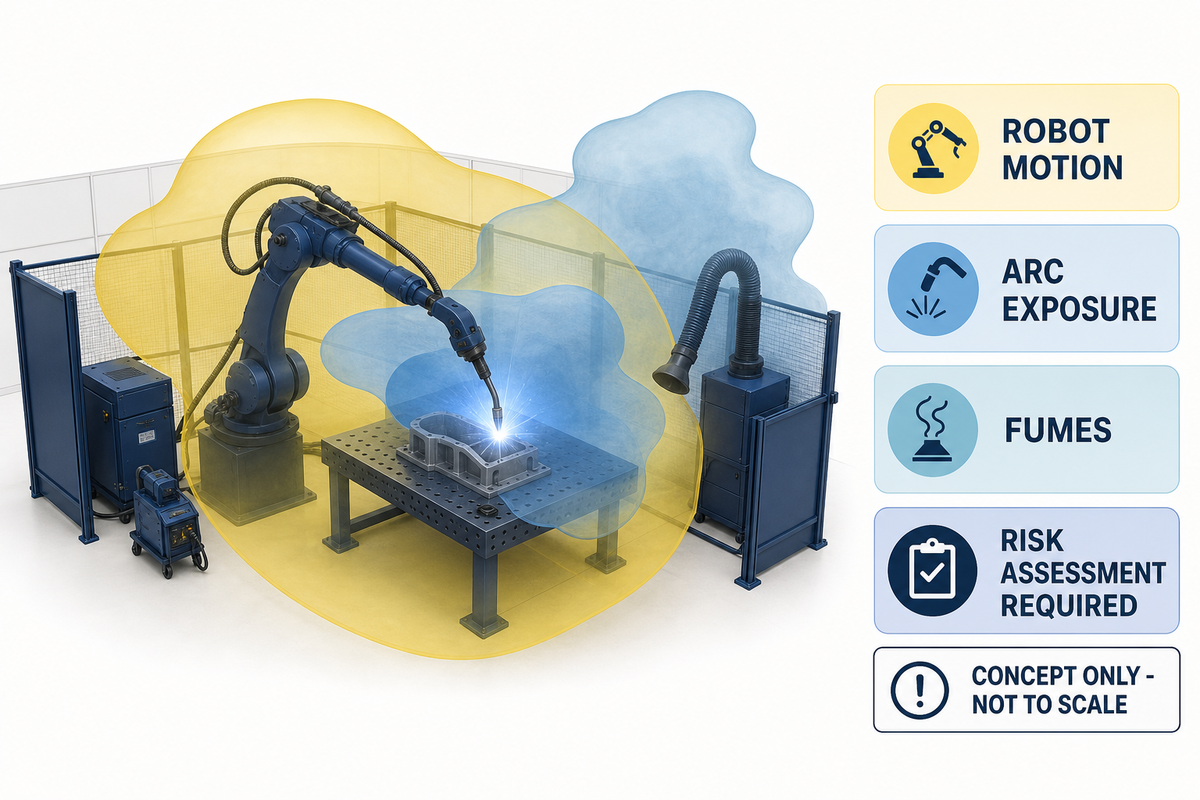
A collaborative arm does not eliminate the need for guarding. OSHA’s robot guidance calls for risk assessment throughout the life of the application and includes exposure to welding fumes, arc radiation, heat, spatter, fire and hot workpieces and process equipment. Our review of welding robot safety standards provides more information, but the qualified review of the currently applicable requirements is required.
What safety checks remain when the arm is collaborative?
Assess the complete application: robot motion, torch and workpiece, clamps and positioners, unexpected restart, arc exposure, fumes, heat, spatter, electrical hazards, loading tasks, maintenance, and nearby people. Also validate the protective measures in relation to the actual layout and operating modes of the equipment.
ESAB’s welding-cobot guidance notes that a risk assessment can still lead to cages, scanners, or door locks. The appropriate controls may also include screens, extraction, interlocks, restricted access, safe speeds, procedures, PPE, or other measures selected by qualified parties under current local requirements. The ANSI overview of ISO 10218-1:2025 is a useful standards-change pointer, not a substitute for obtaining and applying the relevant standards.
Safety note: This guide is planning information, not a cell risk assessment, code interpretation, or authorization to operate. Confirm current standards, jurisdictional duties, and the exact system documentation.
Prepare an RFQ and Acceptance Package a Supplier Can Act On
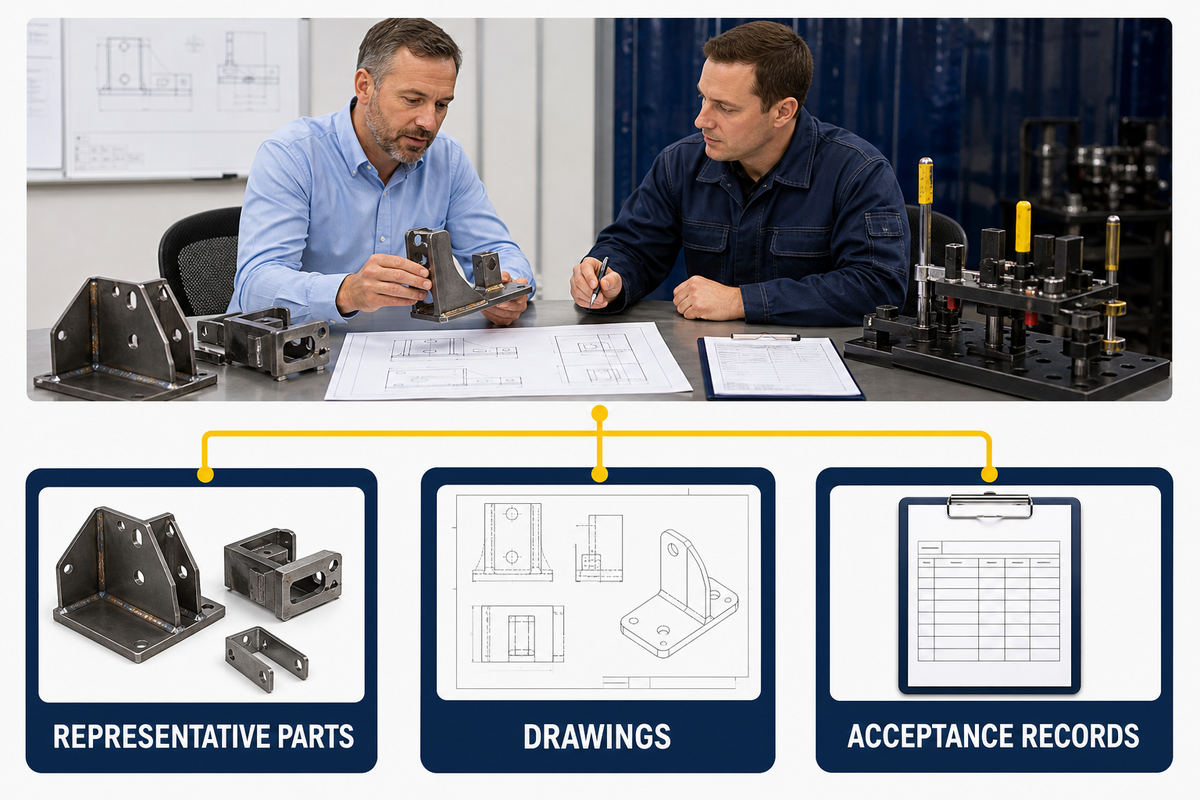
A supplier can design a more credible solution when the RFQ describes the work rather than asking only for a robot model. Provide representative parts and the hardest joints, not just the easiest sample.
A cobot solution must be credible against the defined production needs, be it sample sheet metal or structural steel. Ask the supplier to explain hardware and software compatibility and to separate demonstrated performance from expected optimization.
RFQ checklist
- Part-family matrix, drawings, revisions, and representative samples
- Materials, thicknesses, joints, positions, fit-up, and WPS requirements
- Expected mix, batch pattern, hours, and target operating assumptions
- Fixture scope, datums, positioners, sensing, and changeover responsibility
- Available layout, utilities, extraction, network, and environmental conditions
- Safety-responsibility split and required documentation
- Programming, backup, recovery, operator, maintenance, and training scope
- FAT/SAT, first-piece, documentation, and unresolved-issue criteria
What evidence should a cobot welding supplier provide?
Ask for demonstrated results on representative parts, the exact assumptions behind cycle estimates, a documented safety-integration scope, program and backup deliverables, training content, acceptance records, and clear responsibility boundaries. The customer should define responsibility and boundaries and review acceptance documents. The customer should know what was demonstrated versus what remains an optimization target.
Zhouxiang can use this input package to discuss a suitable collaborative welding robot configuration.
Before supplier discussions, confirm the company and support scope on the Zhouxiang company page.
Frequently Asked Questions
Can one cobot handle many different welded parts?
Yes, if the parts can be grouped into manageable families with stable datums, accessible joints, controlled fit-up, and stored job recipes. The limit is less about the number of part numbers, and more about how much physical and process variation the program structure, inspection plan, and fixture can integrate and absorb without making every repeat order a new integration project.
How long should a high-mix cobot welding changeover take?
There is no defensible universal time. Fixture mass, part complexity, consumable changes, sensing, inspection, and operator skill affect the outcome. Establish a measured baseline for each part family and move preparation outside the stopped period if possible. Avoid wasted motion, while maintaining first-piece controls and dry runs.
Do collaborative welding robots work without guarding?
No, that does not resolve all the risks. Collaborative functions address part of the risk. Arc radiation, fumes, hot metal, spatter, tooling, workpieces, positioners, pinch points, and attached equipment still require assessment; the resulting safeguards depend on the cell, tasks, operating modes, and applicable requirements.
Should every part have a separate robot program?
Use a controlled architecture. Routines and released part jobs or recipes are part-family specific where the controller permits, and recovery and readiness logic is common. Each fixture, path, process recipe, and drawing is revision-controlled such that a convenient recall does not inadvertently combine incompatible versions.
What should be included in a supplier acceptance test?
Use representative parts and agreed drawings, procedures, fixtures, and cycle and inspection assumptions; safety functions; operator tasks; recovery scenarios; training; and documentation. Record observed facts and distinguish between demonstrated and future state requirements. Document who owns unresolved part, tooling, process, and integration issues.
References & Sources
Key sources include OSHA robot-application guidance, NIST high-mix/low-volume cobot context, The Fabricator’s high-product-mix analysis, ESAB’s welding-cobot safety guidance, and ANSI’s standards overview linked in the relevant sections above. See also our separate guide to welding robot safety requirements, neither internal guide replaces an application-specific assessment.
The 6-Gate Changeover Loop and Mix-Repeatability Route Map are editorial frameworks synthesized for this guide. No client cycle-time study, weld-quality dataset, or customer project result was supplied, so this article makes no universal productivity, ROI, or quality guarantee.