Get in Touch with Zhouxiang


Spot Welding Robot vs Arc Welding Robot: How to Choose the Right Process for Your Production Line
Nearly half of all industrial robotic systems in use globally are welding automation, says the IFR World Robotics 2025 Report. With 542,000 new robots installed in 2024 alone, there are two choices to choose from. Should you buy a spot welding robot or an arc welding robot?
The answer to this question depends on your materials, joint type, production rate, and budget. This guide compares the arc and spot welding processes against each other across all characteristics relevant to your shop, with standards set by the auto industry and data collected on your factory floor over the past three decades of industry-leading welding automation.
Spot Welding vs Arc Welding at a Glance

Before getting into the features of each welding process, here is a head-to-head comparison of the characteristics most critical to a purchasing decision. Both join your workpieces using common welding methods — spot welding joins metals at specific points while arc welding also creates continuous seams — but they have very different results.
| Dimension | Spot Welding Robot | Arc Welding Robot |
|---|---|---|
| Welding Principle | Resistance welding (pressure + heat at specific points) | Electric arc melts filler metal into continuous seam |
| Joint Type | Lap joints at discrete points | Butt, fillet, lap, corner, edge joints (continuous) |
| Material Thickness | 0.5 mm – 3 mm (sheet metal) | 0.5 mm – 50+ mm (thin to heavy plate) |
| Speed per Joint | 0.1 – 0.5 seconds per weld | 150 – 800 mm/min travel speed |
| Filler Material | None required | Wire or rod (MIG, TIG, stick welding) |
| Shielding Gas | Not required | Required (argon, CO2, or mixed) |
| Primary Industry | Automotive body assembly | Steel structures, heavy equipment, shipbuilding |
| Typical System Cost | $70K – $140K | $50K – $150K |
💡 Pro Tip
The welding robot you need will be determined by what you are fusing. For overlapping, thinner sheet metals, between 1 and 3 mm, spot welding is the faster option. For thick structural metals, over 4 mm, or for continuous seam production, arc welding is the clear winner.
How Each Welding Process Works

Knowing the physics of how each welding process works puts you in control of selecting the right robotic welding system for your application. These processes form joints by completely different means.
How Robotic Spot Welding Works
Spot welding is a variation on resistance welding in which two copper electrode tips hold overlapping metal sheets in place and pass a high electric current through the interface. The electrical resistance of the interface causes the contact to reach 6,500F (3,600C) and fuse. Unlike arc welding, filler metal and shielding gas are not necessary.
A typical robotic spot welding cycle takes 0.1 to 0.5 seconds per weld. The welding robot guides the gun, the electrodes clamp the workpieces, the current runs for milliseconds, and the robot jumps to its next point. Our welding cells achieve 200 to 300 spot welds per hour, depending on part complexity, with one 6-axis robot.
The process adheres to the AWS D8.1M:2021 automotive weld standards for quality—controlling electrode pressure, current settings, and nugget sizes for steel sheet materials.
How Robotic Arc Welding Works
Arc welding employs an electric arc to melt two materials: the base metal and an electrode (wire or rod) that acts as a filler. It produces a solid gapless bead along a joint. An arc is struck between the electrode and your workpiece, reaching temperatures greater than 6,500F (3,600C). A gas shield prevents the molten weld pool from contact with air.
Common arc welding processes automated by welding robots include:
- MIG/MAG (Metal Inert Gas / Metal Active Gas): the preferred choice for robotic arc welding. Wire feed capable, high deposition, steel and stainless materials
- Tungsten Inert Gas (TIG): utilizes a non-consumable tungsten electrode. It is comparatively slower but best suited to highly precise, thin-metal applications and traditionally exotic alloys
- Stick welding (SMAW): seldom automated. Intended for use in construction and field repairing where portability overtakes production rate. Laser welding and plasma welding are also used for welding in specialized metal fabrication applications
In serial production with robots, arc time—the share of time a robot spends welding versus repositioning—runs between 50% and 90%, which is 4 to 5 times higher than a human welder on the same joint.
Weld Quality and Joint Strength

Weld quality makes the difference between arc welding and spot welding the most significant for structural usages. Each process delivers a fundamentally different type of joint, and the load bearing qualities prove that.
| Quality Metric | Spot Welding | Arc Welding |
|---|---|---|
| Joint Continuity | Discrete points (nuggets) | Continuous seam |
| Shear Strength | High for lap joints in sheet metal | High across all joint configurations |
| Fatigue Resistance | Moderate (stress concentration at nugget edges) | High (continuous load distribution) |
| Seal Integrity | Not gas/liquid-tight (gaps between points) | Gas/liquid-tight when properly executed |
| Repeatability (Robot) | Positioning accuracy ±0.05 mm | Positioning accuracy ±0.05 mm |
| Heat-Affected Zone | Minimal (localized to nugget) | Wider (continuous heat input along seam) |
Because the whole weld bead is continuous and load is distributed across that entire joint, arc welding produces much stronger joints for usages that take structural pressure. That is why most structural steel fabrication, bridge construction, and pressure vessel manufacturing uses arc welding processes according to well established welding engineering principles.
In the automotive industry, resistance welding provides what a body shop requires when it involves overlapping sheet metal panels. This process is used when construction of a vehicle body requires a lot of structure, but no need for penetration the whole way through. A standard automobile body contains 3,000 to 5,000 spot welds, and each one must meet consistent weld quality standards.
In our experience about integrating welding robots for fabricating steel structures, the most common quality flaw is not the welding robot itself, but the fixturing. The robots learns exactly what it is taught. If the workpiece holds the part inconsistently, even a $200,000 robotic welding will produce the same inconsistencies in weld quality.”
— Zhouxiang Engineering Team, 30+ years in welding automation
Production Speed and Cycle Time

Production speed is frequently the deciding factor for manufacturers evaluating robotic welding. Spot welding robots and arc welding robots operate at very different tempos, and the right choice depends on your part geometry and volume requirements.
60
Spot welds per minute (single robot)
50-90%
Arc time ratio (robotic vs 15-30% manual)
4-5x
Productivity gain vs human welder
For the very high volume applications, robotic spot welding running in milliseconds directly accounts for the majority of the total cycle time. This is because the welding robot mostly spends it’s time moving the robots to the different weld points and less time welding. In a published automotive study in robotic resistance spot welding optimization, size of the total cycle time were decreased 13% from 532 seconds to 464 seconds with a simple reordering of all weld points.
Arc welding robots work differently. Speed of a part depends on actual travel speed (about 150 to 800 mm/min using MIG welding), speed of Wire fed rate, and the number of passes. Thicker joints need to be welded many more times, and this adds up quickly to the cycle time. On our robotic welding system with grounded rail architecture, a 6-axis robot can cover a 6-meter seam in one setup reducing time or repositioning for structural elements.
| Speed Factor | Spot Welding Robot | Arc Welding Robot |
|---|---|---|
| Welding cycle per joint | 0.1 – 0.5 seconds | Varies by seam length |
| Repositioning time | Major bottleneck (70-80% of cycle) | Minor (continuous seam tracking) |
| Multi-pass requirement | Single pass always | 1-5 passes depending on thickness |
| Best for | High-volume, many-point assemblies | Long seams, structural joints |
Material Compatibility and Thickness Range

Material selection is one of the areas in which the choice of welding process can lead to very expensive errors. Resistance spot welding uses electrodes to conduct metal workpieces between two structures via heating. As such, it can only be used when the metals conduct electricity and can be held between the electrodes. Arc welding is much more forgiving.
| Material | Spot Welding | Arc Welding (MIG) | Arc Welding (TIG) |
|---|---|---|---|
| Low carbon steel | 0.5 – 3 mm | 0.8 – 50+ mm | 0.5 – 6 mm |
| Stainless steel | 0.5 – 3 mm | 0.8 – 25 mm | 0.3 – 6 mm |
| Galvanized steel | 0.5 – 3 mm (electrode wear increases) | 0.8 – 12 mm | Not recommended |
| Aluminum alloys | Possible (high current needed) | 1 – 25 mm | 0.5 – 6 mm |
| Structural steel (>6 mm) | Not suitable | Multi-pass capable | Not practical |
| Dissimilar metals | Limited | Possible with correct filler | Possible |
⚠️ Common Mistake
Given the assumption that a Spot welding robot will support thick plate, spot welding is not really able to spot weld metal workpieces with thickness thicker than 3 mm. This results in substandard nugget formation, shear strength, and rapid degradation of the electrode. Arc welding is necessary for anything plates over 3 mm.
Globally, the automotive industry accounts for the largest proportion of spot welding applications worldwide. Modern vehicle bodies use a combination of steel and stainless steel grades including certain AHSS, and the AHSS Application Guidelines specify resistance spot welding parameter values for these materials.
arc welding has a far wider range of use. From thin metal sheets under 1mm (TIG welding) to heavy structural members over 50mm (multi-pass MIG welding), arc welding robots can be employed for both ferrous and non-ferrous metals including steel, aluminum, copper alloys and nickel alloys.
Cost Comparison: Robotic Spot Welding vs Arc Welding
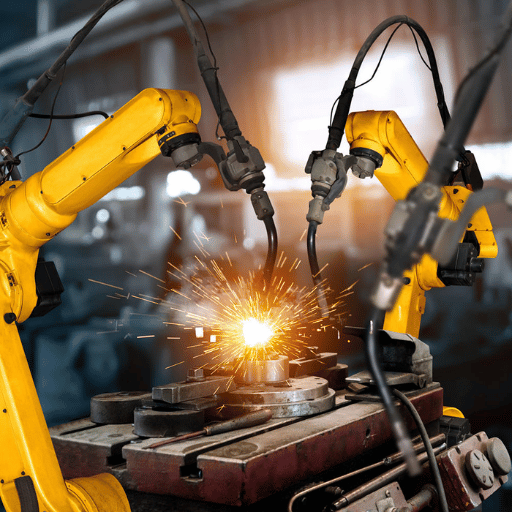
Overall investment for a robotic welding cell goes considerably beyond the spot welding robot or arc welding robot itself. Peripheral equipment, tooling, integration and ongoing consumables all lead to significant cost differences between the two welding automation methods.
| Cost Component | Spot Welding Cell | Arc Welding Cell |
|---|---|---|
| Robot arm (6-axis) | $60,000 – $100,000 | $30,000 – $80,000 |
| Welding equipment | $10,000 – $40,000 (welding gun + transformer) | $8,000 – $25,000 (power source + wire feeder) |
| Integration + safety | $20,000 – $60,000 | $15,000 – $50,000 |
| Total system | $90,000 – $200,000 | $53,000 – $155,000 |
| Consumables (annual) | $2,000 – $5,000 (electrode tips) | $5,000 – $15,000 (wire + gas + tips) |
| Typical ROI | 12 – 18 months | 12 – 24 months |
Because of the heavy welding gun and transformer, spot welding robots often require more expensive higher-payload arms (150 to 250 kg), adding to the robot arm expense. Arc welding robots generally use lighter 6 to 20 kg payload arms as the welding torch is comparatively light. Industrial robots from suppliers such as FANUC, ABB and Yaskawa exist in configurations adaptable to either welding style.
However, arc welding systems have higher operational costs. Wire, shielding gas and contact tip replacements all add up. A plant operating two shifts might spend $8,000 to $15,000 per annum on arc welding consumables as opposed to $2,000 to $5,000 spent on spot welding electrode tip dressings and replacements.
Our cost calculations in assisting clients begins with the workpiece—itself: what material, what thickness, what joint configuration and what volume. From there, we size the welding cell to meet it. Facilities processing in excess of 500 identical assemblies per day in welding automation lines normally recoup the investment in under 18 months through lowered labor time and less rework.
How to Choose the Right Welding Robot
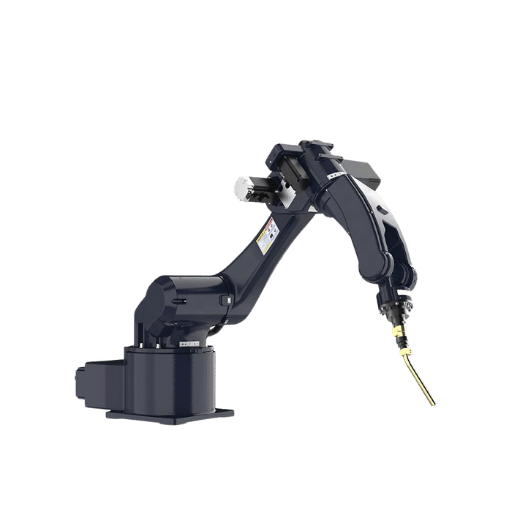
Choosing between a spot welding robot and an arc welding robot comes down to four criteria. Our engineering specialists applying this framework support clients from over 50 countries in welding automation projects.
- ✔
Step 1 — Material and thickness: If your workpieces are sheet metal under 3 mm in lap joint configuration, spot welding is the natural choice. If you weld anything thicker or need continuous seams, choose arc welding.
- ✔
Step 2 — Joint type: Spot welding only handles lap joints. If your design requires butt joints, fillet welds, corner joints, or edge welds, you need an arc welding robot.
- ✔
Step 3 — Volume and speed: For high-volume assemblies with hundreds of weld points per unit (automotive body panels, appliance housings), spot welding delivers unmatched speed. For fewer but longer weld seams, arc welding is more efficient.
- ✔
Step 4 — Seal requirements: If the weld must be gas-tight or liquid-tight (pressure vessels, tanks, piping), arc welding is the only option. Spot welding leaves gaps between discrete weld points.
When NOT to Automate with Spot Welding
Avoid spot welding as a welding application for: structural steel in excess of 3mm thick, in circumstances where full seam penetration is necessary, where construction materials are non-conductive, in low-volume or single piece production (where tooling per part makes manual welding less expensive), or where access to both sides of the joint is impossible due to the electrode.
Frequently, a business will require both. An automotive factory may deploy spot welding robots on the body shop line and arc welding robots in the frame and exhaust fabrication locations. These are two different welding techniques employing the same production line for different welding operations.
Frequently Asked Questions
Q: Is spot welding the same as arc welding?
View Answer
No. Spot welding fuses metal at discrete points using electrode pressure and electric current — a resistance welding method. Arc welding melts filler into a continuous seam using an electric arc. They differ in joint type, material range, and speed.
Q: What are the disadvantages of spot welding?
View Answer
Disadvantages associated with spot welding include: limited material thickness capability, no ability to create a gas-tight or liquid-tight seal, limited availability to perform lap joins, robotic arm (spot welding guns are heavy, requiring a high-payload robot), electrode tip wear requiring regular dressing and replacement, and difficulty welding highly conductive materials like copper and aluminum unless you have high thermal capacity equipment.
Q: What are the disadvantages of robot welding?
View Answer
Robotic welding has several drawbacks: the upfront cost runs $50,000 to $200,000 for a full welding cell, each new part design requires programming and dedicated fixturing, and you need trained staff to keep the system running. Vision systems or offline programming software can reduce setup time, but add to the investment. For repetitive production of identical parts, these costs are offset by gains in speed, consistency, and reduced labor.
Q: Can one welding robot perform both spot and arc welding?
View Answer
In theory, swapping end-of-arm tooling lets one robot handle both. But spot welding demands a 150-250 kg payload robot for the heavy welding gun, while arc welding runs on a 6-20 kg payload arm. Controller software, cable dressing, and peripheral equipment also differ between the two welding processes. In production, most plants dedicate separate robots to each process rather than tool-change between them — the changeover time and dual-payload compromise rarely justify the savings over running two purpose-built welding cells.
Q: Which welding method is better for thin sheet metal?
View Answer
Spot welding wins for lap joints on 0.5 to 3 mm sheet metal at high volume — minimal distortion, zero spatter, under one second per weld. For continuous sealed joints on thin metal sheets, TIG welding gives cleaner results.
Q: How much does a robotic welding cell cost?
View Answer
A complete robotic welding cell runs between $50,000 and $200,000. Arc welding cells start around $50,000 for entry-level setups. Spot welding cells begin higher, around $90,000, because the robot needs enough payload capacity (150-250 kg) to carry the heavy welding gun. Add safety enclosures, fixturing, programming, and installation on top. Industry data shows most manufacturers recover this investment within 12 to 24 months through higher throughput and lower labor costs.
Not Sure Which Welding Robot Fits Your Production Line?
Our team has configured robotic welding systems for steel structure fabricators, shipyards, and automotive suppliers across 50+ countries. Tell us about your workpiece and we will recommend the right setup.
About This Comparison
This guide was produced by the Zhouxiang engineering team, drawing on over 30 years of experience in the design and build of robotic welding production lines mainly for steel structure manufacturers and heavy equipment producers. The cost ranges reflect market data from publicly available industry sources and our own project experience across multiple robot brands. We manufacture arc welding robot systems — this comparison presents both spot welding and arc welding so you can identify the right process for your real production requirements.
References & Sources
- World Robotics 2025 Report — International Federation of Robotics (IFR)
- AWS D8.1M:2021 Specification for Automotive Weld Quality — Resistance Spot Welding of Steel — American Welding Society
- Resistance Spot Welding — AHSS Application Guidelines — WorldAutoSteel
- Optimization of Cycle Time of Robotics Resistance Spot Welding for Automotive Applications — Journal of Advanced Manufacturing and Processing (Wiley)
- Arc Welding — Wikipedia
- Spot Welding — Wikipedia