Get in Touch with Zhouxiang

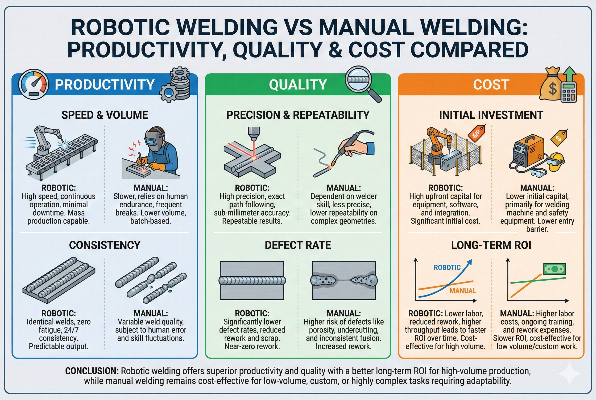
One of the largest capital and labor decisions a metal shop can make is whether to automate their welding with a robot or to have their welders do it manually. Impact on the bottom-line can be felt every shift in the form of either unused capital equipment or under utilized skill workers. This article will examine the specifics of robotic welding vs manual welding utilizing production data, independent research, and real cost benchmarks to allow you to analyze the two welding techniques using the only real metrics: throughput, weld quality, costs and worker safety.
What Separates Robotic Welding from Manual Welding?
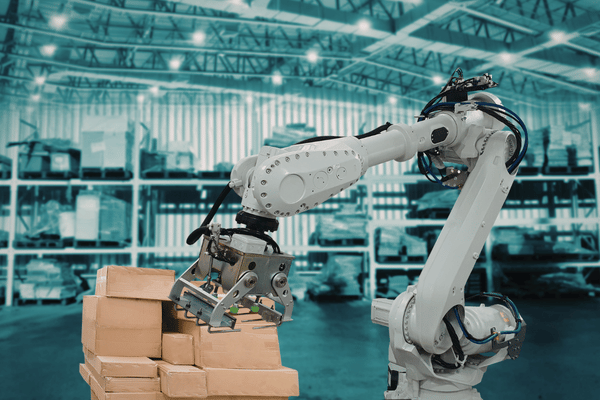
Robotic welding involves the use of a programmable robotic arm with a welding torch attached to it that carries out welds on a specified path. Its robotic arm continuously follows the same cycle repeatedly depositing filler metal and maintaining a constant travel speed, arc length, and wire feed rate. Usually a 6-axis robot along with a positioner, welding power, wire feeder and safety enclosure will constitute a robot welding cell.
Manual welding is performed by a human welder who guides the torch in his/her hand making real time adjustments to angle, travel speed, heat input, etc. after observation and feeling the process. Welding requires many years of training before efficiency, quality and consistency are obtained. The welder’s efficiency may be subject to variation depending on fatigue, environment, joint positioning, and accessibility.
This divide is also increasing. The IFR World Robotics 2024 report notes that 542,000 industrial robots were installed globally in 2024—more than twice as many as the previous ten years. Joining and welding represent 21% of all robot applications, second only to material handling.
Meanwhile, the American Welding Society (AWS) predicts that the United States will require 320,500 new welders by 2029, with about half of the current workforce approaching retirement.
542,000
Robot installations globally (2024)
320,500
New welders needed in U.S. by 2029
21%
Robot applications in welding
Both these factors – the increasing automation and decreasing pool of skilled labor input—are driving manufacturers to question if manual welding can support their manufacturing processes.
Productivity: Arc-On Time, Cycle Speed, and Throughput
Arc-on time stands as the single greatest productivity benefit in robotic welding compared to manual welding – the percentage of the work shift that the torch is depositing weld metal. Manual welders spend the majority of their shift doing non-welding tasks: fitting parts, repositioning, grinding, resting. A robotic system cuts most of that idle time out — robotic welding could realistically triple your daily output on repetitive joints.
| Metric | Manual Welding | Robotic Welding |
|---|---|---|
| Arc-on time | 15–30% of shift | 60–90% of shift |
| Throughput multiplier | 1x (baseline) | 3–5x |
| Shift capability | Single or double shift | 24/7 unattended operation |
| Welder equivalence | 1 welder | Replaces ~4–5 welders in output |
| Cycle time consistency | Varies ±15–20% | Repeatable within ±1% |
A University of North Dakota comparative study compared a collaborative welding robot to experienced manual welders performing similar joints and found the cycle time was 39% less on advanced weldments with the robot. A robotic cell in a high-volume production shop, running two shifts, can equal the welding production output of four or five manual stations, without any expense for the overtime premium rate or indirect effects of absenteeism.
This said, the productivity figures are very sensitive to the part complexity and batch size. It is the advantage of automated welding that the same programme can be used for hundreds or thousands of identical parts. For irregular jobs, programming time for robot path may take longer than skilled welder time for performing the task manually, which is where manual welding may still deliver faster turnaround.
💡 Pro Tip
Use a track arc-on time for a week before considering automation. Many shops find their actual manual arc-on time is less than 20% and this especially effects the ROI calculations.
Weld Quality and Defect Rates Compared
Weld integrity is where robotic welding exceeds manual welding and pulls the greatest advantage. A welding robot does not become fatigued or distracted and, unlike manual welding, it maintains consistency from the first weld of the morning through the last weld before the shift change. Every bead follows the same pattern of travel speed, pattern, and heat input programmed into the welding system.
| Quality Metric | Manual Welding | Robotic Welding |
|---|---|---|
| Typical defect rate | 8–12% | 2–3% |
| Defect rate with adaptive control | N/A | As low as 0.5% |
| Rework rate | 10–15% | <2% |
| Path repeatability | Operator-dependent | ±0.05 mm |
| Bead consistency | Varies with fatigue and skill | Uniform across production run |
As reported in peer-reviewed manufacturing research published by Springer, welding defect rates sit between 8-12 percent for manual welding and hold steady at 2-3% for robotic welding. With automotive industry TIG welding applications using real-time arc monitoring defect rates were identified as 0.5%. An Automate.org case study illustrated how Kawasaki R-series robots achieved path repeatability with 0.05 mm at each weld site thus producing identical beads geometry over thousands of identical parts.
Achieving that degree of robotic precision in a human welder is physically impossible to achieve over an eight-hour shift. Muscle fatigue develops, and small deviations form the torch angle or travel speed leading to inconsistencies in penetration profile. Result: more rework, wasted materials, and more time spent on post-weld inspection.
💡 Pro Tip
Through-Arc Seam Tracking (TAST) reads real-time electrical feedback from the welding arc to adjust torch position on the fly. Pairing TAST with a robotic welding system practically eliminates missed joints caused by part-to-part variation in fixtures.
Cost Analysis — Investment, ROI, and Long-Term Savings
The initial cost of a robotic welding system tops the list of the biggest concerns of manufacturers on the fence; and, it is a significant roadblock. But, on its own looking at costs without including the payback length, labor savings, or consumable efficiency looks at the picture half empty.
| Cost Category | Range |
|---|---|
| Complete MIG robotic welding cell | $75,000 – $200,000 |
| Collaborative robot (cobot) welding system | $80,000 – $150,000 |
| High-end custom cell with positioners | $200,000 – $500,000+ |
| Annual maintenance | $2,000 – $5,000 |
| Monthly consumables (wire, gas, tips) | $1,000 – $3,000 |
Most medium-to-high volume manufacturers claim full amortization within 12 to 24 months. It is worth noting these cost savings are realized in three directions simultaneously: automation reduces labor costs (up to 50 percent fewer welding operators required); the robotic welding machinery wastes less wire and gas per joint; and fewer parts need rework. General Motors claims their robotic systems on their welding lines have led to a 30 per cent increase in productivity and a 20 per cent fall in operating costs.
12–24 mo
Typical ROI payback period
50%
Potential labor cost reduction
20%
Operating cost decrease (GM data)
“In the experiences we have had with structural steel fabricators and large machinery builders, the fastest ROI for robotic welding cells is on shops doing more than 500 similar parts a week. Nevertheless, at least 200 parts a week, would pay for itself in the reduction of rework in two years.”
— Zhouxiang Engineering Team
A cost factor many tend to forget about: entry-level welding machines in 2025 will cost an estimated 40% less than similar ones were priced in 2020. Pricing continues to trend in the direction of automation while the opposite applies to labor.
Workplace Safety — Reducing Hazards Through Automation
All welding processes produce hazards the pose risks for employees. The Occupational Safety and Health Administration (OSHA) points out potential hazards such as the dangers of welding fumes, ultraviolet radiation burns, electrical shock, and the risks of fire are primarily present in manual welding operations. Moving the human welder away from the arc addresses most of these risks directly — automated welding processes shift the hazard exposure from people to enclosed robotic welding machines.
⚠️ Health Alert
All welding fume falls into the Group 1 category (IARC) and has been shown to cause lung cancer in humans. The hazards associated with prolonged exposure are also kidney cancer and chronic respiratory disease.
- ✔
Metal fume exposure — robot operates inside an enclosed cell with dedicated extraction. - ✔
Burns from UV and infrared radiation – the operator remains outside the arc zone. - ✔
Repeated strain and musculoskeletal conditions- no prolonged awkward positioning. - ✔
Burns from spatter and hot metal – physical separation from the welding operation - ✔
Eye injury due to the arc flash- robotic system automatically manages the torch position
According to CDC/NIOSH ergonomics research, work-related musculoskeletal disorders constitute the single largest share of lost-workday injuries, representing 29 percent of all injuries and 34 percent of workers’ compensation claims and costing U.S. employers 20 billion dollars a year. Manual welders are prone to this kind of injury because their work involves holding the arm overhead, bent-knee configurations and repetitive hand/wrist movements for long periods of time. With robotic systems the most strenuous labor is successfully shifted from human to machine so the operator can spend more time loading parts, inspecting welds and handling the next set of parts.
When Manual Welding Is the Better Choice
There are applications in welding where the cons of robotic welding outweigh the benefits. Manual welding has undeniable benefits in many situations where automation, the robotic welder included, is simply not well suited.
- Field and on-site work- installation of pipeline, steel erection, shipyard fitting, and facility maintenance are often performed at locations where taking a robot cell to the jobsite is not feasible. A good welder and a portable machine make things happen.
- Small runs and one-offs – For a single weldment, or five parts, programming and setting up a robot takes longer than the actual welding. Manual welding is best when the number of parts is low.
- Irregular geometries and poor fit-up – Pieces that have loose tolerances, “turkey-wings” or irregular edge types need the dynamic adaptability that a human welder is capable of.
- Welding repair and maintenance – Repairing a cracked casting or filling a surface scar has a series of non-trivial decision points associated with heat input, filler choice and weld sequence, each of which will vary depending on circumstances.
- Limited budget, volume uncertain – If up-front investment in a robotic welding system does not paid for itself, either by efficiency or quality improvement, then the volume of production is uncertain or declining.
💡 Pro Tip
Most steel fabricators operate a hybrid system where robotic cells complete large volumes of repetitive joints while manual welders complete prototype work, rework, and custom fabrication jobs. This method provides the productivity benefits of automation while maintaining flexibility for the human welders.
Making the Decision — A Practical Framework for Manufacturers
To take action instead of in the abstract, walk through the following concrete “quick and dirty” checkpoints from your current production environment:
Decision Checklist: Is Robotic Welding Right for Your Shop?
- Production volume—Are you welding over 200 similar or identical pieces of the same part per week?Higher volume improves the business case for a robotic welding system.
- Part repeatability – Are the parts you receive of a uniform fit-up or do you receive one of each?Consistency is what the robot needs!
- Weld joint reach – Is every joint within reach of a six axis robot arm, or can certain joints only be easily approached by a human hand?
- Current defect and rework costs- Determine what you expense each month on rework, scrap and warranty claims. If that value exceeds $5,000/month, automation will have paid itself off quicker.
- Is there a labor supply – Is there enough available qualified welders?Hired for months and left for nothing, the machine also addressed a human resources concern.
- Floor space and utilities- A typical robotic cell requires about 3m by 4m of floor space along with suitable power distribution and gas supply. Make sure your factory is not short on space!
If four or more of these boxes apply, then robotic welding probably provides a positive ROI within two years. If less than three apply, then manual or robotic welding in a cobot configuration might be the best approach as your volumes increase — the difference between robotic and manual setups shrinks considerably with a robot welder that runs on a teach-pendant programme.
We call on fabrication shops of all shapes and sizes along their automation path – from one-offs purchasing a robot for the first time to companies operating ten or more welding cells. The successful shops typically begin with selecting one high volume part family, demonstrating the economics for one cell first, and then scaling up. Automating everything all at once is the most common mistake we see.
— Zhouxiang Engineering Team
Frequently Asked Questions
Q: Is robotic welding better than manual welding?
Compared to manual welding, robotic welding provides increased productivity (3-5 times higher), improved quality (2-3% defect rate, vs. 8-12% for manual welding), and more uniform weld quality over continuous production cycles. On the other hand, manual welding is more appropriate for field application, low volumes, and complicated fit-up requiring human intervention in the process.
Q: What is the ROI of robotic welding?
Significant ROI for volumes of 200+ parts per week is reported by almost all OEM’s using robotic welding systems within approximately 12 to 24 months. Savings are associated with labor (up to 50%), consumable wastage and rework hours. Shops with higher volumes or costlier filler materials see faster payback.
Q: Can a welding robot replace a human welder?
Welding robot replaces the manual welding labor for the high volume, high repetition production. It doesn’t replace the skilled welders in the shop by any means. Someone has to programme the robot paths, design fixtures, troubleshoot weld defects, and do any out of the ordinary repair work. Most automated shops still have welders in a supervision and programming position. In fact, many shops report that robot operators who started as manual welders bring weld knowledge that improves programme quality, fixture design, and first-pass yield on new part families — skills that no amount of software can replicate on its own.
Q: How much does a robotic welding system cost?
A full robotic MIG welding cell will cost on average with robot arm, welding power source, positioner, safety cover and installation $75,000 and $200,000,. A collaborative robot (cobot) system will cost from $80,000. More sophisticated, custom built cells with multiple positioners and off-line programming can cost more than $500,000.
Q: What types of welding can robots do?
The welding robots are used for MIG/MAG (GMAW), TIG (GTAW), spot welding (resistance welding), laser welding, plasma arc welding, submerged arc welding. MIG welding is the most widely used robotic welding process because of its high deposition rates, and forgiving nature of joint variation. TIG robotic welding process is preferred when weld quality and quality of appearance are a priority (like in aerospace, food grade fabrication).
Q: Is robotic welding suitable for small manufacturers?
Yes. Collaborative robots are affordable, small in footprint, and easy to programme through teach-pendant or lead-through methods.