Get in Touch with Zhouxiang


What Does a Welding Robot Actually Cost in 2026? A No-Fluff Breakdown
Search “welding robot price” and you’ll see offers as low as $25,000 and as high as half a million dollars – a wild range of prices that doesn’t help when building a capital expenditure case. Reports tend to focus on the robot arm price—which accounts for only 25-40% of costs—and don’t include the welding power source, safety enclosure, integration labor, programmer training, or annual consumables.
This guide dissects real welding robot prices by system type, reveals the hidden line items most providers omit from naive quotes, and provides a tool to determine the financial viability of robotic welding in your shop. All price data comes from OEM quotes, industry analysts, and the US Bureau of Labor Statistics—not educated guesses.
How Much Does a Welding Robot Cost? (Quick-Answer Price Ranges)
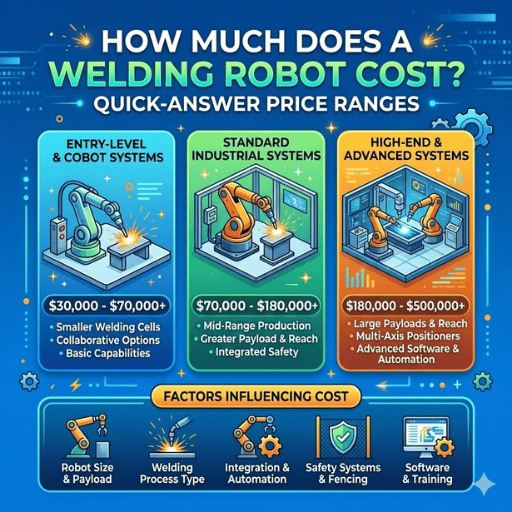
Welding robot prices range from $25,000 to $250,000+ depending on system configuration, process, and how integrated the cell is. Little entry-level collaborative systems start around $25,000 for the robotic arm, while fully integrated cells with safety enclosure, paddle positioners, and programming are in the $100,000 to $250,000 range. Several factors affecting welding robot prices — including the type of welding process, robot payload, and level of cell integration — determine where your project falls in these ranges.
| System Type | Price Range | What’s Included |
|---|---|---|
| Entry-level cobot welder | $25,000 – $70,000 | Robot arm + basic MIG torch + teach pendant |
| Mid-range industrial 6-axis robot | $60,000 – $150,000 | Robotic arm + welding head + controller |
| Full robotic welding cell (turnkey) | $75,000 – $250,000+ | Robot + power source + positioner + enclosure + programming |
| Custom multi-robot system | $250,000 – $500,000+ | Multiple robots + vision systems + material handling + line integration |
According to the IFR World Robotics 2025 Report, worldwide industrial robot installations topped 542,000 units in 2024—more than doubling compared to a decade ago. Welding and soldering applications make up about 21% of global robot deployment, which has led manufacturers to develop lower-cost, more accessible solutions—especially in their collaborative welding arms.
💡 Pro Tip
When evaluating welding robot quotes, always check whether it includes the welding power source. Numerous vendors promote the robot arm price, but the power source alone can add $8,000 to $25,000 above that amount.
Types of Welding Robots and How They Affect Price

The kind of welding robot you select impacts not only the purchase cost but also your overall system costs—including safety walls, space, and programming time. Here’s a comparison of the four main types.
| Robot Type | Arm Price | Payload | Best Welding Process | Best Application |
|---|---|---|---|---|
| 6-Axis Articulated | $50K – $150K+ | 6 – 300 kg | MIG (gas metal arc welding), TIG (gas tungsten arc welding), spot, laser welding | Automotive industry, heavy fabrication |
| Collaborative (Cobot) | $25K – $80K | 3 – 30 kg | MIG welding, TIG, plasma | Small metal fabrication shops, high-mix/low-volume |
| Cartesian welding robot / Gantry | $10K – $50K | Scalable | Spot welding, seam, laser | Large weldments, shipbuilding |
| SCARA | $10K – $40K | 1 – 20 kg | Spot welding (flat only) | Electronics, aerospace, light assembly |
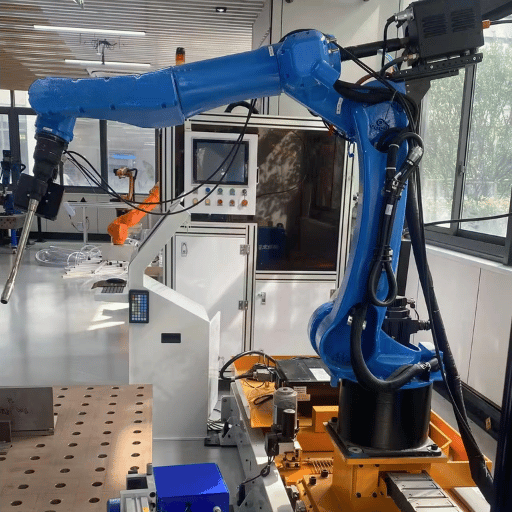
Articulated six-axis robots rule the welding arena. With six different axes, they can manage the complex angles of a welding joint that lower DOF machines cannot. Industry giants—FANUC, Yaskawa, KUKA, and ABB—produce some of the world’s most popular welding arms, each including integrated torch control and walkthrough sensors.
Cobots are unique enough to require special mention—hence a separate treatment of their cost factors. They eliminate the need for fencing infrastructure, switch to lightweight handheld programming systems, and only need a few days’ integration time. The tradeoff is reduced cycle times and decreased largest load carriers, so they’ll do for light-wheel and table-gunning jobs but not the heavier spot welding applications with 50+ kg guns.
SCARA welding robots tend to stay out of most welding applications. Their four-axis design doesn’t allow torches to tilt in a vertical plane, making them good only for horizontal-table spot welding where welding conditions are uniform.
Hidden Costs That Inflate Your Welding Robot Budget

But don’t be misled by the robot arm pricing – that’s a tiny part of your overall expense. Robotiq’s study of robotic welding cell costs shows that 3 to 10 times the robot investment is common in a complete work cell. This is where the rest of your dollars go:
- ✔
Welding power source — $8,000 – $25,000. Robotic-grade units (Lincoln Power Wave, Miller Continuum, Fronius TPS/i) cost more than manual machines. - ✔
Positioner / turntable — $5,000 – $60,000+. A two-station servo positioner lets operators load parts while the robot welds, but a heavy-duty headstock-tailstock unit for long parts can exceed the robot’s own price tag. - ✔
Safety fencing + interlocks — $4,500 – $23,000. Perimeter guards, interlocked gates, light curtains, and other safety equipment are required by OSHA robotics safety standards. Skipping proper guarding risks fines up to $16,000 per violation. - ✔
Wire feeder + welding gun — $2,000 – $6,000. Robotic through-arm MIG torches and push-pull feeders cost more than their manual counterparts. - ✔
Programming + integration labor — $5,000 – $50,000+. Integrating welding robots can represent 30–50% of the total project cost for complex cells. - ✔
Floor prep + fume extraction + electrical — $5,000 – $30,000. Reinforced concrete pads, 480V service upgrades, and source-capture ventilation systems add up quickly. - ✔
Operator training — $2,000 – $10,000 per person. ABB charges $2,700–$3,000 for a standard 4–5 day robotics programming course. - ✔
Shipping + rigging — $5,000 – $15,000. A standard robotic welding cell weighs 3,000–15,000 lbs. - ✔
First-year consumables — $12,000 – $36,000. Welding wire, shielding gas, contact tips, nozzles, and diffusers run $1,000–$3,000 per month. - ✔
Annual maintenance contracts — $2,000 – $12,000/year. Budget for regular maintenance to ensure consistent weld quality; some robotics companies charge an extra fee for firmware updates and TCP recalibration.
⚠️ Important
One thing we often see at Zhouxiang: Customers come in quoting only the welding robot pricing, then have to dig up their capital for the peripherals once the integrator turns in the list. The arm accounts for only 25-40% of the total project spend. Budget for the complete cell from the start.
Total Cost of Welding Automation — A Real-World Budget Example

To give perspective, here’s what a typical mid-priced robotic welding system costs once you add in all components. This example illustrates a single-cell automated MIG welding system with a 6 axis robot, two station positioner, and a typical safety enclosure.
| Cost Category | Amount |
|---|---|
| Robot arm + controller | $65,000 |
| Welding power source + torch + feeder | $22,000 |
| Two-station servo positioner | $18,000 |
| Safety fencing + interlocks + light curtains | $12,000 |
| Integration + programming | $25,000 |
| Floor prep + fume extraction + electrical | $15,000 |
| Training (2 operators) | $6,000 |
| Shipping + rigging | $8,000 |
| First-year consumables | $18,000 |
| Year 1 Total Investment | ~$189,000 |
That $65,000 robotic arm cost turned into a $189,000 Year 1 investment – almost 3x the arm-only cost. Not atypical. CLOOS NA reports pre-engineered robotic welding cells at $130,000-$250,000,; $600,000+ with 2+ robots.
$189K
Year 1 Total (Mid-Range)
$67,800
Manual Welder Annual Cost
3x – 5x
Throughput Multiplier
As comparison, the BLS reports the median annual wage for welders at $51,000 (May 2024). Adding benefits, insurance, and overhead — roughly 33% per BLS employer cost data — fully loaded per-welder cost becomes approximately $67,800. By year 2, a single robotic welding cell doing the work of 3-5 welders is a steal.
ROI and Payback — When Does a Welding Robot Pay for Itself?
Most robotic welding systems have reported pay-back within 12-24 months using multiple data points from the welding industry including Universal Robots and the MANTEC Manufacturing Advisory Council. The return on investment you achieve depends on 3 factors: reduced labor costs, increased throughput, and enhanced quality.
The Payback Math
For example, a sheet metal fabricator replacing four manual welders (overall cost of ~$358,200/year in labor, material, safety, and rework) with one robotic welding cell requiring two operators (~$201,400/year in labor, materials, and maintenance) results in an estimated savings of $156,800 per year. Based on a $225,000 investment, this demonstrates a payback of about 17 months and a 5 year ROI of 248%.
Key ROI Drivers
- Arc-on time: Manual welders typically deliver 10-30% arc-on time. Robots can provide 50-90%, equating to 3-5x more welds per shift.
- Rework: Robotic welding reduces defect rates by 25-75% depending on use case, contributing $8,000-$24,000+ per year in rework and wasted material costs.
- Downtime: Reliable consistent quality reduces scrap parts and unplanned shutdowns. For many companies, unexpected downtime costs can exceed $10,000 per shift.
- Labor shortages: The American Welding Society estimates 82,500 welding jobs will open annually through 2029, with 157,000+ current welders nearing retirement. Automation isn’t replacing workers — it’s filling positions you can’t hire for.
3 hours per day: “Our experience working with manufacturing companies of all sizes shows that the fastest system cost paybacks are experienced by the companies running a 2nd shift. Doubling the robot working time period nearly halving the payback period without increasing the initial capital… ”
— Zhouxiang Engineering Team
When Robotic Welding Does NOT Make Financial Sense
Welding robots aren’t the right solution for every shop. If your welding needs involve very high part mix with no recurring geometries, programming time can surpass welding time—negating productivity benefits. Shops with wildly variable incoming quality suffer, because robotic welds require consistent fit-up tolerances, which upstream processes aren’t likely to provide. And if your annual volume isn’t high enough to occupy the robot for at least a shift, the fixed costs don’t amortize quickly enough to be worthwhile.
Can Small and Mid-Size Shops Afford Robotic Welding?

Five years ago, automated welding barely penciled out. Now, cobot welding has lowered the entry point to less than $60,000 for a basic turnkey system, changing the equation for small fabricators who couldn’t previously justify a six-figure robotic welding cell.
Why do cobots pencil out? Because they remove several sizable cost lines. There’s no safety fencing (force-limited joints handle collision detection). Programming occurs via hand-guiding rather than costly offline simulation software. And deployment takes mere days, instead of 6-12 weeks typical of traditional robotic welding systems. The IFR documented one case study where cobots boosted welding production by 200% for a small manufacturer — with operators who had zero prior robotics experience. Shops exploring robotic welding for the first time often find that cobots offer the shortest path to proving out automated welding systems on their existing welding lines.
For small and medium-sized shops not ready to invest capital, Robots-as-a-Service (RaaS) programs from providers like Formic and Valk Welding have robotic welding cells available for $2,000-$4,000 per month. That transposes a capex into an opex, which can be easier to get approved and trips less risk. Some cobot companies have lease deals where you can rent them for as low as about $5 an hour of operation.
💡 Pro Tip
Start with your most difficult part: the one with the longest manual weld time, highest volume, or poorest quality consistency. Achieve ROI on that single part family, then grow. Trying to automate the entire shop isn’t cost-effective.
How to Cut Welding Robot Costs Without Cutting Corners

It’s not just about lowest purchase price – lowest robotic welder cost per part produced over the system’s 10-15 year life span is. Strategies that actually do the trick.
- Refurbished is the most frugal way to go. Certified used welding robots sell for 40-60% less than new. A refurbished robotic arm with warranty does exactly what a new machine will, and many robotics companies include annual maintenance contracts with their certified units.
- Pre-engineered cells beat custom builds. Standard cells from OEMs like CLOOS and Yaskawa minimize integration time and expense by drawing on proven engineering.
- Phasing one cell at a time can de-risk the process while allowing the savings accumulated to pay for the next one. Automated shop-wide welding takes a year or two; in smaller company models, taking a phased approach is just more intelligent.
- Claim Section 179 and bonus depreciation. Under the 2026 Section 179 rules, businesses can deduct up to $2,560,000 in qualifying equipment purchases. Restored 100% bonus depreciation (through 2029) means a $200,000 robotic welding system creates an immediate $200,000 tax deduction — on the full purchase price, not just the down payment.
- Can negotiate the entire package. Demand that training, fixtures, first-year consumables, and a service contract be included in the sale. Buying those items separately after the installation will always put you out more money.
- Right-sized your gas flow. Up-to-date welding technology allows 35-40 CFH of gas flow to provide a quality level comparable to the 60-65 CFH of today’s older systems—this is an easy, persistent cost savings opportunity that most shops miss.
⚠️ Important
Don’t select an integrator on price alone. The robot itself may not be your largest investment; most of the cost of robotic integration lies in engineering, safety, and process optimization. An ineffective system could cost the end-user much in waste cycles, repairs, and rework—and wipe out any cost savings by going with a cheaper integrator. Our work with OEMs has shown that it costs manufacturers significantly more to fix a bad integration than it would have to buy the entire cell from a competent integrator.
Frequently Asked Questions

Q: How much are robot welders?
View Answer
$25,000 to $250,000+, depending on how much of the system is included. Bare cobot arms start around $25K. Mid-range 6-axis setups with power source and safety run $100K–$200K.
Q: What is the cost of an OTC welding robot?
View Answer
OTC DAIHEN welding robots run $50,000–$120,000 for the robotic arm and controller — lighter arc welding units sit at the lower end, while heavy-payload spot welding models push toward the top. A complete OTC welding cell with their integrated power source, positioner, and safety guarding runs $120,000–$300,000+. OTC is unique in manufacturing both the robot and the welding power source in-house, which can simplify integration and reduce compatibility issues.
Q: Do welding robots require frequent maintenance?
View Answer
With preventative maintenance approximately every 3–6 months costing $2,000-$12,000 per annum, including TCP calibration, lubrication, sensor checks, and cable inspection. Approximately 37 percent of welding robots require annual TCP calibration, so a consistent process for verifying TCP is essential. Additional expenses are servo motor checkups on cells that are used heavily and occasional replacement of torches ($1,500-$3,000), wire liner updates, and periodic advancements within the drive train. Cost that is often overlooked is that of the controller firmware updates as well as software changes—which some OEMs incorporate into service contracts and other charge separately. Cobots in general require less maintenance; FANUC’s CRX cobot line has been rated for 8–10 years of maintenance-free operation of drive motors, and they have fewer wear points than traditional large machines.
Q: How long does it take for a welding robot to pay for itself?
View Answer
12-24 months for most cells. Operations running two shifts will break even in less than a year. A $225,000 cell with a cost savings of $156,800 annually breaks even in approximately 17 months.
Q: Can small businesses afford welding robots?
View Answer
Yes. Cobot welding systems now start under $60,000 for a basic turnkey setup, putting robotic welding within reach of small fabrication shops. Robots-as-a-Service (RaaS) programs eliminate the capital barrier entirely, offering monthly plans from $2,000–$4,000. The 2026 Section 179 deduction (up to $2,560,000) and 100% bonus depreciation further reduce the effective after-tax cost. Many small shops start with a single cobot on their highest-volume part, prove ROI, and expand from there.
Q: Does the welding robot cost include the welding power source?
View Answer
Usually not. Most advertised welding robot prices cover the robotic arm and controller only. The welding power source is a separate purchase costing $8,000–$25,000 depending on the process (MIG, TIG, or multi-process). Some OEMs like OTC DAIHEN offer bundled robot-plus-power-source packages, and pre-engineered cell quotes from integrators typically include the power source. Always confirm exactly what’s included before comparing quotes.
Ready to Get an Accurate Welding Robot Quote?
Zhouxiang develops industrial robotic welding applications for fabricators around the Globe. Describe your welding process to us and we will give you a detailed cost breakdown with no arm-only pricing games.
Or explore our full range of welding robot solutions.
References & Sources
- World Robotics 2025 Report — International Federation of Robotics (IFR)
- Occupational Outlook: Welders, Cutters, Solderers, and Brazers — U.S. Bureau of Labor Statistics
- Employer Costs for Employee Compensation — U.S. Bureau of Labor Statistics
- Where Are the Welders? (October 2025) — American Welding Society (AWS)
- Robotics Safety Standards — U.S. Occupational Safety and Health Administration (OSHA)
- Robotic Welding Cell Cost in 2025 — CLOOS North America
- What is the Cost of a Robotic Welding Cell? — Robotiq
- Calculating ROI and Payback Period for Your Robotic Investment — Universal Robots
- Robotics on the Line: ROI Calculator — MANTEC Manufacturing Advisory Council
- Cobots Boost Production 200% on Welding — International Federation of Robotics (IFR)
- Section 179 Deduction Limits (2026) — Section179.org