Get in Touch with Zhouxiang


How to Choose and Design a Custom Robotic Welding Workstation for Your Shop
The world’s welding industry is in the midst of a structural crisis. Per the American Welding Society (AWS), the United States will encounter a 400,000 welders shortage by 2025, with nearly 30% of the current welding workforce retired by that time (AWS, 2013). For manufacturers running a steel fabrication shop, shipyard, or heavy equipment assembly line, that shortage translates directly to missed delivery deadlines, increased labor costs, and inconsistent weld quality.
Such a custom robotic welding workstation provides solutions to all three issues. But unlike a standard off-the-shelf robotic welding cell, a custom-designed system is engineered around a precise part geometry, production volume, and welding process requirement. In the following, we will explore what factors go into a custom robotic welding system, how to design one toward your installation, what costs end up looking like, and when a collaborative robot may be a more suitable alternative than a traditional industrial form.
What Is a Custom Robotic Welding Workstation?
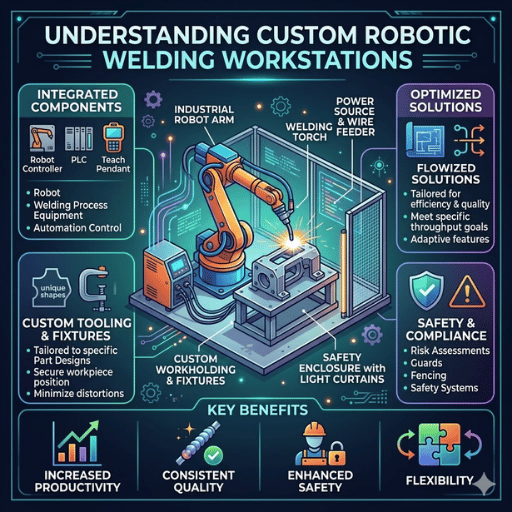
A custom robotic welding workstation is a purpose-designed automated welding cell engineered around a specific manufacturer’s parts, production goals, and space limitations. Where a standard pre-engineered cell ships pre-designed layouts, a customized system starts from your weld joint map and works in reverse to specify the robot arm, positioner, fixturing, safety enclosure, and control architecture.
No two fabrication houses run identical workflows, and that variation makes a difference. A facility welding 12-meter H-beams for structural steel fabrication has different requirements than one running short-batch automotive brackets. Custom robotic welding systems account for part dimension variance, weld path complexity, operator access preferences, and interfacing with upstream/downstream equipment.
542,000
Industrial robots installed globally in 2024
4.66M
Operational robot stock worldwide
+6%
Projected growth in 2025
Source: IFR World Robotics Report 2025
The International Federation of Robotics (IFR) reports that the number of global industrial robot installations exceeded 542,000 units in 2024 – more than doubled the count over a 10-year span. welding automation is credited with a large chunk of this expansion, fueled by the insatiable welder labor shortage and the need for consistent weld output at higher speeds. Metal fabrication and shipbuilding manufacturers have begun turning to customized robotic welding solutions as a way to fill the order-inventory gap that the reduced labor pool is creating.
Core Components Inside a Robotic Welding Cell
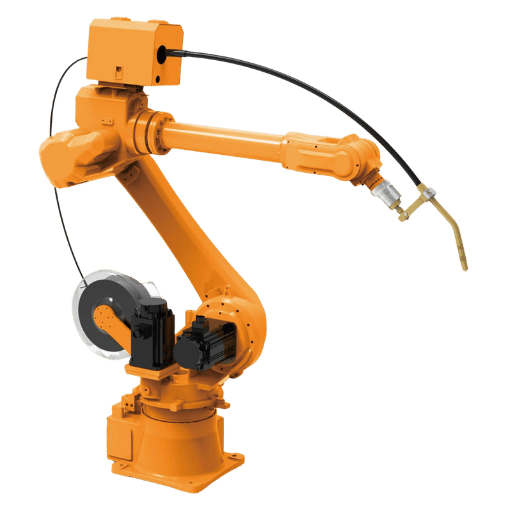
All robotic welding cells—whether standard or custom—share the same fundamental subsystems. Developing an understanding of these building blocks is necessary to articulate a system that suits your welding applications and respective throughput targets.
| Component | Function | Key Specs to Evaluate |
|---|---|---|
| Robot Arm | Executes the programmed weld path across joints | Payload (6–20 kg), reach (1400–2010 mm), 6-axis articulation, ±0.05 mm repeatability |
| Welding Power Source | Supplies controlled current/voltage for the arc welding process | MIG, TIG, or multi-process; synergic controls; pulse capability |
| Positioner / Rotary Table | Rotates and tilts workpieces to maintain flat or downhand welding position | Load capacity (500–10,000 kg), rotation axis count, tilt range |
| Fixturing & Clamping | Secures parts in repeatable positions for each weld cycle | Pneumatic/hydraulic clamps, modular vs. dedicated, changeover time |
| Seam Tracking System | Detects joint position in real time and adjusts the weld path | Laser vision, touch sensing, or arc voltage tracking; arc light resistance |
| Safety Enclosure | Protects operators from arc flash, fumes, and robot motion | Light curtains, interlocked gates, fume extraction, ventilation |
| Controller & Software | Manages robot motion, weld parameters, and I/O signals | Teach pendant, offline programming (Tekla/SolidWorks import), data logging |
| Torch Cleaning Station | Removes spatter buildup and recalibrates TCP between cycles | Automatic slag removal, wire cutting, anti-spatter spray |
Specifically, each of the subsystems can be chosen, configured, and sized using your part data within a custom system arrangement. For instance, a single station robotic welding workstation welding application for carbon steel brackets could specify a 12kg payload robot paired with a single axis headstock positioner. Conversely, a multi station cell dedicated to structural steel H-beam welding could call for a ground rail, dual positioners with 5,000+ kg capacity, and laser seam tracking to manage part to part dimensional differences.
💡 Pro Tip
The welding power source can add $8,000 to $25,000 above the robot arm cost—depending on if you produce with a MIG welding system, TIG, or multi-process system. Define the welding process first, as it dictates torch, wire feed, gas, and power source options.
Custom vs. Standard Robotic Welding Workstations
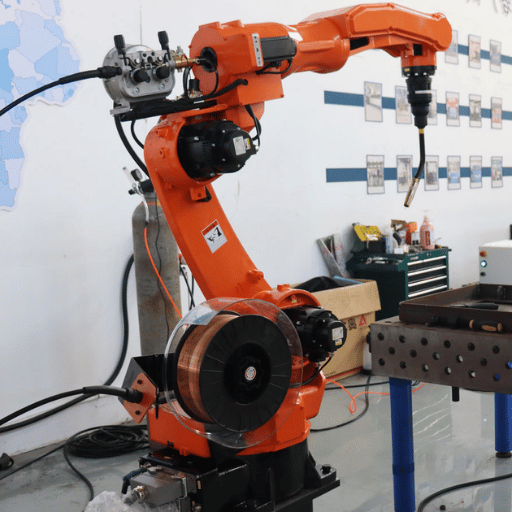
Most shop floor need not require a fully custom- designed cell. Pre-engineered (standard) automated welding systems—sometimes referred to as turnkey robotic welding solutions— ship with preconfigured robot, positioner, enclosure, and power source modules. They are effective for many welding work on parts in the typical size and weight ranges.
Should your production needs be only slightly different than off-the-shelf welding solutions cover, your choice is easier.
| Factor | Standard / Turnkey Cell | Custom Robotic Welding System |
|---|---|---|
| Part Size Range | Fixed envelope (under 1m) | Engineered to your largest workpiece (up to 12m+ with ground rail) |
| Weld Path Complexity | Simple linear/circular joints | Complex 3D geometry, multi-pass welds, adaptive seam tracking |
| Production Volume | Medium–high volume, single part family | Low–high volume, mixed part families with quick changeover |
| Lead Time | 4–8 weeks | 12–20 weeks (engineering + fabrication + testing) |
| Upfront Cost | $50,000–$150,000 | $100,000–$500,000+ |
| Integration Risk | Low (proven configuration) | Managed (requires engineering validation and simulation) |
| Scalability | Limited — adding stations means buying more cells | Modular — designed for future expansion (additional robots, positioners) |
⚠️ Common Mistake
Purchasing a standard cell for components 10% past its work envelope can result in inefficient repositioning between weld passes, reposition errors and doubled cycle times. If your components are near the limits of a standard configuration, the custom path usually provides a lower cumulative ownership cost over 5 years.
If the shop operates multiple part families so that today shall all run structural columns and next month and all pressure vessels. then the flexibility and scalability of an order. custom robotic system will pay off itself by saving the rework and downtime associated forcing abnormal parts through a standard cell.
How to Design a Robotic Welding Workstation for Your Production Line

Creating a robotic welding cell is an engineering task, not a catalog buy. From your parts to a verified system, and on to production. This is the workflow our engineering team works through each custom welding automation project.
- Weld joint audit, Collect 3D models or drawings of all target parts. Map each and every weld joint: type, size, position and access angle. The joint map calculate robot reach, torch orientation & positioner requirement.
- Match each joint to the right arc welding process. MIG (GMAW) handles high-deposition structural welds. TIG (GTAW) provides the finesse to cleanly connect thin gauge stainless and aluminum.Submerged arc provides everything on long, longitudinal seams of 3/8″-1-1/2″ heavy plate. welding process specifies power source, wire feed, shielding gas, fume extraction specs.
- Cell Layout & Simulation – Create a 3D digital copy of the cell in offline programming software (tools, Tekla, SolidWorks). Run a simulation of all weld paths to ensure reach, collision and singularity zones are not hit by the robot work envelope. This gives us a final chance to find setup errors before steel is cut.
- Design the method of part loading, clamping,rotation through weld stations and part unloading. Dual station layout (while one side is welding, operator loads the other side) give maximum arc-on time and minimize idle cycles.
- Safety & Compliance–Check your design complies with ISO 10218-1:2025 (robot safety) and facility level requirements per OSHA robotics guidelines—cover safety (light curtains, interlocked gates), emergency stop circuits, risk assessment records, operator training plans, etc…
All outputs (joint maps, process data sheets, simulation reports, safety assessments, etc.) flows into the build specification. The number one contributor to rework during installation is the absence of a simulation step. Shops that perform 2-3 weeks of early engineering eliminate costly 2-3 month delays in production due to reach or fixture conflicts discovered once the cell is in-house.
💡 Pro Tip
Request your factory acceptance test (FAT) before shipment; your welds integrator can actually sample the exact parts you will be receiving into the finished cell to preview cycle time, welds quality, and operator ergonomics prior to factory delivery. Proper FATs can cut as much as 40-60% off your equipment on-site commissioning time!
Robotic Welding Cell Cost: Investment and ROI Breakdown

Cost of a custom robotic welding range widely with robot complexity, but real shop data points, if not exact quotes, provide workable budgets. Here is where the investment is: by system type:
| Configuration | Typical Price Range | Best For |
|---|---|---|
| Single-robot cell, basic positioner | $75,000–$150,000 | Small parts, medium volume, single weld process |
| Single-robot cell, dual-station positioner | $150,000–$250,000 | Mixed parts, high-volume production with load/weld overlap |
| Multi-robot cell with ground rail | $250,000–$500,000+ | Large structural parts (H-beams, box columns), high-deposition welding |
| Cobot welding cell | $30,000–$80,000 | Low volume, high mix, space-constrained shops |
Beyond the initial capital outlay, however, plan on yearly maintenance costs of $2,000–$5,000 (consumables, torch upgrades, software updates) and changes in the final seam tracking system calibration.
12–24 mo
Typical payback period
Up to 90%
Weld defect reduction vs. manual
$156,800/yr
Estimated annual labor savings (4-welder replacement scenario)
Hidden Costs Most Buyers Miss
A typical conversation around a new robotic welding cell can quickly become focused solely on the hardware itself; several line-item costs, however, often trip up new customers:
- ✔
Floor preparation — Robot bases require level, vibration-dampened foundations. Retrofitting an existing shop floor can run $5,000–$15,000. - ✔
Operator training — Budget 40–80 hours of training per operator for teach pendant operation, basic troubleshooting, and torch maintenance. - ✔
Fixture tooling-will each new part family require a dedicated fixture set ($3,000-$20,000 per set depending on complexity). - ✔
Ventilation upgrades-fume extraction in enclosed robotic welding cells can add $10,000-$30,000 depending on cell volume and local code: ventilation requirements.
Even with those costs factored in, however, the ROI is compelling; the AWS reports that the average fully loaded costs of a manual welder exceeds $57,000 per year. One robotic welding system operating two shifts adds the output of 2-4 manual welders with far greater welds quality, far less rework, far less consumables waste, and every shift has a predictable productivity.
Cobot Welding Cells vs. Industrial Robotic Workstations
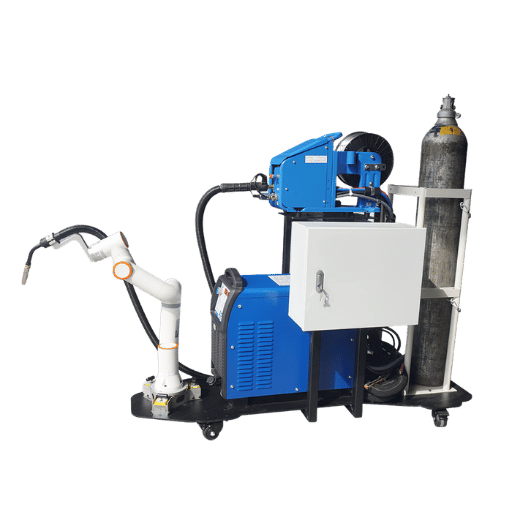
Recently much attention has been paid to the new collaborative welding robots (cobots) in the robotics industry, especially if smaller shops are new to welding automation and should consider the welding cobot. But deciding between a cobot welding cell and full industrial robotic welding cell should hinge on much more than price.
| Dimension | Cobot Welding Cell | Industrial Robotic Welding Workstation |
|---|---|---|
| Payload | 5–16 kg | 6–25+ kg |
| Speed | Limited (safety-rated reduced speed) | Full production speed |
| Safety Infrastructure | Minimal — built-in force limiting per ISO 10218 / TS 15066 | Full enclosure, light curtains, interlocked gates |
| Programming | Hand-guided teaching, app-based | Teach pendant + offline programming |
| Best Volume Fit | Low volume, high mix (short runs, prototyping) | Medium–high volume (dedicated production lines) |
| Typical Cost | $30,000–$80,000 | $75,000–$500,000+ |
| Deployment Time | Days to weeks | Weeks to months |
⚠️ When a Cobot Is Not the Right Choice
While cobots operate at lower speeds and payloads, they also have a lower barrier to entry; therefore, they’re likely your best fit for high-variety, low-volume welding in the shop, while your high-volume machines receive the highest throughput from the full industrial robot-welder. Far longer cycle times (3-5x longer), however, can result by trying to fit cobots to a high-speed welding process.
A high-mix, high-volume shop, therefore, may find a hybrid approach: cobot welding cells for prototyping and low-volume parts, alongside dedicated robotic welding system high-speed welding cells. Making deliberate choices on where to automate leaves you flexibility and efficiency.
Frequently Asked Questions
What safety features should a robotic welding workstation include?
View Answer
All robotic welding robot including cobots must be physically guarded with interlocked access gates, Emergency Stop buttons at all operator positions, arc flash protection systems, and fume extraction. For the ISO 10218-2, a documented risk assessment is also required. When cobots are brought in, full enclosure guarding is replaced with limiting force and speed per ISO/TS 15066 guidelines.
How much does a custom robotic welding cell cost?
View Answer
Custom robotic welding cells: from $75,000 for a single-robot workstation with basic positioner to over $500,000 for multi-robot systems with ground rails, multiple robots, and high-end seam tracking. Your final price will vary based upon robot payload, reach, welding process system capability, number of welds and positions, integration capacity, and existing equipment in your facility. Most operators see payback on most full systems between 12-24 months:
Can a custom welding workstation handle heavy-duty welding tasks?
View Answer
Yes. Custom robotic welding workstations are the answer. This includes any complex welding operation that cells cannot perform efficiently. Examples include multi-pass welds on thick plate (25 mm+), large structural components such as H-beams and box columns up to 12 m long, and precise welding on materials that require stringent heat input control (stainless steel, aluminum). Basic ground rail systems maximize the robots reach for very large parts, while heavy-duty positioners (up to 10,000 kg capacity) can handle very large weldments beyond standard cell capabilities.
Is a custom robotic welding workstation worth the investment?
View Answer
For operations most manufacturers conduct over 4 hours of welding daily, yes. The business case depends on three values: reduction in labor costs (supplement or replacement of 2-4 manual welders per shift), enhancement of quality (as much as 90% fewer weld defects), and increased capacity (robots do not experience increased arc-on times with shift or operator fatigue). A $150,000 custom cell for two work shifts might be fully cost-effective after only 12-18 months as robots run consistently for 800+ hours per year.
How long does it take to design and install a custom robotic welding cell?
View Answer
Typical timeline from first consultation to operation is 12-20 weeks. This includes 3-4 weeks of engineering & simulation, 6-10 weeks of manufacturing and assembly, 1-2 weeks of factory acceptance testing (FAT), 1-3 weeks of on-site installation, commissioning, and training. Smaller, single-robot cells can move even faster (8-10 weeks), while a complex multi-robot with custom positioners may take 20+ weeks.
What is the difference between a robotic welding cell and a robotic welding workstation?
View Answer
These terms are broadly interchangeable in the industry. Both describe an integrated automated welding system that combines a robot arm, welding power source, positioner or fixture, safety guarding, and control system. Some companies refer to a fully closed cell as a “system” and an open “workstation” with cobots or manually manipulators, but no standard nomenclature exists. Focus on system specifications for comparisons between suppliers.
Ready to Design Your Custom Robotic Welding Workstation?
Our engineering team has successfully completed more than 1,000 welding automation projects in 50+ countries since 1991. Share details of your parts, and we can propose a cell layout plan within 48 hours.
About This Analysis
This document is published by Zhouxiang, a proven welding automation manufacturer with 30+ years of experience in designing custom robotic welding workstations and automated production facilities for structural steel, shipbuilding, and heavy equipment builders. Our cost data and design philosophy are based on direct experience with 1,000+ projects. We produce our own robot arms, positioners, and control panels—allowing us to minimize system costs by always recommending entirely integrated solutions. Wherever possible, we cite third-party sources (IFR, AWS, ISO).
References & Sources
- Welding Workforce Data — American Welding Society (AWS)
- World Robotics Report 2025 — International Federation of Robotics (IFR)
- Where Are the Welders? — Welding Digest October 2025 — American Welding Society (AWS)
- ISO 10218-1:2025 Robotics — Safety Requirements — International Organization for Standardization
- Robotics — Standards — Occupational Safety and Health Administration (OSHA)
- ISO 10218-1:2025 Robots And Robotic Devices Safety — American National Standards Institute (ANSI)