Get in Touch with Zhouxiang

Robotic Welding Cell Cost: What You Will Actually Pay in 2026
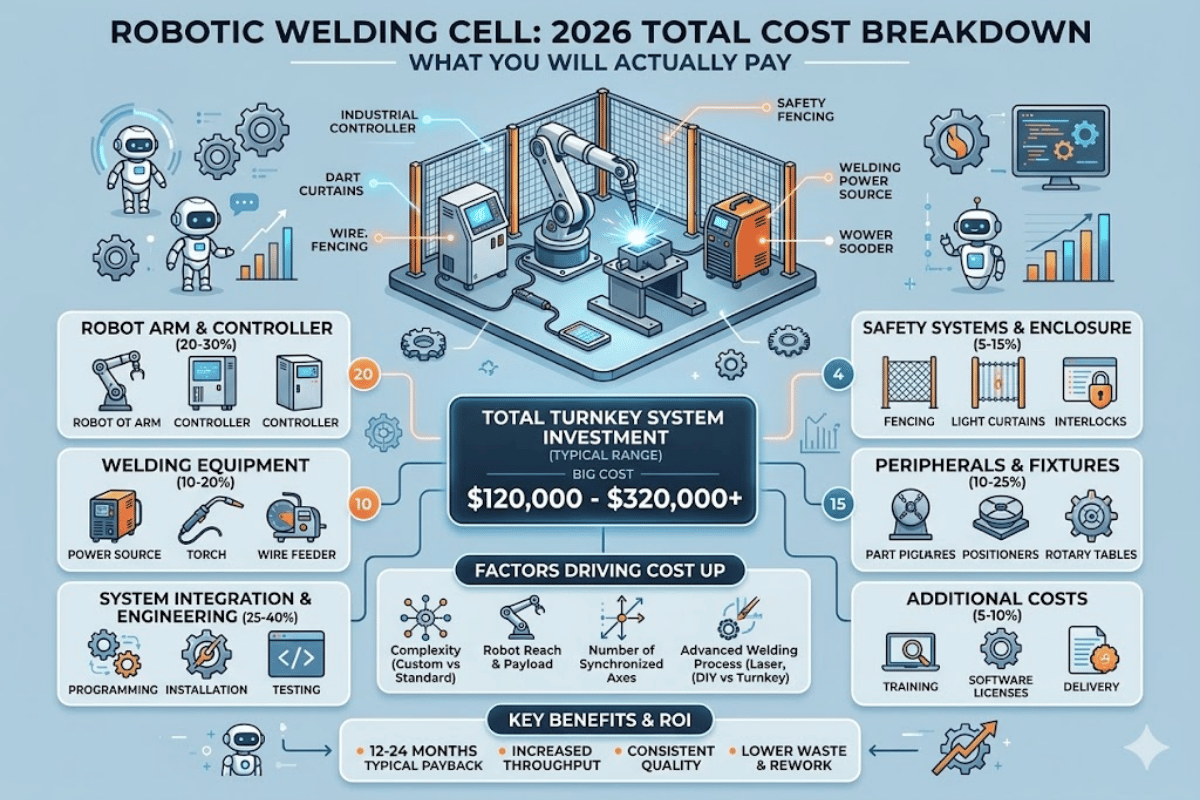
Robotic welding cells can cost anywhere from $50,000 for a basic cobot setup all the way up to over $600,000 for a fully custom multi-robot system. That range is wide enough to be useless without context — so this guide breaks down exactly where the money goes, what drives the price tag up or down, and how to calculate whether the investment pays for itself.
The welding industry is in a bind. The American Welding Society (AWS) projects a 400,000-welder shortage in the U.S. by the end of this decade, with roughly 82,500 welding positions opening each year through 2029. Meanwhile, the International Federation of Robotics (IFR) 2025 World Robotics Report shows 542,000 industrial robots were installed globally in 2024 — double the number from a decade ago. Welding and soldering account for 21% of those deployments. That labor math is pushing more fabrication shops toward automation, and the first question is always the same: how much will it cost?
How Much Does a Robotic Welding Cell Cost in 2026?
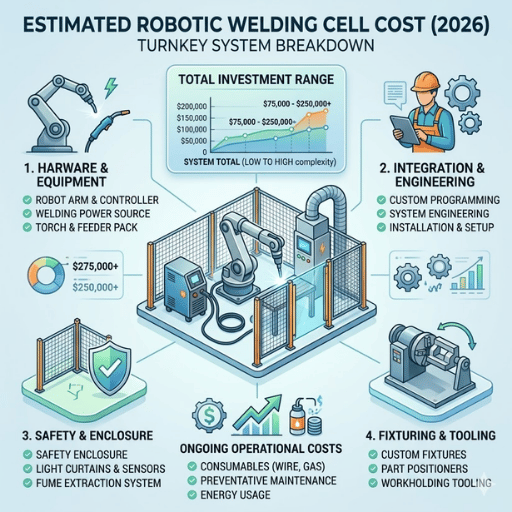
Short answer: most shops spend between $100,000 and $250,000 on their first robotic welding cell. But the real number depends on whether you are buying a plug-and-play pre-engineered cell, a cobot-based system, or a ground-up custom build. Here is how the market breaks down right now.
| System Type | Price Range (USD) | Typical Use Case |
|---|---|---|
| Cobot welding cell | $50,000 – $105,000 | High-mix / low-volume shops, short runs, labor gap filler |
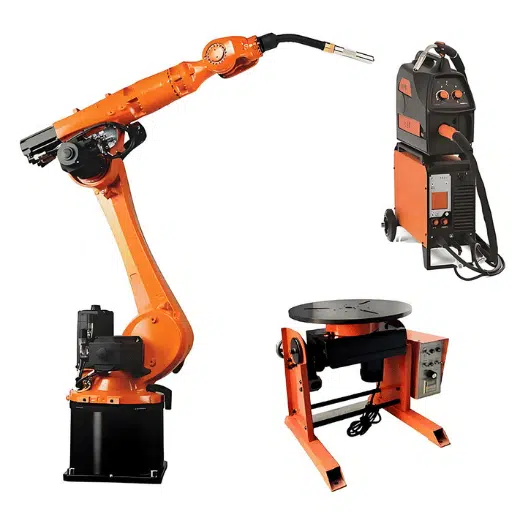
| Pre-engineered single-robot welding workstation | $130,000 – $250,000 | MIG/MAG production welding, dedicated part families |
| Custom single-robot cell | $250,000 – $400,000 | Complex geometry, multi-pass welds, unique fixturing needs |
| Multi-robot welding system | $600,000 – $1,200,000+ | High-volume production lines, automotive-grade throughput |
One number that catches first-time buyers off guard: the robot arm itself accounts for only 25-40% of the total robotic welding cell cost. Your 6-axis welding robot might list at $60,000-$80,000, but by the time you add the welding power source, positioner, safety enclosure, fixtures, and integration, the real year-one investment can land at $150,000-$200,000. Everything around the robot often costs more than the robot itself.
542,000
Industrial robots installed globally in 2024 (IFR)
21%
Used in welding and soldering applications
25–40%
Share of total cell cost that goes to the robot arm alone
💡 Pro Tip
When comparing quotes, always ask whether the number includes the welding power source, torch package, safety fencing, and first set of fixtures. A “$75,000 robot” quote that excludes these items will balloon past $150,000 once the cell is actually running.
What Drives the Price of a Robotic Welding System?
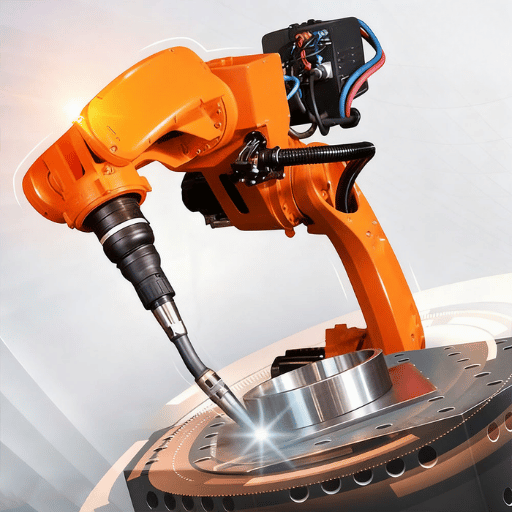
Knowing the range is not enough – you need to know which choices push the welding robot cost toward the low end or the high end. Five factors account for most of the variation.
Five Factors That Move the Price
- Part complexity and geometry – Simple flat welds on mild steel need minimal fixturing. Complex 3D assemblies with tight tolerances require custom jigs and multi-axis positioners that can add $10,000-$40,000 to the build.
- Welding process type — MIG welding cells sit at the lower end. TIG, laser, and multi-process systems cost more because of the power source and torch requirements. A dedicated MIG power source runs $8,000-$15,000; a TIG or multi-process unit can reach $20,000-$25,000.
- Your positioner choice counts — a fixed table is the lowest cost. A two-station headstock-tailstock positioner lets an operator load one part while the robot welds another for maximum throughput, at a cost of $15,000–$35,000. Larger parts demand Ferris wheel or sky-hook positioners.
- The scope of integration also influences cost — a standalone cell is simpler. Getting the weld cell integrated into a complete production line with conveyor, material handling, and upstream/downstream automation doubles engineering hours and equipment costs.
- Adding sensor and vision systems boosts accuracy — seam tracking (laser or touch), arc monitoring, and vision-guided part location all add precision at $5,000–$20,000 per tool. Shops welding parts with high dimensional variation often require these to uphold weld quality without frequent reprogramming.
We have seen positioner selection alone add $25,000 or more to a package quote. Fabrication shops welding one part family on two shifts find a dual-station positioner pays itself off in several months due to the increased throughput. Job shops welding 15 parts a week will probably do better with a simple fixed table cell and rapid changeover fixtures.
💡 Key Takeaway
Your robot arm is almost never the biggest expense driver. Fixturing, positioners, and application engineering combined determine whether you land at $120,000 or $300,000 in your final tally.
Pre-Engineered Weld Cells vs. Custom Robotic Welding Systems

This is the first crossroad for most. Pre-assembled weld cells are sold as complete units — robot, power source, positioner, cabinet, and controls are factory tested as a package. Custom systems will be engineered to fit your parts, volumes and facilities. Here’s how they compare in the most common buy factors.
| Factor | Pre-Engineered Cell | Custom System |
|---|---|---|
| Price range | $130,000 – $250,000 | $250,000 – $600,000+ |
| Lead time | 8 – 12 weeks | 16 – 26 weeks |
| Engineering risk | Low — proven design, factory-tested | Medium — first-article validation needed |
| Flexibility | Moderate — fits standard part envelopes | High — built around your exact weld joints |
| Best for | First-time buyers, standard weld cells | Complex assemblies, high-volume lines |
| Scalability | Add second identical cell easily | Designed for future growth from day one |
Pre-assembled robotic welding cell packages make the most sense if the parts stay within the standard work envelope of the cell and medium volumes are required. Shorter delivery time and lower engineering risk lower the entry barrier. Custom solution justifies the premium if part geometry demands custom fixturing, or the cell flows into an existing line or the volumes justify the engineering price tag.
⚠️ Important
Pre-assembled cells that do not serve your parts well can set you back more than a custom solution over time. Rework, manual touch-up welding and reprogramming will erode savings. Have sample parts run through the cell prior to purchase.
Hidden Costs Most Buyers Overlook

A sticker price on a robotic weld cell quote is almost never the actual bottom line. First-time buyers routinely overshoot by 15–25% because these extras are not included on the initial quote or are often lumped under ‘engineering.’
- ✔
Fixturing and tooling — $5,000–$40,000+. Every part family needs its own fixture. Shops with 5–10 part numbers may need multiple fixture sets, and each set involves design, machining, and prove-out time.
- ✔
Safety enclosure and interlocks — $8,000–$25,000. Light curtains, safety fencing, door interlocks, and area scanners are required by OSHA general duty clause and ANSI/RIA R15.06 standards. Skipping this is not an option.
- ✔
Floor preparation and utilities run $3,000–$8,000. Your cell needs a level concrete pad rated for the combined weight, dedicated electrical service (typically 480V/3-phase), compressed air, and shielding gas supply lines.
- ✔
Shipping and rigging add $5,000–$15,000. Pre-engineered weld cells can weigh several tons, and freight, crane rental, and precise placement on the shop floor are real costs — especially if your facility has narrow door openings or a second-floor location.
- ✔
Training — $3,000–$10,000+. Operators need to learn part loading, program selection, and basic troubleshooting. Programmers need teach pendant training. Budget 3–5 days of on-site instruction.
- ✔
Wire feeder and torch consumables in Year 1 cost $12,000–$36,000. Welding wire, shielding gas, contact tips, nozzles, and diffusers run $1,000–$3,000 per month depending on volume and welding process.
- ✔
Annual service contracts run $2,000–$12,000/year, covering preventive maintenance, firmware updates, TCP recalibration, and emergency support. Some OEMs charge separately for software licensing.
Add these up and a $150,000 cell quote can become a $190,000–$220,000 first-year investment. Planning ahead avoids budget surprises that derail a project half way through installation.
Cobot Welding Cells: A Lower-Cost Entry Point
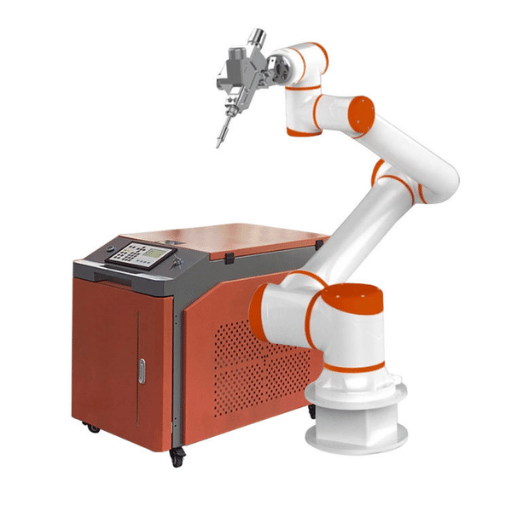
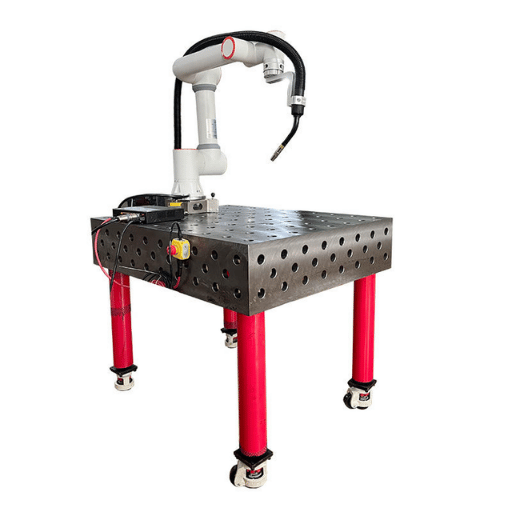
Collaborative robots — cobots — have created a unique sub-category of welding automation. Shops welding standard-size parts find a typical cobot welding cell at $50,000–$105,000 fully equipped is the lowest-cost method of automating a current manual welding process.
What really sets cobots apart is the speed of deployment. Most cobot cells can be unpacked, installed, and running first welds within days rather than the weeks or months a traditional automated welding cell demands. Programming can be as simple as hand-guiding the robot arm through the weld path, or using tablet PC-based interfaces — you don’t even need teach pendant know-how. For a job shop handling 15-20 distinct parts a week, this turnkey availability can be a huge benefit.
But cobots are not an all-in-one solution. Their constraints are significant and should be understood prior to purchase.
| Specification | Cobot Welding Cell | Industrial Welding Robot |
|---|---|---|
| Payload capacity | Up to 25 kg | Up to 200+ kg |
| Repositioning speed | ~1,000 mm/s (safety-limited) | 2,000+ mm/s |
| Cycle time advantage | Baseline | 25–30% faster on high-volume parts |
| Setup time per new part | Minutes (hand-guided programming) | Hours (teach pendant programming) |
| Safety enclosure required? | Often not (risk assessment dependent) | Yes — full fencing + interlocks |
During the actual weld, both robot types move at about the same speed (20-40″/min for MIG) because the welding process is limited by the speed of the weld, not the motors. Where it makes a difference is between welds. An industrial robot repositions at over twice the speed of a cobot, and on a bracket with 20 short stitch welds, that repositioning advantage can translate into 25-30% greater throughput per shift.
💡 Pro Tip
Choose a cobot when your key bottleneck is labor constraints and your parts are high-mix, low-volume. Choose an industrial robot when your key bottleneck is cycle time and your parts are dedicated family.
ROI and Payback Period for Robotic Weld Cells
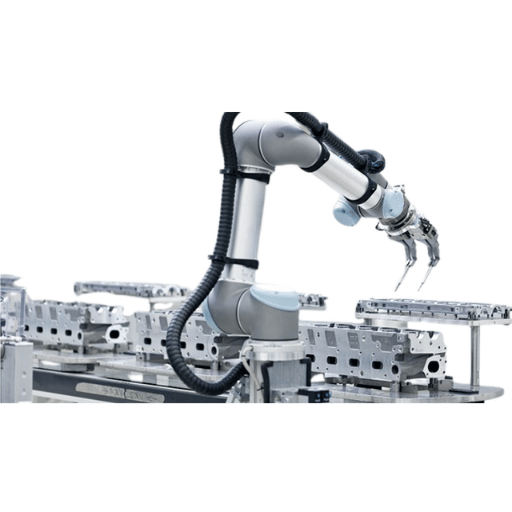
Payback on a robotic welding cell usually takes place between 18-36 months. Shops running two shifts with high utilization commonly realize payback within 18 months. Single shift operations with moderate volume tend to happen closer to 30-36 months.
Three factors drive the return simultaneously.
| ROI Driver | Manual Welding | Robotic Welding | Impact |
|---|---|---|---|
| Arc-on time | 10–30% | 50–90% | 3–5x more welds per shift |
| Defect rate | Baseline | 25–75% fewer defects | $8,000–$24,000/yr saved in rework |
| Labor dependency | 1 welder per station | 1 operator runs 1–3 cells | Reduced exposure to labor shortage |
Labor savings alone are significant. The AWS reports the average age of U.S. welders at 55, and for every five experienced welders retiring, only two new welders enter the trade. When you add in the annual wage increases, overtime premiums, and the cost of empty positions, robotics becomes less of a capital expense question and more of a business continuity decision.
Section 179 and Bonus Depreciation in 2026
Thanks to the One Big Beautiful Bill Act (OBBBA), Congress increased the Section 179 deduction cap to $2,560,000 for 2026 and reinstated 100% bonus depreciation. That means a $200,000 robotic welding system can be deducted outright in its entirety in the year it is placed into service – not over 5-7 years of depreciation. For a company in the 21% federal tax category, that’s $42,000 in first-year tax savings on a $200,000 system.
At Zhouxiang’s single-robot welding workstation price points, this deduction can offset a sizable part of the upfront cost and reduce the actual payback by a few months.
18–36 mo
Typical payback period
3–5x
Increase in welds per shift vs. manual
$2.56M
Section 179 deduction limit (2026)
How to Budget for Your First Robotic Welding Cell
If you’re a job shop or mid-sized fabricator considering automation for the first time, this five-step method will help keep your dollar budget on track.
- Pinpoint your highest-volume weld bottleneck. Your first robotic cell should be designed around the work center that has the most repeatable parts and the greatest throughput difference, not necessarily the most challenging weld in the shop.
- Find three quotes and examine the total cost, not just the sticker price. Request an itemized quote from each supplier: robot arm, power supply, positioner, fixtures, enclosure, implementation and training. Sometimes the lowest headline number isn’t the lowest total.
- Figure 20% on top of your quoted system cost to cover hidden costs. You will need to factor in floor prep, utilities, spare parts kits, and first-year consumable costs. The checklist in the previous section accounts for the majority of expected scenarios.
- Use your own operators and production data to model the payback. Enter your current welder operating cost per hour, shift utilization, rework rate, and average weld count per part. Calculators based on generic ROI assumptions will not give you accurate results by not accounting for the realities in your shop.
- Start with a turnkey single-station cell built for high-mix production, then expand. A gradual implementation plan – install a single cell now, then add a second cell after 12-18 months once the first cell is optimized – minimizes risk and allows the savings from the initial investment to finance the expansion.
For a high-mix low-volume environment do not invest in overdone equipment. A well-equipped high-mix cell, with quick-change fixturing and in-house programming capabilities, will be more practical and productive than a complex turnkey system that remains idle until the next run.
Frequently Asked Questions
Q: How much does a robotic welding cell cost for a small job shop?
View Answer
A cobot cell ($50,000-$105,000) is commonly implemented in small job shops for high-mix work, or when a pre-engineered single-station cell ($130,000-$250,000) is preferred where specific part families dominate weld volume.
Q: Is a robotic welding cell cost-effective for low-volume production?
View Answer
Automation is highly dependent on the part mix. A robotic cell, executing 8 hours per day at consistent 50% utilization, will outperform a manual welder at 20% arc-on time. The break-even point for most cells occurs at 40-60% utilization. If overall weld volume across part numbers keeps the robot busy at that rate, then automation delivers a positive ROI even at a low per-part volume. cobot cells equipped with fast programming capabilities can even lower this break-even rate.
Q: What is the typical ROI payback period for a robotic welding cell?
View Answer
Most firms realize their payback within 18 to 36 months. Single or two-shift operations that operate at high utilization can even realize their ROI in less than 18 months. Take into consideration labor savings, throughput improvement, quality enhancements (reduced rejects and rework), and benefits like Section 179 deductions. For a concrete example, let’s suppose a $200,000 cell replaces two welders each costing $60,000/year, generating $120,000 in annual labor savings. Add $18,000 in rework savings and a $42,000 first-year Section 179 tax benefit (at 21% federal rate), then effective ROI drops to approximately 14 months – before throughput increases due to more arc-on time are factored in.
Q: How much does a cobot welding cell cost compared to an industrial system?
View Answer
Cobot welding cells range from $50,000-$105,000; industrial robotic welding cells are available starting at $130,000 and running to $600,000+ for custom builds. The price difference accounts for differences in payload capacity (cobots max around 25 kg), time between welds (cobots run at about half the speed of industrial robots between welds), and the safety enclosure necessary for industrial systems. Cobots reduce throughput in exchange for quicker setup times and less start-up capital.
Q: Can I finance a robotic welding cell instead of paying upfront?
View Answer
Absolutely. Equipment leasing and financing options are available on most robotics equipment transactions. Terms are common between 36-72 months with interest rates that vary by credit profile. Section 179 (up to $2,560,000 in 2026) and 100% bonus depreciation apply to financed equipment purchase – the full purchase price can be deducted in Year 1. This combination allows for positive cashflow from the cell even before the loan is paid off.
Q: What ongoing maintenance costs should I budget for a welding robot?
View Answer
Budget $2,000-$12,000/year for service agreements and $1,000-$3,000/month for consumables (wire, gas, tips, nozzles). All in, expect $17,000–$48,000/year in ongoing expenses.
Need a Price Quote for Your Robotic Welding Cell?
Zhouxiang, with over 200 patents and product installs in more than 50 countries, has been building welding automation systems for over 30 years. Give us your parts, volumes, and requirements — we’ll suggest the right cell configuration.
About This Cost Guide
Zhouxiang is a welding robot producer in Wuxi, China, we’ve been doing this for a long time, we make and sell the robotic welding cells referenced herein so we have a commercial stake in this topic. The pricing and range data we’re reporting here is gleaned from published sources, competitor webpages and our own quoting experience on hundreds of projects. We list our references below so you can corroborate the figures.
References & Sources
- World Robotics 2025 Report — International Federation of Robotics (IFR)
- Welding Workforce Data — American Welding Society (AWS)
- Where Are the Welders? (October 2025) — AWS Welding Digest
- Robotics Safety Standards — U.S. Occupational Safety and Health Administration (OSHA)
- 2026 Section 179 Deduction Limits — Section179.org