Get in Touch with Zhouxiang

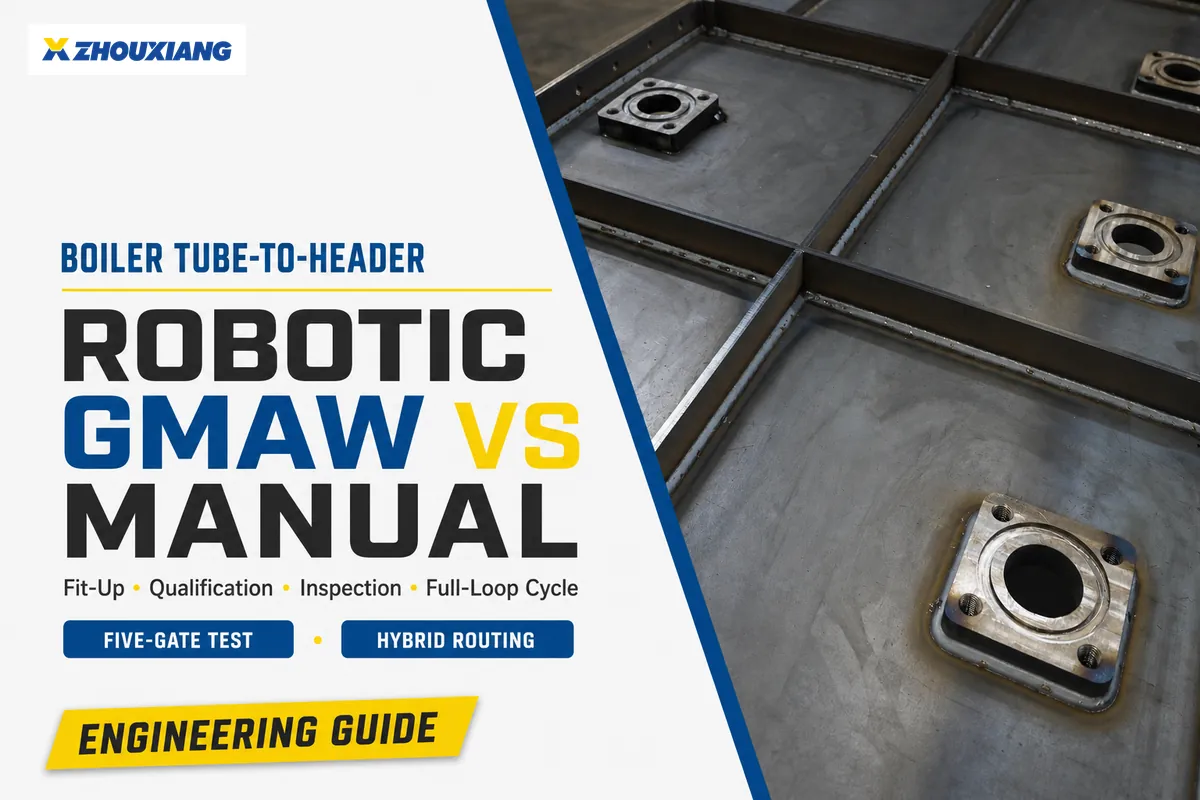
A boiler tube sheet welding robot is worth testing only when the actual tube-to-header joint can be located, welded, reached, inspected, and produced inside controlled limits. Passing those five feasibility gates is necessary, but it does not replace the governing boiler code, authorized inspection, or an integrated robot-cell safety review.
Decision in brief
- Choose robotic GMAW for a trial when a repeatable part family, qualified process window, workable torch path, joint-level evidence plan, and favorable full-loop cycle can all be demonstrated.
- Choose manual welding when work is repair-heavy, access changes from joint to joint, or the operator must continually interpret conditions that have not been bounded.
- Choose a hybrid cell when automation can control the repeatable path but a person still needs to load, locate, tack, inspect, or handle exceptions.
Tube Sheet or Tube-to-Header? Define the Joint First
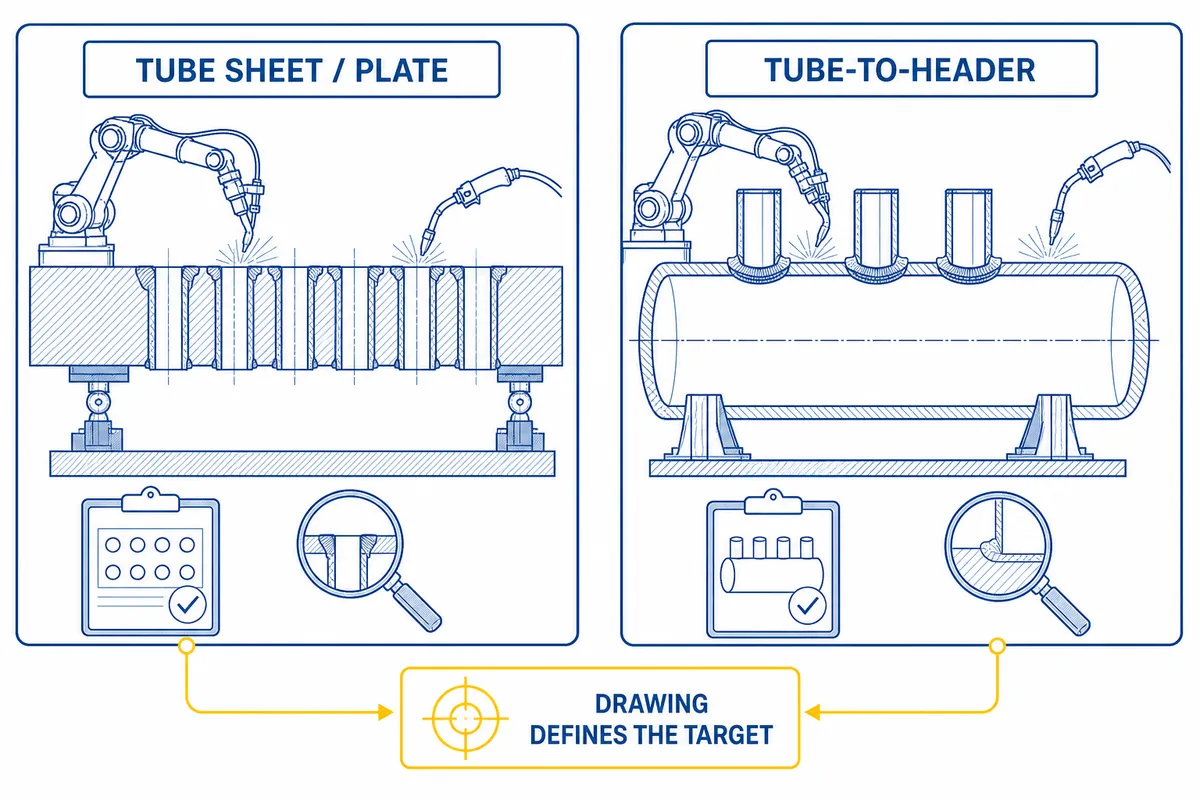
“Tube sheet” is common search language, but it can describe a flat plate filled with tube holes rather than tubes attached to a cylindrical boiler header. That distinction changes the weld path, access, positioning method, and likely process, so drawings—not the search phrase—must define the automation target.
| Term used | Geometry to confirm | Why it changes the cell concept |
|---|---|---|
| Tube sheet / tubesheet | Flat or curved plate with many tube openings | Often associated with orbital tube-to-tubesheet work; joint orientation and torch architecture differ from a header |
| Tube-to-header | Tube or stub attached to a cylindrical pressure-retaining header | Rows, curvature, neighboring tubes, and internal access can constrain robot and positioner motion |
| Tube-to-pipe or branch connection | Branch, socket, or other connection defined by the drawing | Joint preparation, weld sequence, and acceptance route may not match either family above |
A boiler-header patent record illustrates tube stubs connected to cylindrical headers and discusses constrained access, but it is geometry evidence—not proof of commercial performance. Start the request for quotation with a marked-up drawing, joint detail, header diameter range, tube projection range, and the surfaces from which the joint may be reached.
Search results may also surface orbital welding, TIG welding, tube-to-tubesheet laser welding, and other processes. Treat those as separate candidates until the drawing and governing welding process show that their joint geometry and control basis apply.
Terminology stop condition: if the supplier and buyer cannot point to the same weld on the same drawing, no robot-versus-manual comparison is ready for approval.
Adjacent Search Terms That Do Not Define This Joint
| Adjacent search language | Scope boundary to verify |
|---|---|
| tube plate, tubesheet welding, tube-sheet welding | Confirm whether the drawing shows a plate joint or a cylindrical header connection. |
| automatic tube, orbital welding machine, TIG welding machine, efficient TIG welding | Confirm whether the proposed process is orbital GTAW rather than robotic GMAW. |
| machine for boiler, automatic welding machine, pulse argon arc welding machine, MIG welding machine | Replace generic machine labels with the actual process, joint, position, and control envelope. |
| robot tube, unmanned operation of tube, automated welding, welding automation, intelligent welding | Treat automation claims as functions to test, not as evidence of autonomous acceptance. |
| welding power, power supply, MIG, MAG | Identify the qualified process and power-source controls instead of relying on an acronym. |
| vision system, data acquisition, real time, control technology | Define what is measured, the response limit, record ownership, and the stop condition. |
| 3D, precision, high precision, precise, autonomous | Convert promotional adjectives into measurable path, datum, sensing, and recovery criteria. |
| pipeline, steel pipe, butt joint | Do not transfer pipe-spool assumptions to a tube-to-header attachment without joint evidence. |
| boiler industry, nuclear, fabrication | Name the construction or repair basis, jurisdiction, and inspection authority for the actual equipment. |
| improve production efficiency, labor intensity | Test full-loop output and exposure reduction with a consistent boundary before making a benefit claim. |
Robotic GMAW vs Manual Welding at a Glance
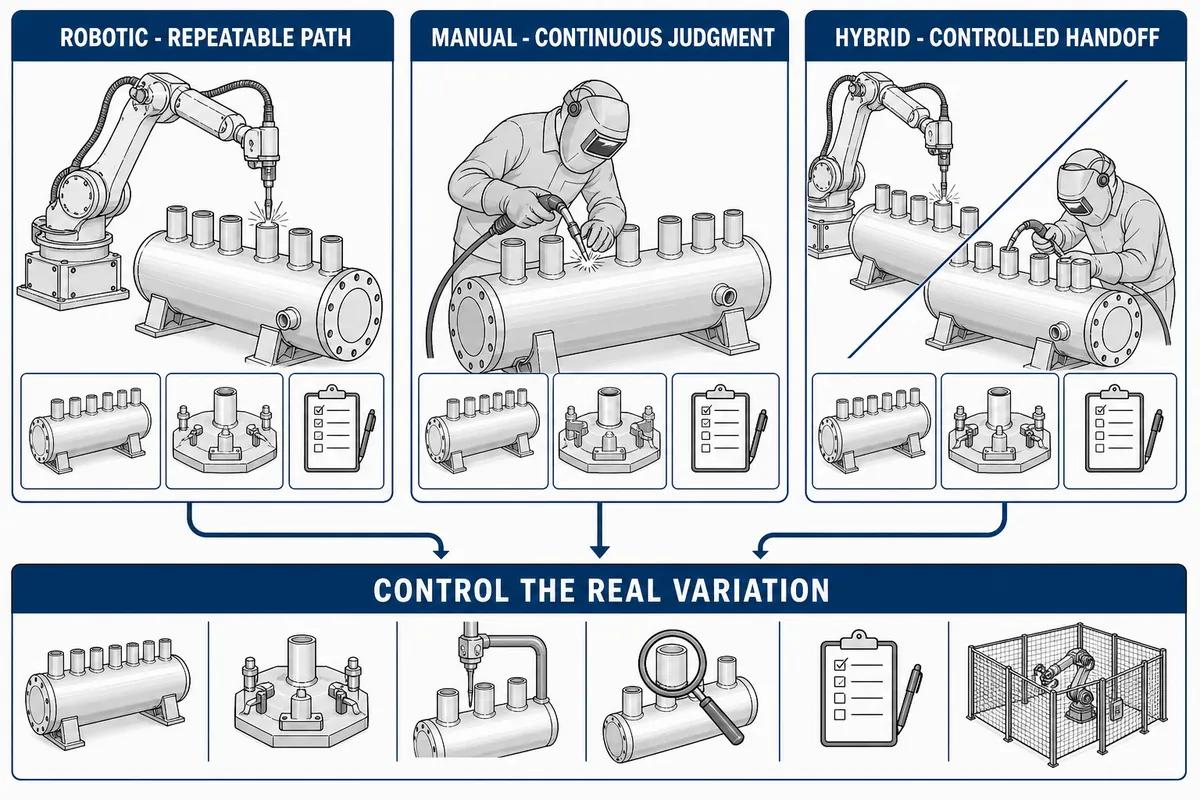
Robotic GMAW controls a programmed path and repeatable parameter sequence; manual welding adds an operator’s continuous interpretation and adaptation. Neither is inherently superior for every tube-to-header job. The stronger choice controls the actual variation while producing the evidence required for the joint.
| Decision factor | Robotic GMAW | Manual GMAW | Evidence to request |
|---|---|---|---|
| Path execution | Repeats the validated program and coordinate relationship | Welder adjusts travel continuously | Representative path trial on the real joint family |
| Fit-up response | Requires a measured sensing and correction envelope | Uses visual and tactile judgment within the qualified procedure | Gap, offset, projection, ovality, and location study |
| Changeover | Needs fixtures, programs, datum checks, and proven restart logic | Changes through instructions, tools, and welder setup | Timed changeover with first-piece acceptance |
| Access | Limited by arm, torch, cable, fixture, and neighboring geometry | Limited by welder reach, visibility, posture, and heat exposure | Collision-free reach review for every joint position |
| Production records | Can associate program and process data with a joint identifier | Relies more heavily on controlled paperwork and inspection records | Record schema tied to the inspection plan |
| Best-fit work | Repeatable families with stable upstream preparation | Variable, obstructed, low-repeat, or repair-oriented work | Part-family mix and exception log |
| Primary failure risk | Repeating an unrecognized bad condition | Operator-to-operator variation and fatigue | Failure-mode trial, not a showcase coupon |
One university case study found manual welding faster and less costly for its specific low-volume part. That result cannot set a universal batch threshold, but it does disprove the assumption that robot arc time alone decides the business case. Labels such as “intelligent automatic welding” still require the same evidence.
Deployment Preconditions Before the Five Feasibility Gates
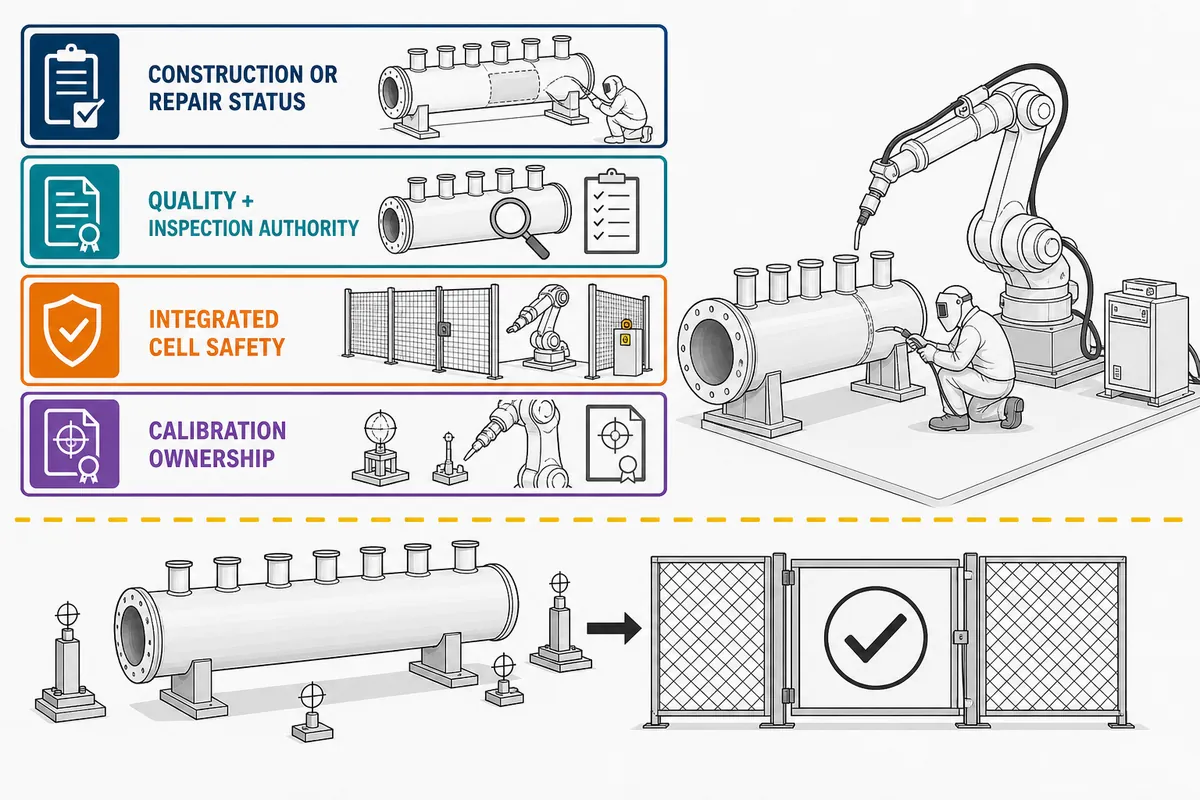
Before evaluating weld feasibility, classify the work, identify the authority chain, assess the integrated cell, and assign calibration ownership. These four preconditions sit outside the five-gate model because a feasible weld program cannot authorize a repair method, approve its own inspection, or make an unsafe cell acceptable.
| Precondition | Responsible decision owner | Evidence required before a production trial |
|---|---|---|
| New construction vs in-service repair or alteration | Certificate holder, owner/user, inspector, and jurisdiction as applicable | Equipment status, original code of construction, repair classification, permitted method, and heat-treatment route |
| Governing quality and inspection authority | Certificate holder and authorized inspection parties | Applicable code edition, drawing, WPS/PQR status, inspection plan, acceptance route, and hold points |
| Integrated robot-cell safety | Employer, integrator, safety specialists, and equipment suppliers within their scopes | Risk assessment covering integration, setup/teaching, operation, maintenance, foreseeable misuse, fume, heat, radiation, sparks, and access |
| Calibration and maintenance ownership | Plant engineering, maintenance, quality, and integrator | Datum-verification method, tool-center-point checks, sensing checks, trigger limits, recovery records, and revalidation responsibilities |
AWS D16.1 covers safety during the design, manufacture, maintenance, operation, integration, and setup of robotic arc-welding systems. OSHA’s robot guidance also identifies lifecycle hazards and welding-related fumes, hot surfaces, radiation, sparks, and noise, while NBIC Interpretation 17-06 shows that a proposed method may be disallowed for a stated tube-to-header repair condition.
Applicability boundary: this guide is an engineering procurement framework, not a code interpretation or safety assessment. Controlling certificate-holder, inspector, jurisdiction, employer, and qualified-specialist decisions determine what applies to the actual boiler and location.
The 5-Gate Tube-to-Header Automation Feasibility Test
After the deployment preconditions are assigned, test joint capability, process transfer, access, quality evidence, and the production loop as five separate gates. A failed process or evidence gate blocks release; a recoverable fit-up, access, or production gap may justify an upstream change or a controlled hybrid route.
A welding concept is not deployment-ready merely because all five feasibility gates pass. Safety, governing authority, authorized inspection, and lifecycle calibration remain independent preconditions.
— Editorial decision rule used in this guide
Fit-Up and Seam Location — Feasibility Gate 1
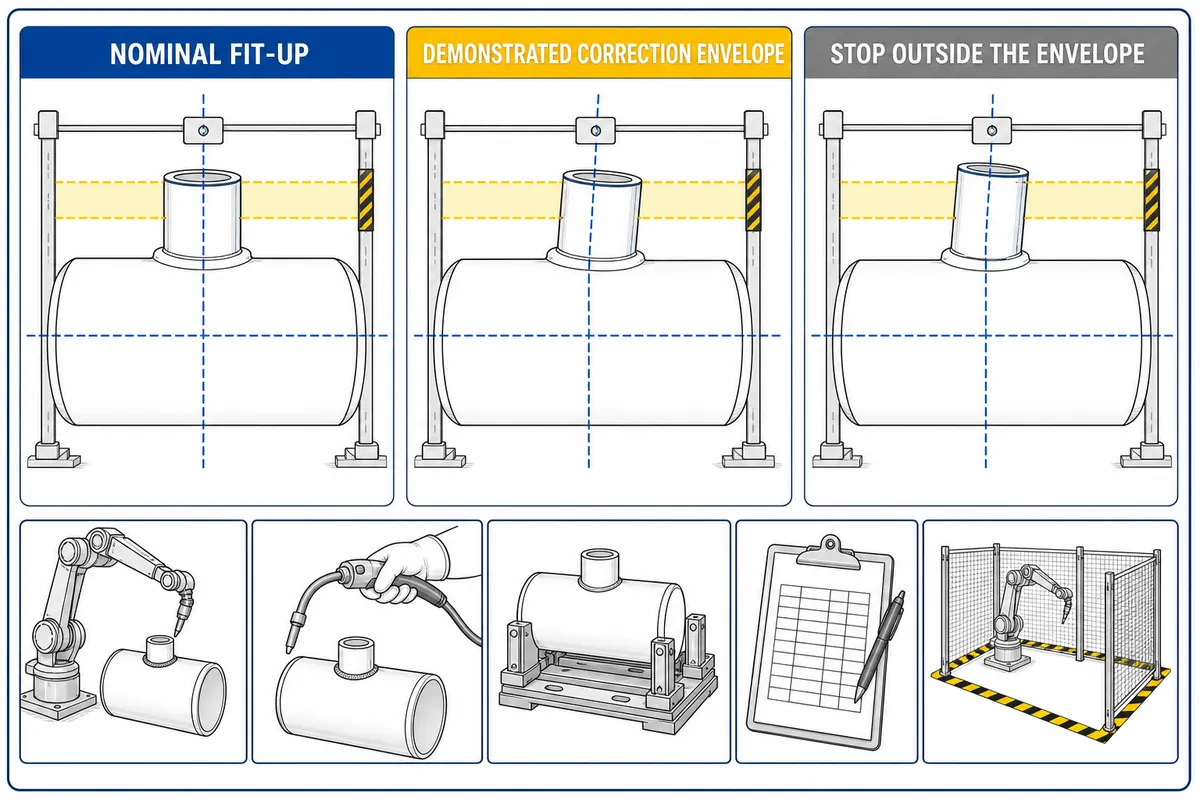
Fit-up feasibility passes only when the real part family presents the seam within a measured range that the proposed sensing, fixturing, and program response can handle. “Includes seam tracking” is not evidence; the buyer needs a capability study and a stop rule for conditions outside the demonstrated window.
Fit-up study fields
- Gap and offset at defined clock positions
- Tube projection, angle, ovality, and header surface condition
- Joint location relative to fixture datums and neighboring tubes
- Tack size, tack position, and whether the robot has to traverse and blend them.
- Sensor confidence, correction applied, operator intervention, and rejected conditions
A 2023 adaptive robotic GMAW study treats fit-up variation as a failure risk and demonstrates a control response for its own measured setup. It does not provide a transferable boiler-header tolerance, so sensor adjustment and the acceptance window must come from the project’s joint, procedure, trials, and quality requirements.
Stop condition for Gate 1: if the cell cannot reliably detect, correct, or reject the observed variation, fix the upstream process or retain human interpretation for that condition.
Qualified GMAW Transfer — Feasibility Gate 2
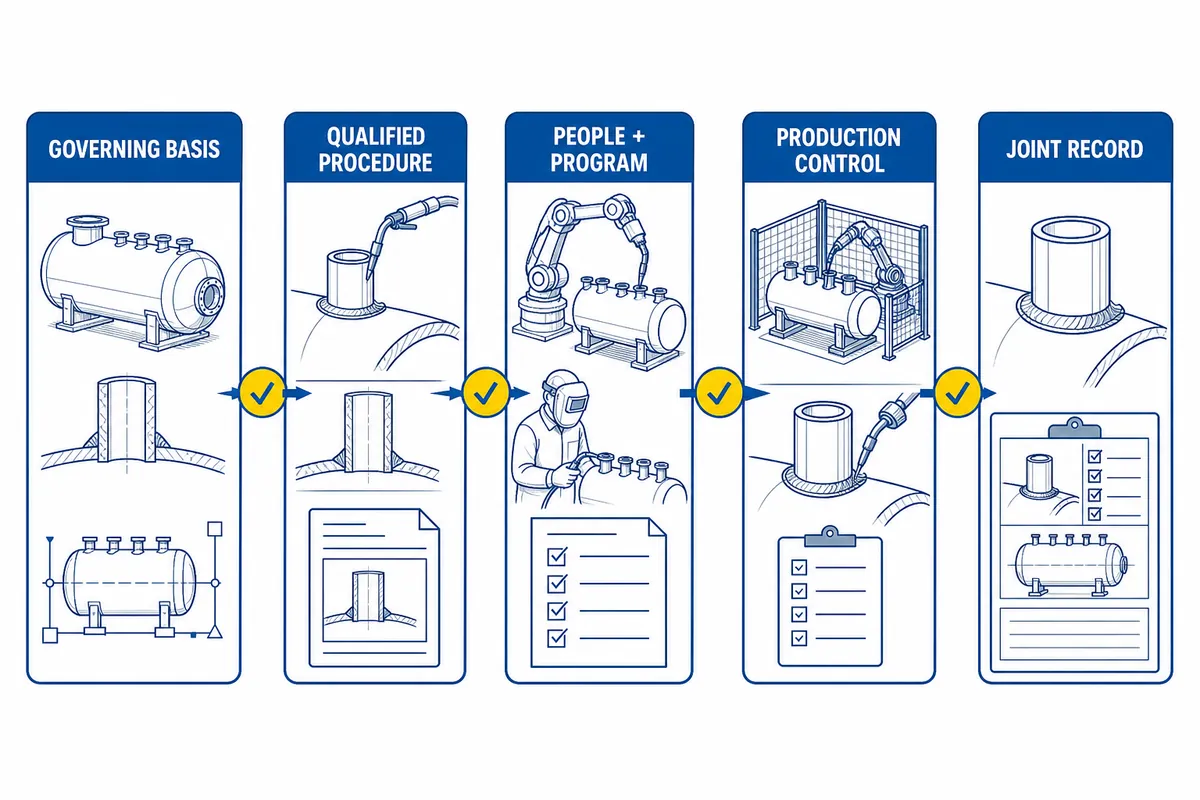
A manual procedure does not automatically prove that a robotic production setup is acceptable. Gate 2 requires the responsible organization to connect the applicable construction requirements, qualified welding procedure, robotic personnel roles, controlled program, and production records without claiming that the robot purchase itself creates qualification.
Four-layer qualification stack
- Construction and repair basis: identify the governing section, edition, jurisdictional rules, and equipment status.
- Procedure basis: confirm that the welding procedure specification and supporting qualification cover the actual welding process, wire, arc length control, and applicable variables.
- People and program: assign qualified welding, robotic, programming, supervision, and inspection responsibilities.
- Production control: lock approved programs and consumables, identify changes, and define first-piece plus ongoing verification.
The 2025 BPVC Section IX catalog scope covers qualification of welding procedures and welding machine operators. AWS D16.4M/D16.4:2025 separately defines classifications and qualification requirements for robotic arc-welding personnel, which is why one certificate or role should never be described as covering the whole stack.
Stop condition for Gate 2: unresolved applicability, undocumented program changes, or an unqualified responsibility layer must be closed before production authorization.
Torch Access and Motion — Feasibility Gate 3
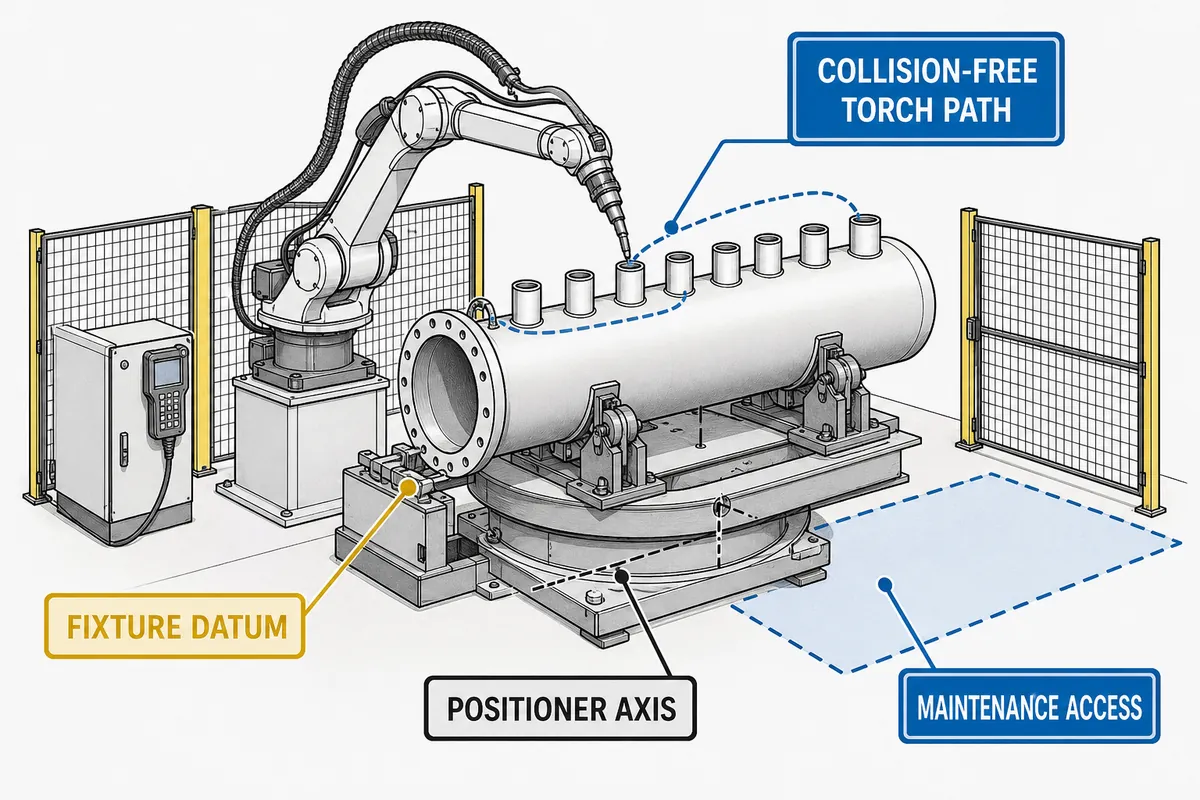
Torch-access feasibility passes when every required joint position has a collision-free, serviceable path that preserves the qualified welding position and datum relationship. Robot reach on a brochure is insufficient because the torch neck, cable, fixture, neighboring tubes, header curvature, and maintenance access define the usable envelope.
| Motion concept | Use it when | Trial evidence |
|---|---|---|
| Robot around a fixed header | The fixture can expose the joint family without forcing unstable arm postures | All clock positions, cable behavior, tip change, and recovery path reviewed |
| Header on a positioner | Rotation can present a controlled weld position without losing datum or creating support risk | Clamp repeatability, runout, grounding, coordinated motion, and safe loading checked |
| Robot plus coordinated external axis | The joint family needs more workspace or orientation control than either device provides alone | Synchronized path, singularity margin, collision zones, and fault recovery demonstrated |
A boiler-header welding patent describes support, header rotation, robot positioning, and access to multiple rows as parts of one motion concept. Use that only as design context; select any welding positioner from the verified workpiece, fixture, process, and safety requirements.
Stop condition for Gate 3: a simulated path that cannot be serviced, recovered after a fault, or repeated with production fixtures is not a passed access gate.
Joint-Level Quality Evidence — Feasibility Gate 4
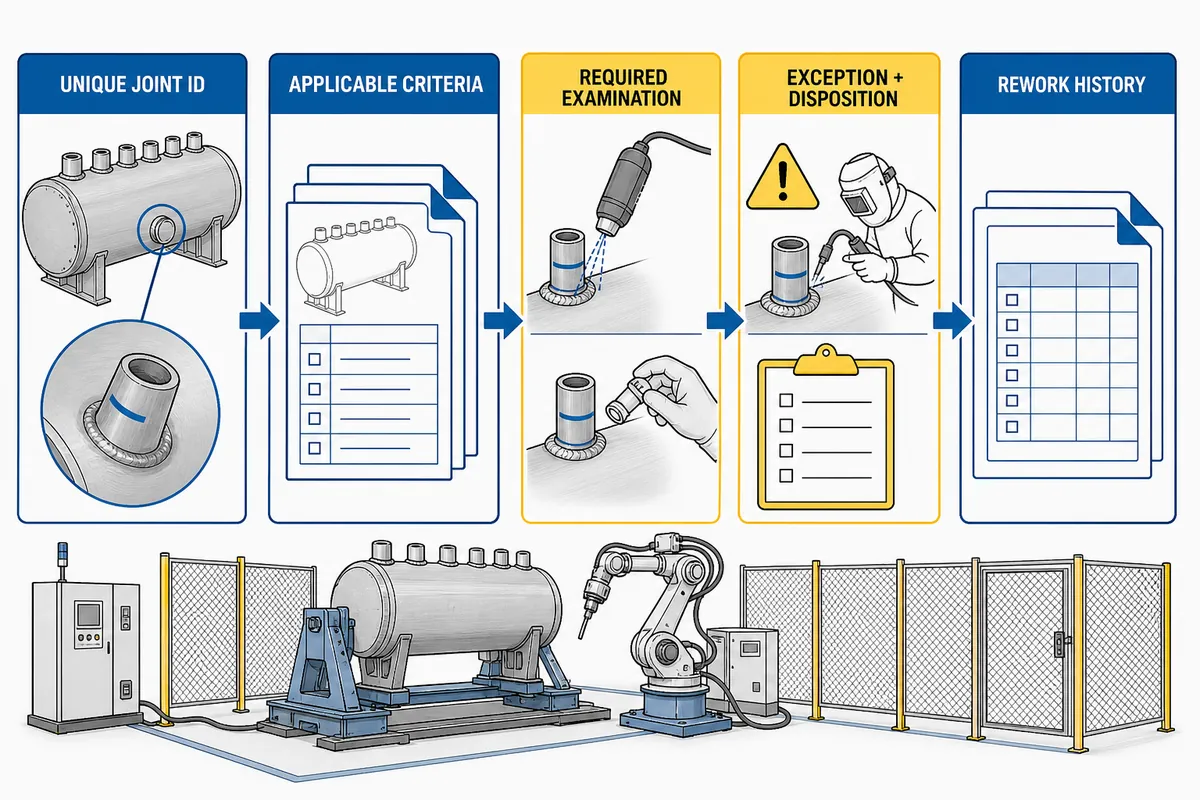
Repeatable robot motion is not the same as an accepted pressure-boundary weld. Quality-evidence feasibility passes when each joint identifier can be connected to the applicable criteria, inspection route, process and program record, exception disposition, and rework history under the responsible quality and inspection system.
Minimum joint record design
Identity
Part, header, tube, joint, drawing revision, and work order
Part, header, tube, joint, drawing revision, and work order
Execution
Approved WPS, program revision, consumable lot, operator, and timestamp
Approved WPS, program revision, consumable lot, operator, and timestamp
Exceptions
Tracking loss, alarms, intervention, stop/restart, and deviation approval
Tracking loss, alarms, intervention, stop/restart, and deviation approval
Acceptance
Required examination, result, inspector/authority sign-off, and rework link
Required examination, result, inspector/authority sign-off, and rework link
ISO 17635:2025 states that weld non-destructive testing methods, techniques, and acceptance levels are selected according to quality requirements, material, thickness, process, and examination extent. ISO 5817:2023 offers quality levels for covered fusion-welded imperfections, but the applicable level and its relationship to the governing construction rules still need project-specific selection.
Evidence boundary: cell logs can show what the equipment did; they do not appoint the acceptance authority. Build the record around the approved weld inspection methods and use first-pass weld acceptance rate only with a fixed denominator, criteria set, and attribution rule.
Full Production Loop — Feasibility Gate 5
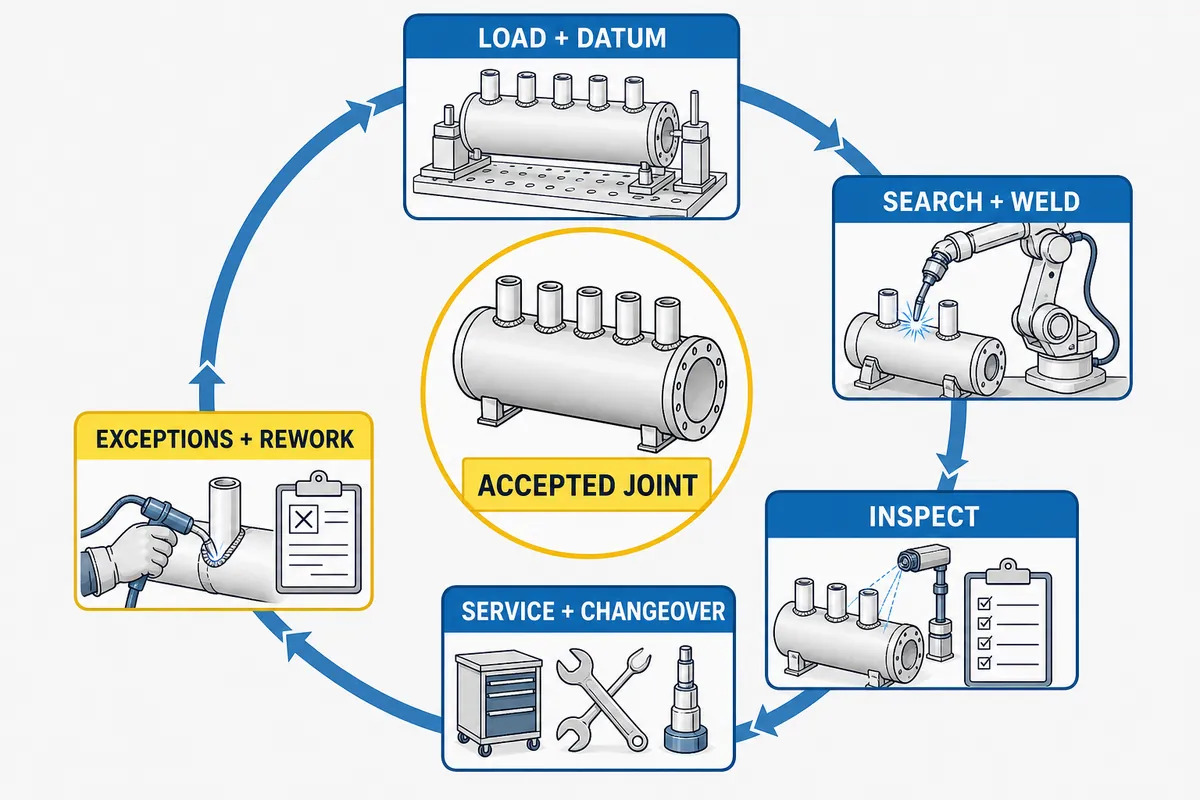
Full-loop feasibility compares the whole repeatable cycle, not robot arc time against a welder’s total shift. Count loading, datum confirmation, search or touch-up, welding, cooling constraints, inspection, tip service, changeover, exception handling, and rework with the same boundary for both methods.
The Full-Loop Cycle Model
T_loop = T_load + T_datum + T_search + T_weld + T_constraint + T_inspect + T_service + T_changeover + T_rework
Hypothetical example—do not use as a production promise: suppose one robotic loop allocates 50 seconds to loading, 20 to datum confirmation, 15 to search, 90 to welding, 0 to a separate cooling hold, 45 to inspection, 10 to tip service, 20 to changeover, and 30 to rework. The model yields 280 seconds per accepted joint.
| Illustrative time category | Baseline | After upstream change | What changed |
|---|---|---|---|
| Loading | 50 s | 35 s | Fixture presentation improved |
| Datum confirmation | 20 s | 20 s | No assumption of faster verification |
| Search | 15 s | 15 s | Same sensing sequence |
| Welding | 90 s | 90 s | Qualified process unchanged |
| Inspection | 45 s | 45 s | Acceptance route unchanged |
| Tip service allocation | 10 s | 10 s | Same service policy |
| Changeover allocation | 20 s | 20 s | Same product mix |
| Rework allocation | 30 s | 10 s | Illustrative reduction after fit-up control |
| Total accepted-joint loop | 280 s | 245 s | Efficiency gain came from loading and rework, not faster welding |
NIST research groups manufacturing measures across throughput, availability, productivity, quality, and maintenance and notes their interdependence. Collect matched observations for robotic, manual, and hybrid routes, then compare accepted joints per staffed hour and per scheduled hour alongside rework and changeover—not one favorable stopwatch interval.
Stop condition for Gate 5: if the result changes whenever setup, inspection, service, or rework is included, the business case is not mature enough for a payback promise.
When Manual or Hybrid Tube-to-Header Welding Is the Better Choice
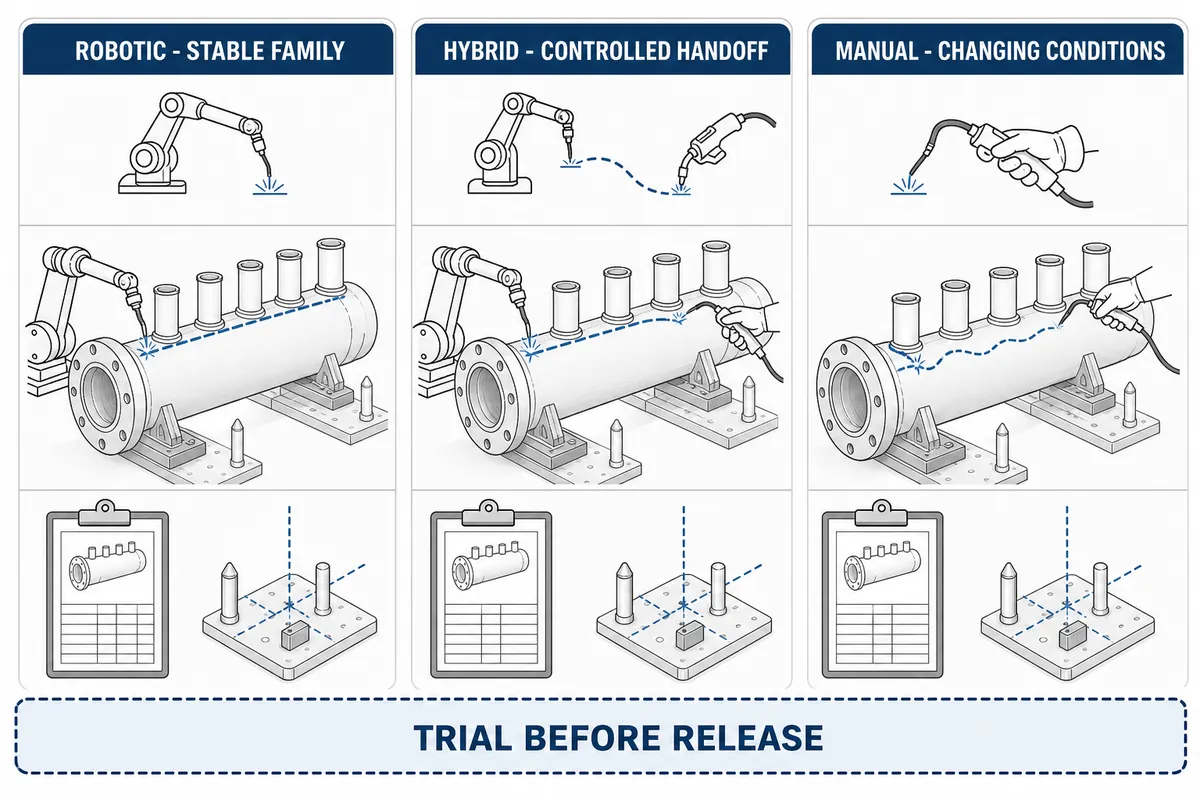
Manual welding is a control strategy, not merely the absence of automation. Keep it when qualified welders must interpret changing access or repair conditions; use a hybrid route when a robot can repeat the stable portion while a person manages location, preparation, inspection, or exceptions.
| Observed production condition | Route to test first | Why | Do not choose it when |
|---|---|---|---|
| Stable family, repeated datum, proven access | Robotic | The main variation can be bounded and repeated | Acceptance ownership or safety prerequisites remain open |
| Stable weld path, variable loading or location | Hybrid | A person handles presentation; the robot controls the repeatable path | The handoff cannot be error-proofed or verified |
| Repair-heavy work with changing constraints | Manual | Interpretation and adaptability dominate programming repeatability | Ergonomic or exposure risk cannot be controlled |
| Obstructed joints with a repeatable accessible subset | Hybrid | Automate only the validated subset | Joint identity and routing can be mixed up |
| Frequent family change with long first-piece recovery | Manual, then hybrid study | Changeover may dominate the loop | Volume and stability later justify a controlled family cell |
| Heat, fumes, posture, or access create operator exposure | Engineered automation study | Risk reduction may matter even without a simple labor payback | The cell merely moves the hazard to setup or maintenance |
This matrix is a routing tool, not an approval. A representative trial should include nominal joints, expected edge conditions, a deliberate tracking interruption, a changeover, a first-piece check, and the recovery actions that operators and maintenance will actually perform.
What Changed in 2025: Cell Safety and Qualification Are Separate Workstreams
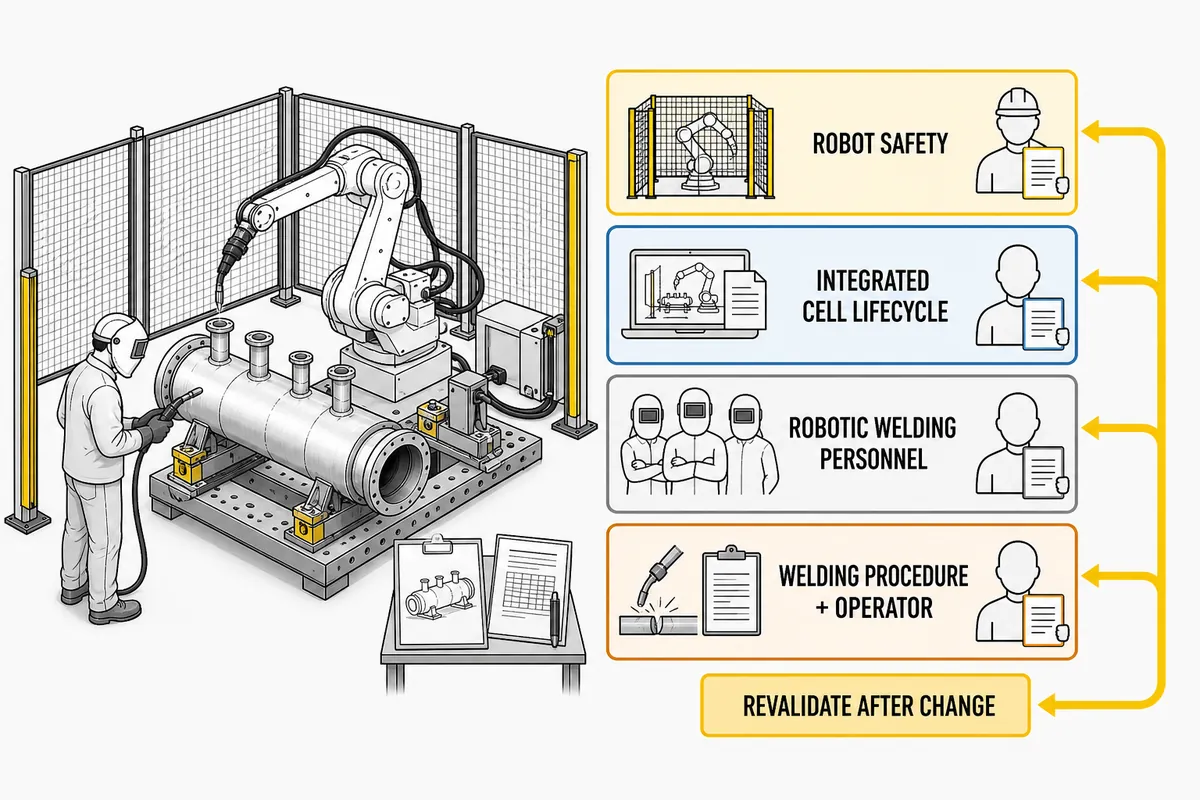
The useful 2025 change is not a generic robot-market forecast. Current documents make it easier for a buyer to separate the robot, integrated application, robotic welding personnel, and welding-procedure responsibilities, which should change the evidence requested during specification and acceptance.
Responsibility stack for a 2026 procurement
- ISO 10218-1:2025: safety requirements for the industrial robot as partly completed machinery.
- ISO 10218-2:2025: design, integration, commissioning, operation, maintenance, decommissioning, and disposal of robot applications and cells.
- AWS D16.1:2018: robotic arc-welding system safety, including risks during integration and setup.
- AWS D16.4:2025: qualification requirements for robotic arc-welding personnel classifications.
- ASME BPVC Section IX 2025: welding procedure and welding personnel/operator qualification scope within the applicable construction framework.
For procurement, assign an owner and a required acceptance artifact to each layer instead of writing “supplier shall comply with all standards.” Also define revalidation after program, fixture, torch, sensor, datum, or maintenance changes that could alter the proven condition.
Maintenance evidence matters: NIST identifies robot accuracy-degradation monitoring as important for welding and separates measurement-instrument uncertainty from actual robot error. A commissioning result is therefore a baseline, not a lifetime guarantee.
RFQ Inputs for a Boiler Tube-to-Header Welding Cell
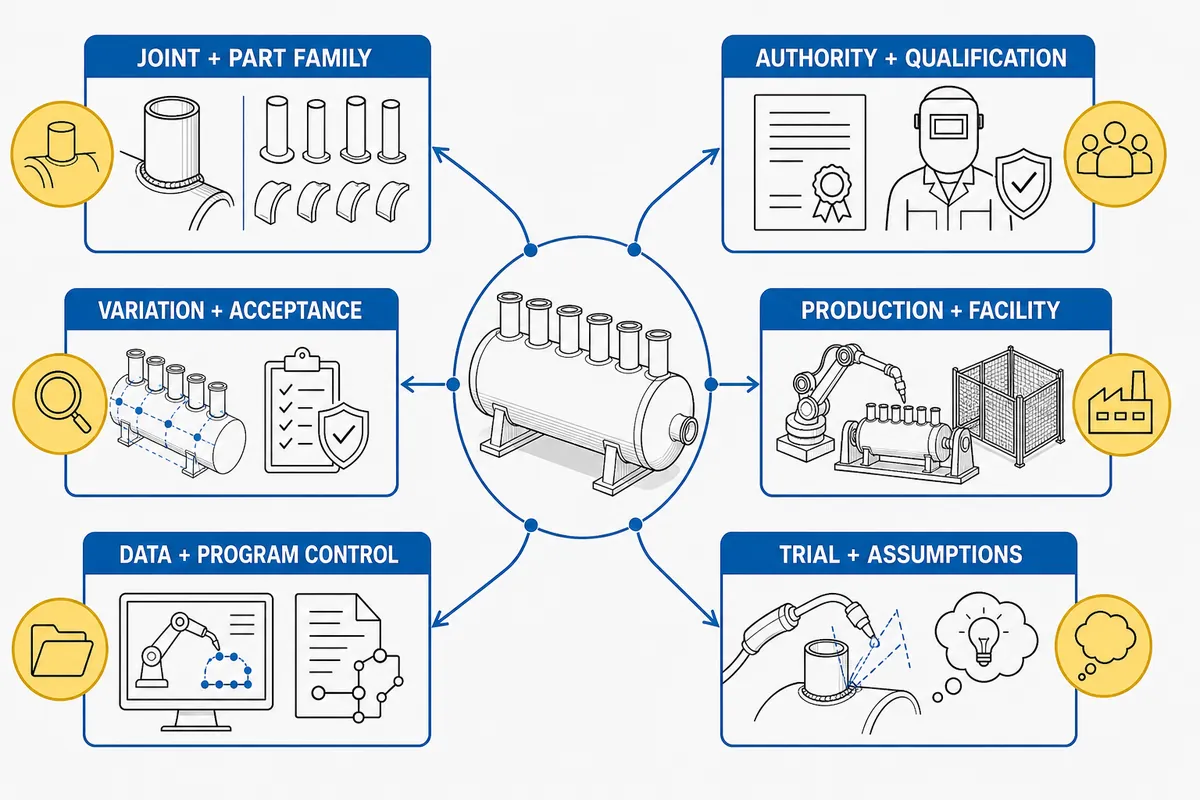
A useful request for quotation gives the integrator enough evidence to reject a weak concept before pricing it. Supply the joint family, process and qualification status, variation study, acceptance route, production mix, facility constraints, and witness-test plan; then ask the supplier to list every assumption.
Boiler tube-to-header robot RFQ checklist
- ✔ Part and joint drawings, revision control, carbon steel or stainless steel grades as applicable, thickness range, tube projection, header diameter, and production orientation
- ✔ New-construction or repair/alteration status, original construction basis, jurisdiction, certificate-holder role, and inspection authority
- ✔ WPS/PQR status, process boundaries, consumables, preheat/interpass or heat-treatment requirements where applicable
- ✔ Measured gap, offset, ovality, location, tack, and surface-condition data from representative production parts
- ✔ Required examination, acceptance route, hold points, first-piece rules, exception handling, and rework traceability
- ✔ Part-family volumes and mix, loading method, changeover frequency, staffing boundary, and full-loop timing definition
- ✔ Layout, floor loading, utilities, fume extraction, guarding interfaces, material flow, maintenance access, and recovery space
- ✔ Required production records, data ownership, program control, backup, access rights, and retention period
- ✔ Representative weld-trial matrix, witness parties, failure cases, calibration checks, and acceptance artifacts
- ✔ Supplier assumptions, exclusions, buyer-supplied equipment, training scope, spare parts, and post-acceptance support
Use Zhouxiang’s power-industry robotic welding systems page for the commercial solution context, then keep this article’s five gates as the technical screening layer. Concept review should end with open assumptions and trial evidence, not only a rendered cell layout.
Ask for a representative weld trial
In practice, a meaningful trial uses production-representative parts and the intended fixtures, torch, sensing, consumables, program controls, inspection route, and responsible witnesses. Record nominal runs, edge conditions, changeover, fault recovery, maintenance access, and rejected conditions before discussing production release.
Frequently Asked Questions
These answers address the joint-definition, process, fit-up, evidence, and routing questions that remain after the five-gate review. The exact query returned no People Also Ask set in the available search data, so the questions are editorial decision aids rather than claimed search-engine questions.
Is a boiler tube sheet the same as a tube-to-header joint?
No—a tube sheet usually means a plate with tube openings, while a tube-to-header joint connects a tube or stub to a boiler header in this article’s scope.
Search results often mix heat-exchanger tube-to-tubesheet work with boiler header fabrication. Confirm the drawing, joint detail, pressure-boundary function, weld path, and access before choosing GMAW, orbital GTAW, a robot, or a positioner. Similar wording does not make the geometry or qualification route interchangeable, and a supplier should not price the cell until both sides identify the same weld on the same controlled drawing.
Can a welding robot replace manual tube-to-header welding?
A robot can replace the repeatable portion only after the joint, process, access, evidence, and full-loop production gates pass and the remaining work is controlled.
People may still load, locate, tack, inspect, maintain, handle exceptions, or weld joints outside the demonstrated envelope. For repair-heavy or obstructed work, manual welding can remain the better control. For mixed conditions, a hybrid route often protects adaptability without giving up repeatable path execution. Replacement should therefore be defined task by task, with clear stop conditions and ownership for every condition the cell cannot classify.
Is GMAW suitable for boiler tube-to-header welding?
GMAW may be suitable when the governing construction or repair requirements, qualified procedure, joint position, materials, heat controls, and inspection route allow it for the actual pressure boundary.
Suitability cannot be decided from the process name alone. Responsible certificate-holder and inspection parties must confirm the applicable requirements, while the production trial must show that the robotic setup stays inside the qualified variables and produces acceptable evidence on the real joint family. Material, position, joint preparation, heat controls, consumables, and examination route all belong in that decision rather than in a generic process comparison.
How much fit-up variation can a welding robot handle?
There is no universal fit-up value; the limit is the measured range that the specific fixture, sensor, program, process, and acceptance plan have demonstrated together.
Measure production parts, test expected edge conditions, and define when the cell must stop or route the joint to manual review.
Does a manual WPS automatically cover robotic welding?
No—the responsible organization must confirm how the qualified procedure applies to the robotic process, variables, equipment control, operator/personnel roles, and production records for the actual construction or repair scope.
A manual WPS is evidence, not an automatic bridge. Review the applicable code edition and construction or repair basis, then compare the robotic setup with the qualified variables and supporting record. Define who may approve programs and changes, how consumables and heat controls are managed, how first-piece release works, and what triggers requalification or revalidation. The cell purchase, robot brand, or integrator’s demonstration does not replace those decisions.
What inspection records should a robotic cell produce?
Cell records should connect a unique joint to the approved program, process context, exceptions, required examinations, disposition, and rework history under the governing quality system.
Exact fields depend on the governing quality system and inspection plan. Equipment data can support traceability, but the authorized acceptance route decides whether the weld is accepted.
When is a hybrid cell better than full automation?
A hybrid cell is better when the weld path is repeatable but loading, location, preparation, inspection, or exception handling still needs human judgment at specific production steps.
Define the handoff, joint identity, stop conditions, and responsibility for each exception so the hybrid route does not create an invisible gap between manual and automated controls.
Analysis Scope and Sources
This guide separates joint-specific engineering decisions from the broad robot-versus-manual benefits already covered elsewhere on the Zhouxiang site. Company identity and history are taken from the Zhouxiang company profile; no company-reported fact is used as proof of tube-to-header weld performance.
References & Sources
- AWS D16.1M/D16.1:2018 — Specification for Robotic Arc Welding Safety
- ISO 10218-1:2025 — Industrial robot safety requirements
- ISO 10218-2:2025 — Robot applications and robot cells
- OSHA Technical Manual — Industrial robot systems and applications
- National Board — NBIC Interpretation 17-06
- ASME — Boiler and Pressure Vessel Certification Program
- AWS D16.4M/D16.4:2025 — Robotic Arc Welding Personnel preview
- ISO 17635:2025 — General rules for non-destructive testing of welds
- ISO 5817:2023 — Quality levels for weld imperfections
- NIST — Industrial Robot Accuracy Degradation Monitoring and Quick Health Assessment
- NIST — Hierarchical Structure of Manufacturing Key Performance Indicators
- Adaptive robotic control for fit-up variation in GMAW — conference paper
- Minnesota State University thesis — bounded manual-versus-robot welding case