Get in Touch with Zhouxiang


How to Choose the Right MIG Welding Robot Workstation for Your Production Line
Finding skilled welding labor is a bigger challenge to the fabrication shop year after year. Fewer trained welders coupled with the increase in production demands has led an upward spiral in the adoption of automation—The International Federation of robotics reported more than 542,000 industrial robots installed world-wide in 2024. For shops running GMAW (MIG) welding, a robotic welding workstation answers these pressures.
It provides a path for stable, optimal weld quality, increased throughput, and reduction in labor exclusively through an investment in an automated process. In this brochure you’ll learn the details of what will be part of your initial investment—the configuration options in an robotic MIG cell, why choose industrial robots over cobots, price considerations, and common pitfalls for first-time buyers.
Table of Contents
- What Is a MIG Welding Robot Workstation?
- Industrial Welding Robot vs Cobot: Which Fits Your Shop?
- Core Components of a Robotic MIG Welding Cell
- How Automated MIG Welding Improves Weld Quality and Throughput
- What Does a MIG Welding Robot Workstation Cost?
- Common Mistakes When Choosing a Robotic MIG Welding System
- FAQ
What Is a MIG Welding Robot Workstation?

A MIG welding robot workstation is an integrated welding system which uses a programmed robotic arm to complete the Gas Metal arc welding (GMAW). GMAW involves the use of a continuously fed solid wire that melts into the joint within a shielding gas atmosphere. The workstation comprises robot arm(s), welding power source, wire feeder, welding torch, part positioner, safety enclosure and a central robot controller that orchestrates all welding process elements.
GMAW – also called mig welding in the presence of Inert Gas or MAG welding with active gas mixtures – continues to be the generally automated arc welding process in production. However, on the robot operational robot arm moves the torch along a preprogramed contour, at the same time, power source incident voltage and current. In GMAW, wire feed speeds generally from 100 to 800 inch/min (2540 to 20320 mm/min), depending upon thickness of the work piece, joint configuration, and transfer mode (short-circuit, spray, or pulsed).
Gas shielding surrounds the molten pool preventing porosity of the weld from the atmosphere. For mild steel the commonly used mix used is 75% argon / 25% CO mixture. Filler wire must conform to the AWS A5.18 classification for carbon steel welding applications.
Where as laser welding requires very tight fit up of the joints, MIG can be forgiving of slack – making it the process of choice for most types of fabrication.
In our workcells running in 50+ countries, the workcell configurations that most frequently couple a 6-axis robot arm with a one-axis L-type positioner, providing the most flexible accom_modation of a flat plate or structural weldments and supporting the most compact cell footprint are.. would be used as a benchmark.
Industrial Welding Robot vs Cobot: Which Fits Your Shop?
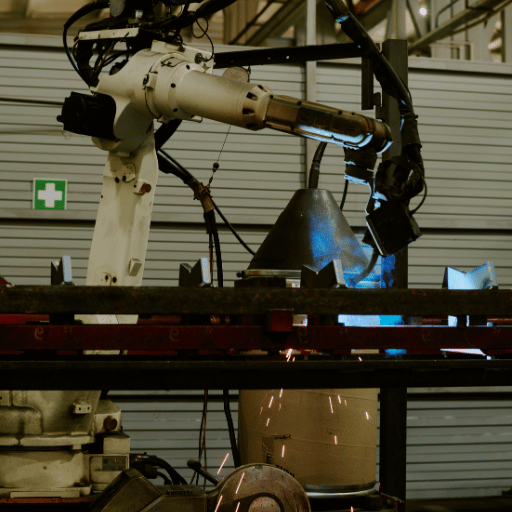
Prior to equipment selection, your first dilemma is whether to choose. Industrial welding robot or collaborative robot (cobot)?
Both are capable of running MIG welding processes. Where they differ is in payload, repositioning speed, programming approach and safety considerations.
| Specification | Industrial Welding Robot | Welding Cobot |
|---|---|---|
| Payload | >20 kg | ≤20 kg (e.g., UR20 = 1,750 mm reach) |
| Air-Cut Speed | 2,000+ mm/s repositioning | ~1,000 mm/s repositioning |
| Programming | Teach pendant + KAREL / RAPID | Lead-through teaching / tablet interface |
| Safety | Full safety fencing required | Built-in force sensing; no fence needed* |
| Welding Speed | 20–40 IPM (process-limited) | 20–40 IPM (process-limited) |
| Typical System Cost | $130,000 – $250,000+ | $80,000 – $150,000 |
* Arc flash and spatters yet still need protective screens. Assessment of risk of ISO/TS 15066.
One aspect that surprises a lot of customers is actually the resemblance of the two types in actual welding speed. The mig welding travel rate depends only on the metallurgy—wire diameter, shielding gas, material thickness, joint geometry—not on the robotic arm. Where the industrial robot takes the edge is in air-cut repositioning after the welding of each seam. Over 2,000+mm/s versus ~1,000+mm/s, the industrial arm completes multipass or multi-seam components faster, which adds up over thousands of cycles per shift.
💡 Pro Tip
If your parts are less than 10 kg and lot sizes fluctuate weekly, a cobot will give you faster changeovers. For larger-volume runs with parts exceeding 15 kg, an industrial robot offers more economical parts due to less cycle time and larger payload capacity.
Partnerships between collaborative welding cells and high-mix/low-volume job shops and contract manufacturers are on the rise. MIG welding cobots allow operators to teach new paths in as little as fifteen minutes without programming. But don’t assume cobots are always more cost-effective. For high-volume, single-part runs, industrial robots typically offer lower per-part cost thanks to faster repositioning over thousands of daily cycles.
⚠️ Common Mistake
Assuming the cobots are always less expensive. Run some calculations on your expected annual volume before making a decision-a cobot welding cell at $120K with slower cycle times will produce more costly parts than an $200K industrial cell operating at full speed.
Core Components of a Robotic MIG Welding Cell

Constructing a robotic mig welding cell required more than simply installing a torch on a robot arm. Below are the eight fundamental elements that make a reliable, production-ready welding system:
- Robot Arm – Automated or collaborative 6 axes arm providing 0.05 mm repeatability. Arc welding applications select arms rated 6-12 kg as payloads enough to handle the torch assembly and cable package.
- welding Power Source – Inverter efficiency units rated 350-500A for MIG/MAG. Contemporary units offer multiple transfer modes short-circuit, pulsed, spray—speaking directly to the robot controller.
- Wire Feeder – Motor-driven or push-pull feeder for steady wire delivery to the torch. Consistent wire feeding is the most significant factor in minimizing spatter and porosity in automated mig welding.
- welding torch – Manipulate 360 degrees with a tube passage for wire cable stack. Liquid cooled applications offer higher duty-cycles; air cooled are lightweight.
- Positioner – Rotary-tilts the workpiece to provide robot max access. Typical styles are P (vertical surface round parts), P (head-and-tail tubular parts), L (compound angle flat plates).
- Robot Controller – Directs axis speed, acceleration. Stores part programs. Controls positioner motion, and I/O.
- Safety System – Light curtains or fencing for industrial applications. Collaborative cobots employ force control, but arc flash and spatter still require physical barrier.
- Fume Extraction – Zoning for OSHA 29 CFR 1910 Subpart Q compliance. robotic welding cells emit fumes identical to manual stations and are subject to the same ventilation standards.
| Robot Size | Payload | Reach | Typical Application |
|---|---|---|---|
| Compact Arc | 8 kg | 1,840 mm | Small parts, tight cell layouts |
| Mid-Range Arc | 10 kg | 1,440 mm | General fabrication, medium weldments |
| Extended-Reach Arc | 12 kg | 2,010 mm | Large frames, structural steel |
When we configure a robot welding cell, we assign positioner type based on part geometry—L-type for flat plates, head-and-tail for tubular frames. A mismatched positioner creates blind spots that torch cannot reach. This results in tedious, time-consuming manual touch-up welds that beat the purpose of automation. Take a look at our pre-set mig welding workstation packages and see how these elements fit together to create a ready-to-run welding package:
How Automated MIG Welding Improves Weld Quality and Throughput

2–3×
Typical throughput gain over manual welding
Source: Industry field data
By moving from manual MIG to robotic welding, you change two variables in the equation simultaneously: the quality of your welds, and the volume of your throughput. Manual welders can produce good quality welds—and that might be enough if you’re just establishing a new shop. But consistent quality from day-to-day depends on missing quality. Human reaction times, fatigue and long working hours mean two good beads don’t really match. A robotic MIG welder delivers the same pulse and duration every time. It never suffers fatigue, producing consistent weld quality on every joint.
The gained throughput is entirely a function of arc-on time. Manual welders average less than 30% arc-on time. between loading, setup, repositioning, breaks and lag resulted in most of their shift. robotic welding systems focus arc-on 80% of the work shift—the robot never needs to take a break, stretch or reposition itself. It just sits there, ticks, sticks and nods.
Most of our new customers who have migrated from manual MIG report at least 2-3X gains within the first 90 days. Gains accrual from higher arc-on time, faster ramp time, and less rework. Mechanical consistency from robotic welding means that less parts are flagged at inspection.
market statistics backs up this correlation. Up until 2024, the worldwide arc welding robot market was worth $5.73 billion, and estimated to grow at a remarkable 8.1% CAGR, per Straits Research. welding automation isn’t just a trend of tomorrow, it’s the standard of today for shops that are trying to suspend production to automate
What Does a MIG Welding Robot Workstation Cost?
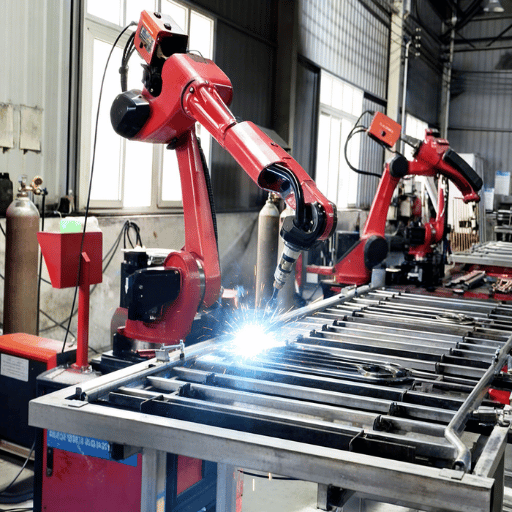
Out in the real world, budget planning for robotic automation factors in end effector design, integration production, and project implementation costs. Here’s a sample breakdown based on 2024-2025 industry numbers:
| System Type / Line Item | Typical Price Range |
|---|---|
| Pre-Engineered Cell (robot + power source + positioner + safety + controls) | $130,000 – $250,000 |
| Custom Robotic System | $250,000 – $600,000+ |
| Cobot Welding Cell | $80,000 – $150,000 |
| Fixturing (per part program) | $5,000 – $40,000 |
| Training | $3,000 – $10,000 |
| Annual Service Contract | $5,000 – $25,000 |
ROI and Payback: Industry numbers tell us that most of the best-known Model robotic automation reach payback time frame within 12-36 months. The average size $225,000 automation delivery system, pays off in about 17 months and gains around 248% ROI over 5 years. Cobot-sized companies, with nearly 35% lower upfront price tags, often claim 6-12 month payback periods.
ROI estimation has often involved multiple steps and dozens of calculations, but how? run the numbers required for a rough guess with: add the wages/benefits/overtime for displaced welder workers, amortize the maintenance count, and divide monthly savings into overall system cost. You get a grasp on what months should be needed.
⚠️ Hidden Cost Warning
Fixture design and fixturing programming for those initial 5-10 TIG welder jobs may add another 15-25% to the original quoted system cost. Always get your system integrator to provide a separate quote for fixturing – don’t ignore or underspend on fixturing per se.
Trying to determine a table top configuration and pricing? Our engineering team can help you match the right cell layout to your production goals and build a quote for your project.
Need help choosing between a cobot and industrial robot cell?
Talk to an Engineer
Talk to an Engineer
Common Mistakes When Choosing a Robotic MIG Welding System
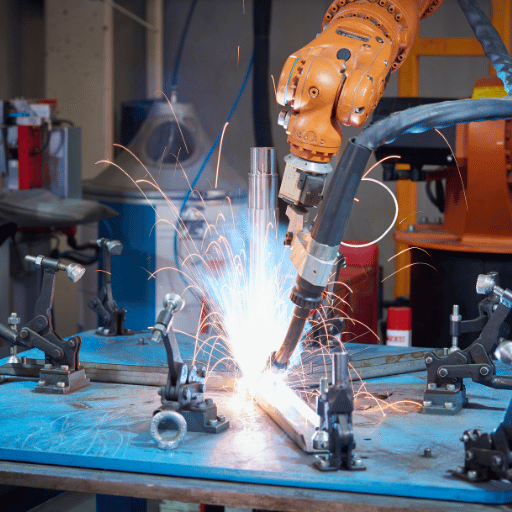
From years of configuring welding automation solutions for customers everywhere, we can spot the same costly mistake over and over:
1. Buying on robot brand alone. The robot arm is one piece of a complete welding solution. Your application experience – material handling, type of joints, volume of production – of the system integrator is far more important than glon on the arm. A good cell integrated with a second tier robot beats a bad cell integrated with a first tier robot.
2. Underestimating fixturing costs in new technology cells. Budget 15-25% of total system price for fixturing on custom-fixturing systems. Each new part number needs its own dedicated fixturing. Multi-station fixturing may be necessary for complex weldments.
3. Overlooking requirements for fume extraction – robotic welding cells have to meet the same OSHA ventilation requirements as manual stations. Operator position outside the cell does not remove the need for fume extraction as required by 29 CFR 1910 Subpart Q.
4. Expecting zero programming. Even “teach-free” cobot systems with leadthrough teaching need offline path verification, especially on multi-pass welds. Factor programming into your integration plan – someone in your company needs to learn how to operate the system.
5. Neglecting the integration process. Cell layout, material flow, and operator workflow are more critical that robot specifications on paper. A welding robot in a cell where the operator has to walk 30 feet for each load and unload or where the crane cannot reach the positioner will never reach the productivity goals. Consult your integrator on floor plan layout before ordering.
💡 Pro Tip
Consult your system integrator for references from successful shops running similar parts and materials. A system integrator with handling experience in structural steel factories will be a more flexible and sustainable choice than one accustomed to automotive thin-gauge applications.
Planned maintenance planning is best when included in the buying process, not after installation. Ask about torch consumption rates, wire liner replacement schedule, and whether the power source is capable of remote diagnostics. These factors will influence the total cost of ownership, far more than the purchasing price.
Frequently Asked Questions

Q: How much do welding robots usually cost?
View Answer
Pre-engineered cells vary from $130,000-$250,000, cobot welding cells $80,000-$150,000, to specialized robotic cells $250,000-$600,000+. On top of the initial price for the cell, additional cost factors are fixturing ($5,000-$40,000 per part program), training ($3,000-$10,000), annual service ($5,000-$25,000), and other customization options.
Q: Can MIG welding be automated for small-batch production?
View Answer
Yes. cobots lead-through teaching systems significantly reduce changeover time to minutes, enabling batch sizes as small as 10-20 parts.
Q: Do I need a safety enclosure for MIG welding with a cobot?
View Answer
cobots feature force sensing and do not require full safety fencing. Nevertheless, for arc flash and weld spattering, protective screens around welding area are required. Determining the exact safeguarding requirements for your process should be done through a ISO/TS 15066 risk assessment.
Q: How fast can I weld with a welding cobot?
View Answer
Arc-on welding operation times are comparable to industrial robots with 20-40 IPM – the speed of welding is related to the metallurgy, not the robot. What makes a cobots different is in the repositioning between weld seams from air: at 1,000 mm/s, versus 2,000+ mm/s for industrial arms, which affects the total cycle time on parts with multiple seams.
Q: What is the expected ROI for a robotic MIG welding cell?
View Answer
Most industrial cells recoup their investment in 12-36 months. cobot systems recoup their investment in about 6-12 months since they are cheaper to install.
Q: Can a MIG welding robot handle aluminum and stainless steel?
View Answer
Yes. MIG welding robots can weld carbon steel, stainless steel and aluminum. Each one needs the right filler wire (A5.18 AWS for carbon steel, A5.9 AWS for stainless steel, A5.10 AWS for aluminum) and particular shielding gas. Carbon and stainless need the same mixture of 75/25 argon/CO₂, aluminum needs pure argon, and some stainless need tri-mix gas.
Ready to Configure Your MIG Welding Robot Workstation?
Our engineers can recommend the best set-up for your part, material and production goals. We shall propose your configuration in 48 hours.
About This Guide
This selection guide is based on Zhouxiang’s major experience working with 50+ countries over 30+ years. We have built and shipped MIG welding robots to produce steel structures, assemble cars and make heavy equipment. The cost information here is general industry averages from published source from 2024-2025 but not a Zhouxiang quote – for a particular project, contact us.
References & Sources
- (IFR World robotics 2025 Report – International Federation of robotics ifr.org)
- OSHA welding, Cutting & Brazing Standards – 29 CFR 1910 Subpart Q (osha.gov)
- OSHA Fact Sheet: Controlling Hazardous Fume and Gases during welding (osha.gov)
- Arc Welding Robot Market Size & Outlook, 2025-2033 – Straits Research (straitsresearch.com)
- AWS welding Digest: What is GMAW? – American welding Society (aws.org)
- Miller Electric: Guidelines for Gas Metal arc welding (millerwelds.com)