Get in Touch with Zhouxiang


Heavy industrial welding fabrication is facing a looming labor crisis. The American Welding Society estimates that by 2029, U.S. shops will require 320,500 new welding professionals, even as nearly 157,000 senior welders approach retirement. In that context, a 7-axis gantry welding robot isn’t a luxury — it is the configuration that lets one operator weld H-beams, ship panels, and bridge plate units that formerly depended on a whole crew. This guide covers what a 7-axis gantry welding robot is, how the seventh axis broadens the reach of a robot arm during long-travel welding operations, the features that are critical for heavy fabrication, and where it produces bottom-line efficiency improvements over traditional welding practice.
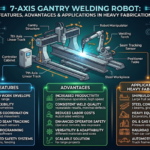
Quick Specs — 7-Axis Gantry Welding Robot
| Total Axes | 7 (6 articulated + 1 linear rail) |
| Weld Width (span) | Up to 5 m |
| Standard Rail Length | 12 m (customizable to 24 m+) |
| Positional Repeatability | ±0.05 mm |
| Typical Welding Speed | 0.3–0.5 m/min per robot |
| Supported Welding Processes | MIG, MAG, TIG, argon arc welding, flux-cored, laser welding |
| Robot Payload Range | 8–25 kg (model dependent) |
| Vision System | 3D line-scan stereo, up to 400 fps |
What Is a 7-Axis Gantry Welding Robot?

A 7-axis gantry welding robot is an industrial welding machine that combines a 6-axis articulated robot arm with a 7th linear axis mounted on a gantry portal frame, allowing the head to traverse the length of a large workpiece without repositioning a crane. Its 6-axis arm takes care of torch positioning and tilt; the 7th axis—a servo-driven linear rail—moves the entire arm horizontally over distances of 5 meters or greater.
This is significant because a fixed 6-axis robot quickly encounters the limits of its reach. As a typical 6-axis robot has a horizontal reach of less than 1,000 mm, and increasing its reach to 2,000 mm necessitates a pedestal approximately 700 mm across — plus the structural floor space to support it. For tasks like welding a 12-meter H-beam or a ship panel, that ratio simply doesn’t work. Supplementing a robot with a linear 7th axis lets machinery makers increase the effective working area without enlarging the existing robot. According to the International Federation of Robotics, 542,000 industrial robots were installed worldwide in 2024, with long-reach designs like gantry systems among the fastest-growing industrial sub-segments.
How the 7th Axis Transforms a Gantry Welding Robot
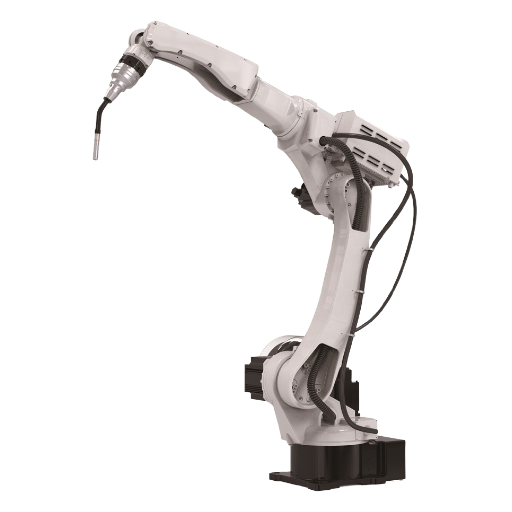
Beneath the portal, the seventh axis is a Robot Transfer Unit (RTU): a highly-accurate linear actuator that the robot is secured to, controlled by the same system that drives the six articulated joints. On a gantry welding robot, this RTU moves along the portal crossbeam, so the arm can reach any point along a 12 m span — or longer — while maintaining complete six-axis torch orientation. A more technical discussion lives in our related guide on how a gantry welding robot works.
In terms of actuators, industrial RTUs use four operating types — belt, screw, rack-and-pinion, and linear motor — but for long-travel welding applications, rack-and-pinion and linear motor drives tend to predominate because they maintain positioning precision over distances of 6 meters and more. Rack-and-pinion drives additionally let multiple independent robots share the same RTU — which is the foundation for dual-robot gantry setups where two arms work on opposite sides of the same ship panel.
What makes this a seventh axis rather than a mere transport mechanism is that the controller integrates the linear stroke into trajectory planning. Unlike simpler machines, a 7-axis welding robot does not drive the arm to a position and then start welding; the CNC controller coordinates linear travel with arm motion during the weld itself, eliminating singular-point lock-ups on long continuous seams and giving the torch a constant, optimized orientation along the entire workpiece. Coordinated motion like this is what makes a gantry welding robot behave like a true CNC machine rather than an articulated arm bolted on top of a linear slide.
📐 Engineering Note — Rail SpecificationsProduction-grade 7-axis rails support a 6-axis arm (typically 210–313 kg) plus its payload. Standard rail length is 12 m, with custom builds reaching 24 m for hull sections and bridge girders. Drive systems use rack-and-pinion for strokes above 6 m, with automatic lubrication and linear guide rails on both sides of the beam resisting the dynamic load of fast torch repositioning. Rail-alignment tolerance is the single most common source of maintenance downtime — floor-mounted designs require periodic shim checks; integrated portal frames eliminate the problem entirely.
Key Features of a 7-Axis Gantry Welding Robot

Five capabilities separate a production-grade 7-axis gantry from the lower-axis systems it replaces. Each is measurable and verifiable against robotic welding technology benchmarks — not a marketing abstraction. A wider context on the underlying automation stack lives in our overview of robotic welding technology.
Extended Rail Reach Beyond 12 m
The linear seventh axis carries the robot arm over a standard 12 m rail, with custom lengths beyond 24 m for shipyard and bridge plate applications. A single robot can weld a 12 m H-beam in one programmed pass, avoiding the stitched-joint compromises that constrain shorter 6-axis installations. Workpieces up to 5 m wide fit under a standard portal frame without an additional crane lift.
Teaching-Free 3D Programming
Modern 7-axis gantry systems accept a 3D model (Tekla, SOLIDWORKS, or UG) directly, and the controller generates the weld path automatically — no time-consuming teach pendant walk-through. On drawings-free work, a line-scan stereo camera reconstructs a point cloud of the physical part and reverse-engineers the weld trajectories on the spot, so operators can weld parts that were never modelled in CAD.
Intelligent Seam Tracking and Deformation Control
Running at up to 400 fps with 0.1 mm point-cloud accuracy, the 3D vision system tracks the actual seam position in real time and corrects for thermal distortion during the weld itself. Closed-loop vision with adaptive parameter control is documented in a 2024 Nature Scientific Reports study on smart-manufacturing robotic welding, which tracked how real-time sensing can reduce welding deformation and improve weld consistency on long seams — the exact failure mode that manual welding struggles with on heavy plate.
Multi-Process Welding Head
One 7-axis gantry can toggle between MIG, MAG, TIG, argon arc welding, flux-cored, and laser welding by swapping the torch and its power source. This flexibility matters for shops running mixed carbon steel, stainless steel, and aluminum workpieces on the same production line — rather than buying one dedicated robotic welder per process.
Dual-Robot Synchronized Operation
Gantry form factor supports two 6-axis arms on the same rail, operating under coordinated CNC control with collision-free trajectory planning. During shipyard flat-panel and bridge-plate-unit fabrication, a twin-robot workstation delivers roughly 1.8× to 2× the throughput of a single-arm cell, because both robots weld opposite sides of the workpiece simultaneously.
💡 Pro Tip
Not all features are worth paying for on every shop floor. If your dominant workpiece is less than 3 m long, a 6-axis cantilever on a short rail may beat a full 7-axis gantry on both capex and programming time. ROI on a 7-axis gantry compounds once your workpiece length is above 5 m or once you need two synchronized arms.
Advantages of a 7-Axis Gantry Welding Robot

Automation’s story begins with throughput and ends with defect control. Independent industry data, not vendor marketing, justifies the advantage math:
25–30%
Productivity gain (structural steel)
320,500
U.S. welder gap by 2029 (AWS)
12–24 mo
Typical payback period
542,000
Industrial robots installed 2024 (IFR)
That productivity number is the conservative, sourced figure — IFR World Robotics 2025 data records record industrial robot deployment, but the 25–30% throughput improvement comes from structural-steel automation case reports and industry welding productivity whitepapers, not aggregate market numbers. Some vendors claim 3–5× throughput gains; those are achievable in specific high-repeatability, no-fixture-change situations and should not be generalized. A complete cost and savings teardown in our welding robot cost breakdown walks through capex, consumable, and labor line items.
Defect rate is where a 7-axis gantry welding robot earns its value through measurable production efficiency. Manual welding on large plate reports a 5-15% defect rate, depending on position and operator fatigue; robotic welding with seam tracking maintains first-pass acceptance over 98% along long continuous seams. That defect differential alone can pay back the automation capex inside two years on a high-volume structural steel line.
✔ Advantages
- Handles workpieces too large for stationary 6-axis robots
- Closed-loop heat input limits welding deformation on long plate seams
- Teaching-free 3D programming reduces setup time from days to minutes
- Dual-robot gantry option nearly doubles throughput without floor space expansion
- Stable torch angle and travel speed drives welding quality above 98% first-pass
⚠️ Limitations
- Capex tier $100k–$500k+ for a fully integrated workstation
- The gantry footprint will always exceed the arm itself.
- Rail alignment and vision calibration need scheduled maintenance (quarterly)
- Programming learning curve for CAD import workflows and process parameters
- High-mix, low-volume shops may not realize ROI in less than 24 months
Before you commit to a full gantry workstation
Run rough numbers against your workpiece mix with the Workstation Selector or Efficiency Estimator before requesting a formal quote — no login required.
Applications of 7-Axis Gantry Welding Robots in Heavy Industry

Market demand aligns directly with four heavy-fabrication segments. The global robotics-in-shipbuilding market alone is projected to grow from $2.63B in 2025 to $5.44B by 2032 (10.9% CAGR), and similar growth in structural steel, bridge, and power equipment manufacturing is why gantry welding robots are replacing manual welders within these four segments first. Shops needing a compact-footprint alternative optimized for small and medium workpieces should look at our 8-axis cantilever workstation guide, which covers the narrower use case.
Steel Structure Fabrication
H-beams (equal and variable section), box columns, crane runway beams, steel trusses and rib plates comprise the majority of the robotic welding workload in structural steel shops. The combination of long continuous seams and repetitive geometry is precisely where teaching-free 3D programming and extended rail travel excel, and where automated welding stations deliver repeatable first-pass quality run after run. In one Zhouxiang dual-gantry deployment on H-beam production, throughput jumped 300% over manual welding with continuous 24/7 operation.
Shipbuilding
Hull sections up to 20 m long, deck plates, U-rib reinforced panels, and pipe-to-flange welds are the shipyard workload. A DTIC study on shipbuilding robotics and economics found that many shipyards now weld 25% or more of each ship by robot, with goals above 80% — a trajectory that the 7-axis gantry configuration directly serves. In a Zhouxiang shipyard panel-assembly case, a vision-guided robotic welding cell reduced welding cost 45% and held first-pass yield at 99.8%.
Bridge Plate Units
Orthotropic bridge deck panels combine long continuous seams with complex three-dimensional geometry — the worst case for manual welding’s accumulated thermal distortion. 3D trajectory planning with coordinated seventh-axis motion keeps heat input bounded on each pass, limiting welding deformation over spans that previously required post-weld straightening.
Power Equipment Fabrication
Transformer tanks, switchgear cabinets, wind-tower shell sections, and transmission-tower components demand tight dimensional control (here the ±0.05 mm robot repeatability is a baseline, not a selling point). Consistency from a 7-axis gantry is what qualifies these parts for service in the grid — and why energy-sector fabrication was among the earliest adopters of automated welding.
7-Axis Gantry vs Ground Rail vs Cantilever: Which Fits Your Shop?

Three long-reach welding robot configurations serve overlapping but distinct workpieces. The right choice comes down to the dominant dimension of the part you are welding — width, length, or accessibility — and how much floor you can hand the system. Our ground rail vs cantilever vs gantry comparison has the full three-way side-by-side.
| Feature | 7-Axis Gantry | Ground Rail | Cantilever | 6-Axis Stationary |
|---|---|---|---|---|
| Max Weld Width | Up to 5 m | 1.5–2 m | 3–4 m | Under 2 m reach |
| Max Travel Length | 12–24 m (rail) | 6–10 m (rail) | Fixed arm swing | Fixed pedestal |
| Floor Footprint | Largest (portal spans work space) | Long, narrow (fits along wall) | Compact | Smallest |
| Typical Workpiece | H-beams, hull panels, bridge plates | Long beams, single-side welds | Small-to-medium frames | Small parts, sub-assemblies |
| Capex Tier | Highest ($200k–$500k+) | Medium-high ($100k–$250k) | Medium ($80k–$180k) | Lowest ($40k–$100k) |
| Total Axes | 7 (scales to 8/9 with positioner) | 7 (rail + 6-axis arm) | 7/8/9 (cantilever + positioner) | 6 |
Stepping up to an 8- or 9-axis configuration adds a workpiece positioner or dual-axis rotation for higher stability on irregular parts, which is worth the extra cost when your geometry is complex (rib plates, manholes, non-orthogonal joints). For light-duty assembly work, a collaborative robot (cobot) on a short rail is a cheaper alternative, but it will not match the throughput or rigidity of a full-scale gantry welding station on heavy plate. Our guide to cantilever 7/8/9-axis configurations and the 9-axis cantilever flexibility write-up explain when that math tips over.
Choosing a 7-Axis Gantry Welding Robot for Your Production

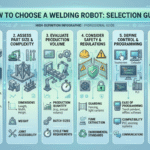
System selection is driven by five factors, not a simple catalog selection. Consider each of these in order before defining your system requirements, because the first three choices determine the rest.
- Maximum weldment span. Take your longest workpiece and measure in its dominant direction. Use this dimension to guide rail length: 6 m for shop-floor steel sub-assemblies, 12 m for in-process H-beams, 18–24 m for hull sections and bridge units.
- Workpiece payload and torch reach. 8 kg robot arms suit thin-wall structural welds; 12 kg is the dominant mid-market choice for heavy plate; 25 kg covers tandem-torch welding and heavy fixturing. Match robot motion radius to the deepest point you need to reach on a cross-section, not just the longest dimension.
- Welding process mix. Single-process shops (MIG only) can run a simpler torch package; multi-process fabrication (MIG, MAG, TIG, argon arc welding, laser) needs a quick-change torch and a multi-output power source such as the Aotai or Megmeet digital inverters commonly specified on gantry workstations.
- Programming workflow. If your engineering team already models parts in Tekla, SOLIDWORKS, or UG, buy a controller that imports those formats directly. If you do make-to-print from customer drawings, buy the stereo-camera point-cloud option so you can scan and weld without modeling first.
- Integration scope. A standalone welding station can be commissioned in weeks; integrating it into an existing line is straightforward when the controller is equipped to talk to your MES. An MES-linked production line — with task scheduling, digital twin monitoring, and automatic loading and unloading conveyance — needs architectural integration planning up front. Budget two to three months for the latter. For the broader decision framework, see our welding robot selection guide.
📐 Engineering Note — Two Worked ExamplesStructural steel shop, mid-volume: 12 m rail, single 12 kg arm (e.g. MR12-2010), MIG + flux-cored torch, Tekla model import, ground-mounted — typical capex $180k–$260k, payback 14–18 months on a line running 1,500+ H-beams/year.
Shipyard flat-panel cell: 24 m rail, twin 12 kg arms on dual carriages, MIG + argon arc welding, drawings-free point-cloud workflow, integrated portal frame — capex $400k–$600k+, payback 18–24 months on a hull-section production line.
Request a Zhouxiang gantry welding robot workstation quote →
Frequently Asked Questions

Q: Is a 7-axis gantry welding robot worth it for a mid-size fabrication shop?
View Answer
It varies with your workpiece mix and volume. Shops running long continuous seams on oversized parts — H-beams, box columns, flat panels above 4 m — hit payback inside 18 months because the gantry handles in one pass what a 6-axis stationary robot cannot physically reach. Low-volume job shops with high part variety see longer payback and may do better with a cantilever.
Q: How does a 7-axis gantry welding robot work, step by step?
View Answer
The operator loads a workpiece onto the fixture and either imports a 3D model (Tekla / SOLIDWORKS / UG) or runs a scan pass with the stereo camera. Once loaded, the intelligent welding controller identifies seam positions, matches process parameters (current, voltage, wire speed, torch angle) from its database, and plans a collision-free 3D path that coordinates the six articulated joints with the seventh linear axis. One-click execution then runs the full weld, with vision-based seam tracking correcting the path in real time and an automatic torch-cleaning cycle between passes.
Q: What is the 7th axis, and how is it different from a 6-axis robot?
View Answer
Six axes on an articulated robot are all rotary joints that give the torch orientation. Its seventh axis is a linear rail — the Robot Transfer Unit — that carries the entire arm horizontally. It is treated as an axis rather than a transport mechanism because the controller coordinates its motion with the other six during welding itself, allowing continuous long seams with consistent torch angle.
Q: How much does a 7-axis gantry welding robot cost?
View Answer
Complete workstations typically fall in the $150k–$500k+ range. Key cost drivers are rail length (per meter), the number of robot arms (single vs twin), vision system specification, and MES integration scope. Request an itemized quote rather than a ballpark — component-level pricing varies more than system-level.
Q: Can a 7-axis gantry welding robot handle both long pipes and flat panels?
View Answer
Yes — with the right fixture. Modular gantry cells accept both a flat workholding table for panels and a rotation-axis positioner for cylindrical workpieces. On pipe-heavy shipyard work, that positioner is typically an 8th-axis option. Programming switches between pipe-facing and flat-plate paths through fixture presets in the controller.
Q: What maintenance does a gantry welding robot need annually?
View Answer
Quarterly rail alignment check, lubrication of linear guides, and vision-sensor calibration are the three recurring items. Welding consumables — contact tips and gun liners — drive the most frequent preventative intervention and are the top cause of burnback on a robotic torch, so automatic torch-cleaning and scheduled tip replacement matter more than any single CNC parameter. Controller firmware updates are annual. Most OEM service contracts roll these into a 2–5% of capex annual maintenance budget.
Related Articles
- Gantry Robot vs Articulated Robot for Welding — configuration-level trade-offs
- Robotic Welding Cell Cost Breakdown — capex and opex line items
- Welding Robot Maintenance Schedule — what to check and when
- Robotic Welding vs Manual Welding — productivity, quality, and cost comparison
References & Sources
- World Robotics 2025 Report — Global robot demand in factories doubles over 10 years — International Federation of Robotics
- Where Are the Welders? — October 2025 Welding Digest — American Welding Society
- Welding Workforce Data Portal — American Welding Society
- What is a 7th Axis (also known as an RTU) and when is it used? — Linear Motion Tips
- A smart-manufacturing approach for robotic welding process planning — Nature Scientific Reports, 2024
- Shipbuilding Robotics & Economics — Defense Technical Information Center (DTIC)
- Robotics in Shipbuilding Market Report 2025–2032 — Fortune Business Insights
About This Analysis
This article addresses fabrication buyers comparing 7-axis gantry welding robot configurations against cantilever and ground-rail alternatives for steel structure, shipbuilding, and bridge-plate production. Authority data on welder demand and industrial robot deployment is drawn from AWS Welding Digest October 2025 and the IFR 2025 World Robotics Report; the productivity benchmarks reflect published structural-steel and shipyard case reports. Zhouxiang’s 34 years of welding-automation deployment experience informs the sector-specific sizing guidance, but all sourced statistics above come from independent authorities, not vendor literature.