Get in Touch with Zhouxiang

Ground Rail Welding Robot Station: How It Works, What It Costs, and How to Choose One
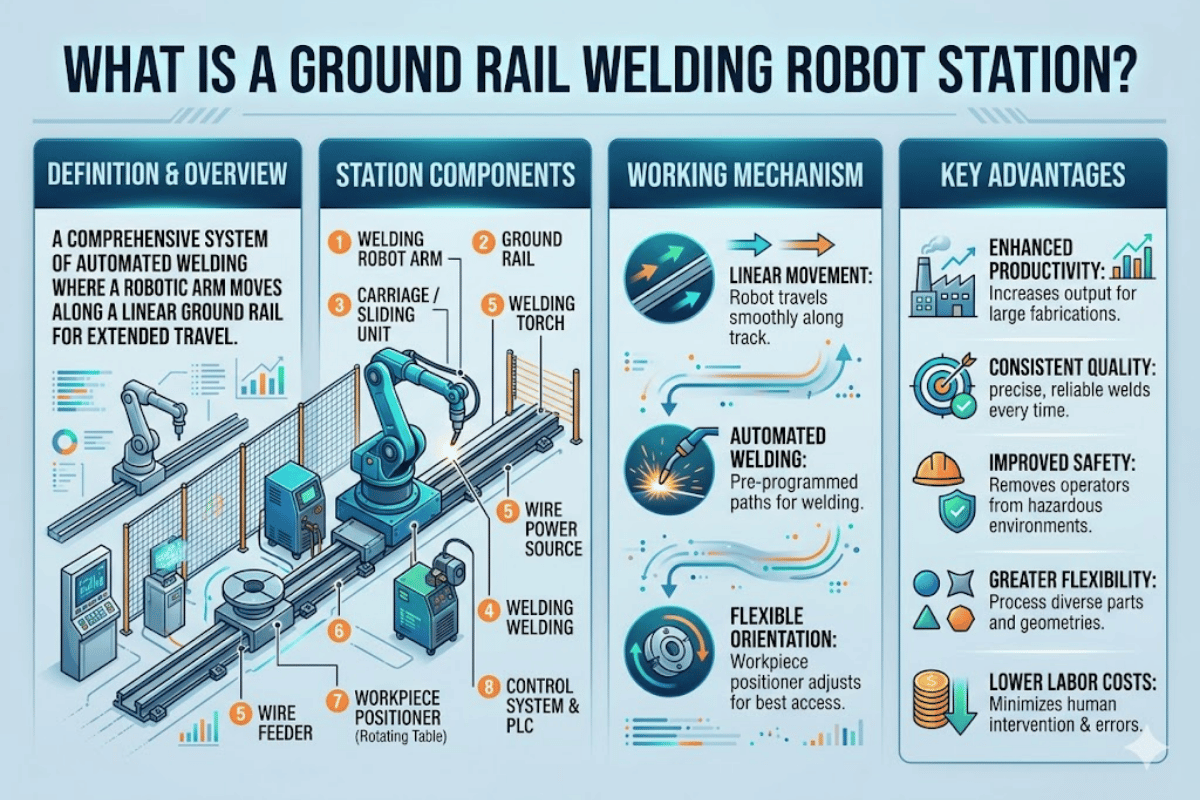
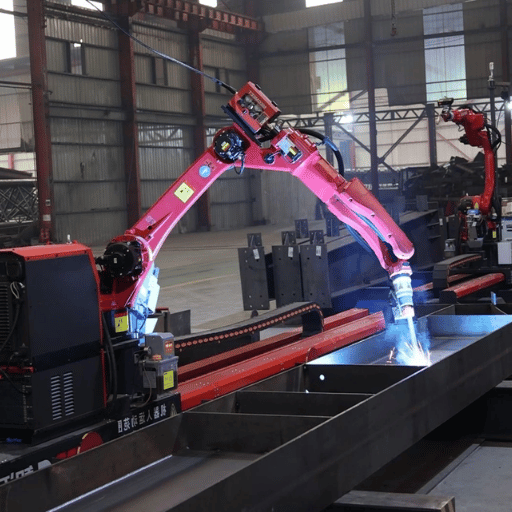
When a steel shop welds H-beams that are 12 meters long or box columns weighing multiple tons, a fixed-position robot just isn’t able to reach the entire length of the joint. That’s the dilemma a ground rail welding robot station addresses. As defined, a ground rail welding robot station is a robotic welding system that holds a 6-axis industrial welding robot on a linear floor-mounted track (ground rail), allowing the robot arm to move along the track to weld long or oversized steel structure workpieces that go beyond the limits of a fixed-position robot.
Tooling requests for these types of automation are not decreasing. According to the IFR 2025 World Robotics Report, 542,000 industrial robots were installed globally in 2024 – double the number that were installed a decade ago – and 21% of those units were used for welding and soldering applications. This article breaks down each component, walks through the welding process one by one, compares ground rail stations against other layout options, and provides you with real cost data so you can make a confident buying decision.
What Is a Ground Rail Welding Robot Station?
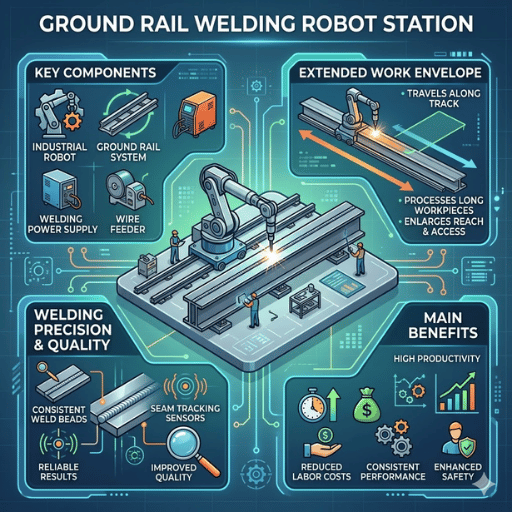
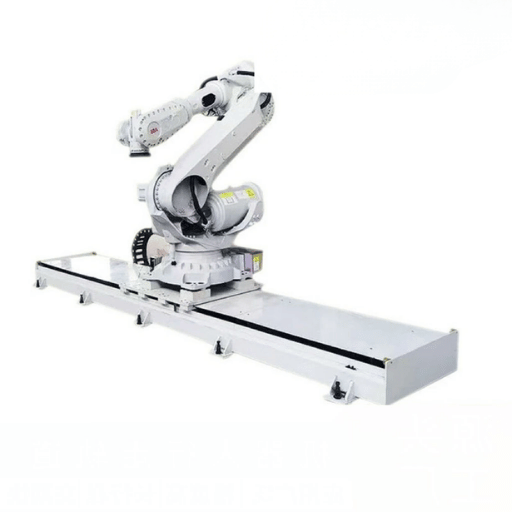
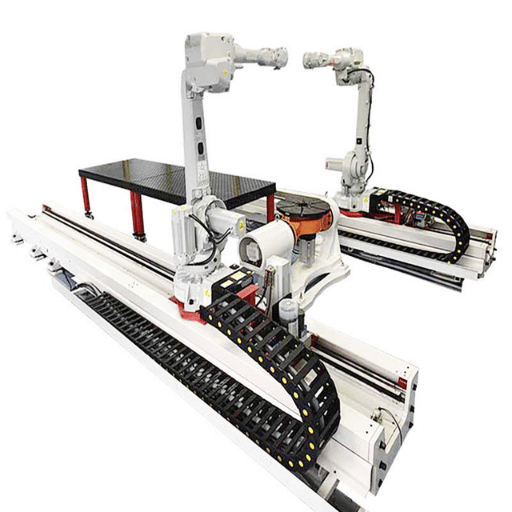
A ground rail welding robot station is a robotic welding system in which a 6-axis welding robot travels on a precision machined linear track mounted in the floor. Its rail extends the robot’s operation range from a fixed radius cell to a linear path of 6 meters, 12 meters, or more – allowing the robot to weld long steel structure members in a single set up without moving the workpiece.
Compared to overhead gantry systems that require significant steel framing above the work envelope, a ground rail welding robot keeps a low profile. During welding, the robot travels the rail axis (often called the 7th external axis), matching its travel speed to the six joint axes so the welding torch stays oriented at a constant angle and standoff distance relative to the weld seam. This synchronized movement explains why a true ground rail workstation is different from a robot placed on a cart.
542,000
Industrial Robots Installed Globally (2024)
21%
Used in Welding & Soldering
6–20m+
Typical Rail Travel Length
Zhouxiang has built welding automation equipment for more than three decades, and we have observed ground rail stations become the standard layout for steel structure shops that process long members. View our current selection on the ground rail welding robot station product page.
💡 Pro Tip
If your workpieces are less than 2 meters long and are relatively consistent in profile, a fixed robot cell may make more economic sense. ground rail stations are an investment that makes sense when the need to weld joints across long spans or several workpieces together; or fixturing many parts on a ground rail station for batch processing.
Core Components of a Ground Rail Welding Workstation
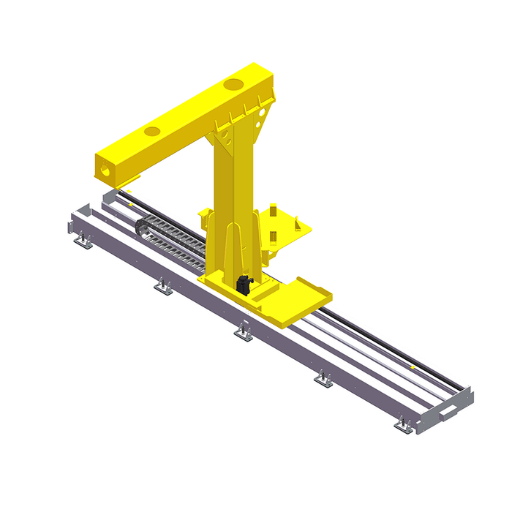
A ground rail welding workstation is not a single machine – it is an integrated cell comprised of eight subsystems that need to function in harmony. Gaining perspective on each module helps you evaluate proposals from vendors, juxtapose quotes, and identify hidden costs during installation. Here’s a breakout of each major assembly, what it does, and the critical criteria.
| Component | Function | Key Specs |
|---|---|---|
| 6-Axis Welding Robot | Positions the welding torch along programmed weld paths with high repeatability | ±0.05 mm repeatability, IP67, 6–20 kg payload |
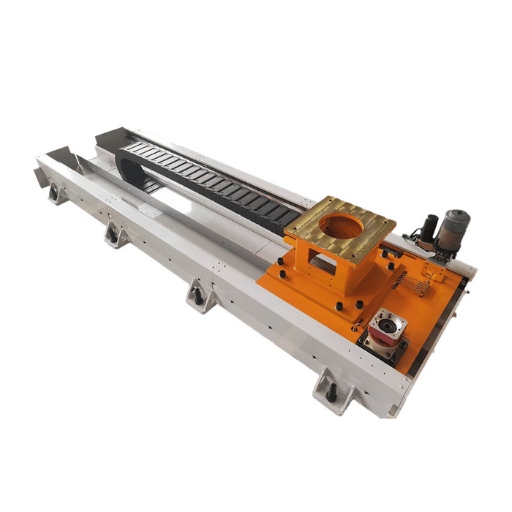
| Ground Rail System (7th Axis) | Provides linear travel so the robot can reach the full length of the workpiece | 6 m standard; customizable to 20 m+; rack-and-pinion or ball-screw drive |
| Welding Power Source (Welding Machine) | Delivers controlled welding voltage and current to the arc | MIG/MAG, 350–500 A; digital process parameters control; pulse/double-pulse modes |
| Welding Torch / Welding Gun | Directs wire, gas shielding, and current to the weld joint | Liquid-cooled; quick-change contact tip; anti-collision mount |
| Control System (Robot Control Cabinet) | Coordinates robot motion, rail travel, and welding process parameters in real time | Integrated PLC; teach pendant + offline programming interface |
| Gun Cleaning Station | Removes spatter from the welding gun nozzle and applies anti-spatter spray between cycles | Automatic trigger; wire cutter; programmable cleaning cycle |
| Laser Seam Tracking Sensor (e.g., CP350V) | Detects weld seam position and adjusts torch path in real-time to compensate for fit-up variation | ±0.1 mm detection accuracy; 350 mm standoff; collision detection built in |
| Safety Enclosure | Protects personnel from arc flash, spatter, and robot motion | Compliant with OSHA Guidelines for Robotics Safety and ANSI/RIA R15.06 |
All of these elements go into the final weld quality. An accurate robot is worth nothing if the power feed produces an unstable arc, and the greatest welding machine in the world cannot eliminate rail backlash. That is why turnkey integration- in which a single supplier manages the entire cell- frequently results in better performance than sourcing individual components from five separate suppliers. You can examine Zhouxiang’s ground rail welding robot models to see how these elements all integrate in a finished workstation.
💡 Pro Tip
Always verify that your safety enclosure adheres to OSHA and ANSI/RIA R15.06 before signing your purchase order. Improper enclosure design can lead to expensive retrofits and production interruptions in your facility audit.
How Does a Ground Rail Welding Robot Station Work?
Every production run on a ground rail station progresses through a five-step cycle performed in a continuous loop. Once the programming is finalized, the eight-step cycle can be run entirely in autopilot. Here’s a detailed summary of the process.
- Workpiece positioning – the operator or crane places the steel structure workpiece onto the rail-mounted fixtures. Magnets and clamps secure the workpiece. When its position is confirmed, the operator leaves the enclosure.
- Programming – the engineer develops the part program without using the teaching pendant based on a Tekla import. The Tekla3D model of the part is brought directly into the robot offline environment, and welding paths are automatically generated using digital twin technology data. This process replaces time-consuming teach pendant job setup. When the process needs repeating, the operator saves a copy of the job data for recall.
- welding path performance – the robot goes into welding and runs down the ground rail as directed. The laser seam tracking sensor scans ahead of the welding torch and modifies weld position in real-time – adjusting for thermal distortion, difference in fit-up and tack weld irregularities. Meanwhile, the control system adjusts rail velocity, robot joint angles, welding voltage, wire feed speed, and shielding gas flow simultaneously.
- Gun maintenance – between cycles, the robot moves to the gun cleaning station. During this auto-maintenance, the nozzle is reamed, anti-spatter agent is dispensed, and the wire is cut to a predetermined stick-out. This practice optimizes contact tip life and smooths out weld arc stability.
- Inspection and data collection – once weld is complete, the entire program logs all process parameters – amperage, voltage, wire feed, travel speed, and seam tracking fine-tuning – to an SQL Server database that can be monitored remotely. Some systems add vision camera and ultrasonic sensors to display determined part quality metrics in real-time. After logging, the workpiece is unloaded to get ready for the next cycle.
Studies published in Frontiers in Mechanical Engineering (2024) demonstrate that digital twin technology implementation on robotic welding cells reduces programming duration up to 70% over teach pendant system. At Zhouxiang Corporation, we have converted in-house shop programs from teach pendants to Tekla-based offline programming, reducing setup time for new part numbers from several hours to under 30 minutes.
💡 Pro Tip
A teaching-free offline programming pays for itself in the shortest order when you’re running more than five unique part geometries per month. If you weld the same two or three parts over and over again, a stored teach pendant program will do just fine.
Industries and Applications
ground rail welding robot stations were at first created to weld steel structure fabrication. Their long, heavy geometry has naturally drawn them into many other industries beyond structural steel, from vessel manufacturing to HVAC fabrication. Any shop where weld joints are several meters long—a sizable shop indeed—or where many assemblies are staged along the same rail, can easily become a ground rail welding robot user.
- steel structure fabrication—H-beams, box columns, purlins, trusses, and plate girders. This continues to be the largest market segment. A single ground rail station can weld both flanges of an H-beam in a single pass cycle, immensely decreasing handling times.
- Shipbuilding—Hull panels, deck sections, bulkheads, and sub-assemblies. Ship yards often instead run extended-length rails (15-20 m) to weld long flat panel sections before lifting them into the hull.
- Bridges & Infrastructure construction: Bridge girders, pier caps, and cross-frames call for multi-pass fillet and butt weld on members often longer than 10 meters. Using automated weld on a ground rail ensures a uniform penetration along the entire length of the joint.
- Energy equipment—Transformer tanks, transmission tower segments, and wind turbine ring bases. These parts pair heavy plate with strict weld quality standards—just where robot welding excels over manual labor.
- Heavy equipment & transport—Excavator booms, crane arms, rail car frames, and trailer chassis. As a high-mix shop, fixturing can switch quickly from one part family to another by utilizing fast-change tooling on the rail.
The myth busting: Many purchasing managers believe that a ground rail station can only be used economically in large factories running high volumes. They couldn’t be more mistaken. Small and medium-sized high-mix/low-volume Shops reap far the most benefit given rail-fixturing since many different part types may be fixtured in a single cycle. The robot weld workpiece, drifts down the rail to the next; meanwhile the operator is loading the station for the next cycle. This dual-station set-up maintains continuous weld and reduces the idle time that kill ROI in a small shop.
Also, it is worthy to point out that IFR statistics indicate in 2024 electronics surpassed automotive as the most-robot-installing industry. The use of automation in now expanding into industrial areas other than automotive assembly plants—anywhere regular weld quality and reliable labor is hard to find.
#1
Steel Structure — Top Application Sector
15–20 m
Rail Length Common in Shipbuilding
Ground Rail Welding Robot vs. Other Configurations
A ground rail station is just 1 of the options to increase welding robot reach. Which is right for you depends on your part geometry, available floor space, budget, and production mix. Below is a comparison of the 4 most common arrangements is meant to help you understand how each type would suit you— and what its limitations are.
| Feature | Ground Rail Station | Gantry Welding Robot | Fixed Robot Cell | Positioner + Robot |
|---|---|---|---|---|
| Best For | Long/oversized parts | Very large flat panels | Small-medium batch | Rotational welds |
| Reach Extension | Linear (6–20 m+) | X-Y-Z overhead | Fixed radius | Rotation only |
| Floor Space | Moderate (linear footprint) | Large (overhead frame) | Compact | Compact |
| Cost Range | $80K–$200K | $200K–$500K+ | $75K–$175K | $60K–$150K |
| Programming | Offline + teach-free | Offline programming | Teach pendant | Teach pendant |
| Flexibility | High (rail length adjustable) | Moderate | Low-medium | Medium |
A gantry welding robot mounts the arm on an overhead X-Y-Z frame. This is best for extremely large, flat assemblies (ship deck panels or storage tank shells). A gantry structure is two to three times the cost of a ground rail station, and requires significant steelwork overhead of the work cell. Fixed robot welding cells are least expensive for parts that fit well in the robot’s reach envelope, but give no reach extension at all. A positioner-plus-robot arrangement is well suited for welds that are linear-driven (pipes, flanges, pressure vessels), or rotational in combination, but cannot handle linear travel demands.
💡 Pro Tip
Select a ground rail configuration if your workpieces are longer than 3 meters or you weld multiple shorter parts within one automation cycle. If most of your parts involve rotational joints under 2 meters, a positioner-based cell will be more economical and deliver higher arc-on time. Contact our engineering team for help selecting the right ground rail configuration for your workshop.
Cost and ROI of a Ground Rail Welding Robot Station
Pricing for a complete ground rail welding robot station can vary from $80,000 to over $200,000 depending on the length of its rails, robot payload, sensor packages, and the complexity of custom fixturing. Here is a component-level cost breakdown is based on 2024-2025 project quotes, so you can see where your budget is allocated and where you might be able to scale things back.
| Cost Component | Typical Range |
|---|---|
| 6-Axis Welding Robot | $30,000–$80,000 |
| Ground Rail System | $10,000–$30,000 |
| Welding Power Source | $5,000–$15,000 |
| Sensors & Software | $10,000–$25,000 |
| Safety Enclosure | $5,000–$15,000 |
| Integration & Installation | $15,000–$40,000 |
| Total Turnkey System | $80,000–$200,000+ |
Your welding robot is normally the single largest expense, but don’t neglect integration and installation costs; they include mechanical mounting, electrical hookup, safety system commissioning, programming initial part families, and operator training. Avoiding professional integration to save money is a false economy; a misaligned rail foundation or miscalibrated sensor will cause rework that makes your original savings irrelevant.
1–3 Years
Typical Payback Period
3–5×
Throughput Increase vs. Manual Welding
Up to 90%
Defect Reduction
Most fabricators realize ROI in one to three years, driven by three factors: labor savings (a single robot replaces two or three manual welders per shift), throughput increases (robots sustain arc-on time at over 60 percent instead of 20-30 percent for a human welder), and defect reduction (consistent process parameters lead to fewer repairs and scrap). Typical annual costs for maintenance including nozzle reaming parts, contact tip replacements, rail lubrication, and periodic calibration runs $2,000 to $5,000.
💡 Pro Tip
Include in ROI calculations the cost of weld repairs and rework time from defects in your current manual process. Many shops underestimate this figure; record rework hours for one month before running your number.
How to Select the Right Ground Rail Welding Robot System
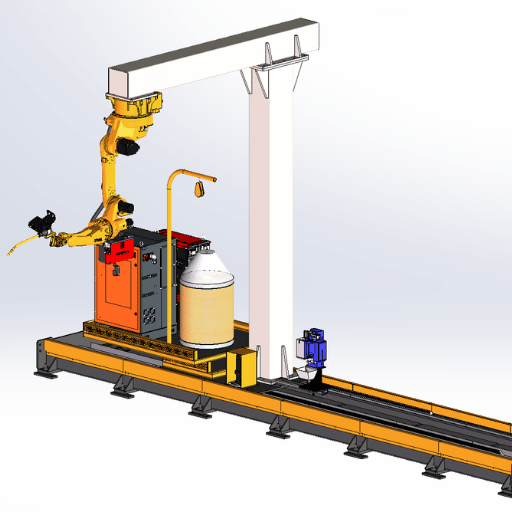
To select a system, you need to match your production needs to the station’s technical limits. Oversizing costs money; undersizing creates bottlenecks within a matter of months. Use the five-point criteria to measure your needs, so that the purchase you make fits the operation.
- Identify your maximum workpiece length. This will be determining factor for rail length. Allow for robot travel and fixture clearance by adding at least 1.5 meters to your longest part.
- Determine what your most common weld types are. Fillet welds on H-beams will need different torch angles and weave patterns that butt welds on plate. Multi-pass welds on thick steel structure members will require higher duty cycle power supplies and more advanced welding process control than single-pass welds on thin members. Make sure you get a system capable of running the joint types you need most often.
- Assess your programming needs. If you run less than five part numbers, a teach pendant will be fine. If you process dozens of unique geometries every month, look for offline programming tools with Tekla or SolidWorks loading capability. Teach-free offline programming will cut setup times in high-mix shops.
- Design your shop floor layout and work cells. ground rail stations need space for the entire rail length, plus a safety zone to meet ANSI/RIA R15.06 and your local standards. Lay out your foundations before you start pouring. weld fume extraction systems and overhead crane access points also need to be included in your plans.
- Calculate your ROI based on your current production rate and labor efficiency. Ask your provider to give you an estimated cycle time for your most common parts. Grow your throughput and reduce your labor costs for three years and compare this value with your complete turnkey pricing, including installation and training. If it takes more than three years to break even, explore a scaled-down system. A shorter rail or fewer sensors may save enough capital for your project to make financial sense.
All welding has to comply with the relevant codes. For structural steel in the United States that can mean AWS D1.1:2025 Structural Welding Code compliance. Ask your vendor to produce convincing proof that their system generates welds that beat your code requirement before you buy.
Visit the ground rail welding robot station product page to download spec sheets and configuration options.
💡 Pro Tip
Ask your weld vendor for a quick coupon weld test of your actual material and joint type before you buy. A test on mild steel plate does not mean you will be happy with the results on your data alloy, in your specific application.
Frequently Asked Questions
Q: How is the welding path programmed on a ground rail robot?
View Answer
There are two methods for high-mix shops. The traditional method uses a teach pendant, where weld points are achieved by placing the robot by hand and recording a weld position with a hand jog. The alternate method uses offline programming software that pulls data out of your Tekla or SolidWorks drawings and running a simulation to produce a welding path toolpath automatically. Laser seam tracking then fine-tunes the path during actual welding to correct for real-world fit-up variations.
Q: What maintenance does a robotic welding station require?
View Answer
Here’s the routine maintenance. Changing contact tips and nozzles on the welding torch (per shift or day depending on volume), regularly lubricating the ground rail drive system, quarterly calibration of the laser seam tracking sensor, and checking cable harnesses for signs of wear. Budget $2,000 to $5,000 per year to keep the controls calibrated and weld quality consistent.
Q: What is the function of the gun cleaning station on a welding robot?
View Answer
Reams spatter out of the welding gun nozzle, sprays anti-spatter fluid, and cuts the wire to a set length after every weld cycle, automatically.
Q: Can small businesses benefit from a ground rail welding robot?
View Answer
Yes. Small and medium-sized fabricators often see the fastest payback because they face the greatest pressure from skilled welder shortages and rising labor costs. A dual-station ground rail layout — where the operator loads one end while the robot welds at the other — keeps arc-on time high even at lower production volumes. Entry-level systems starting around $80,000 can pay for themselves within two years for shops running two shifts. Some smaller shops lease rather than buy, spreading the capital outlay over 36–60 months as an operating expense that scales with order volume. Arc-on time is the key metric: if your manual welders average 20–25%, a robot station pushing 60%+ will deliver a dramatic throughput jump even on a single-shift schedule.
Q: What is the lifespan of a welding robot?
View Answer
A well-maintained industrial welding robot typically runs for 80,000 to 100,000 hours, or 10-15 years in a two-shift facility. Rare failures occur at the welding source, the robot arm controller or the power interface: most degradation occurs in consumables (torch, tips, liners) and peripheral power sources and cabling. Periodic refurbishings of the rail drive system and robot joint gearboxes can extend useful life beyond 15 years.
Q: What type of voltage does the ground rail welding robot use?
View Answer
The robot controller and welds require a three-phase industrial power input (380V/50Hz or 480V/60Hz) native to your country. The power source will also require a three-phase industrial power input, The welding output will be a highly controlled welding voltage (nominal 15-35V for MIG/MAG) supplied to the arc. Confirm the input power requirements with your vendor.
Ready to Automate Your Welding Line?
Get a custom quote for a ground rail welding robot station sized to your production needs.
Explore our complete range of ground rail welding robot stations to find the perfect configuration for your shop.
About This Guide
This article is based on Zhouxiang’s 30+ years experience designing welding automation systems for steel structure fabricators, shipbuilders and heavy equipment builders. Price ranges are indicative of 2024-2025 project estimates using multiple different rail lengths and robot payloads. Details cited of components come from our current ZXR robot series and CP350V laser sensor data – your actual installation maybe different based on workpiece geometry and output requirements.
References & Sources
- IFR 2025 World Robotics Report — International Federation of Robotics
- OSHA Guidelines for Robotics Safety — U.S. Department of Labor
- OSHA Welding, Cutting, and Brazing Standards — U.S. Department of Labor
- AWS D1.1:2025 Structural Welding Code — American Welding Society
- Welding Robot Automation Technology Based on Digital Twin — Frontiers in Mechanical Engineering
- ANSI Z49.1-2021 Welding Safety Standard — American National Standards Institute