Get in Touch with Zhouxiang

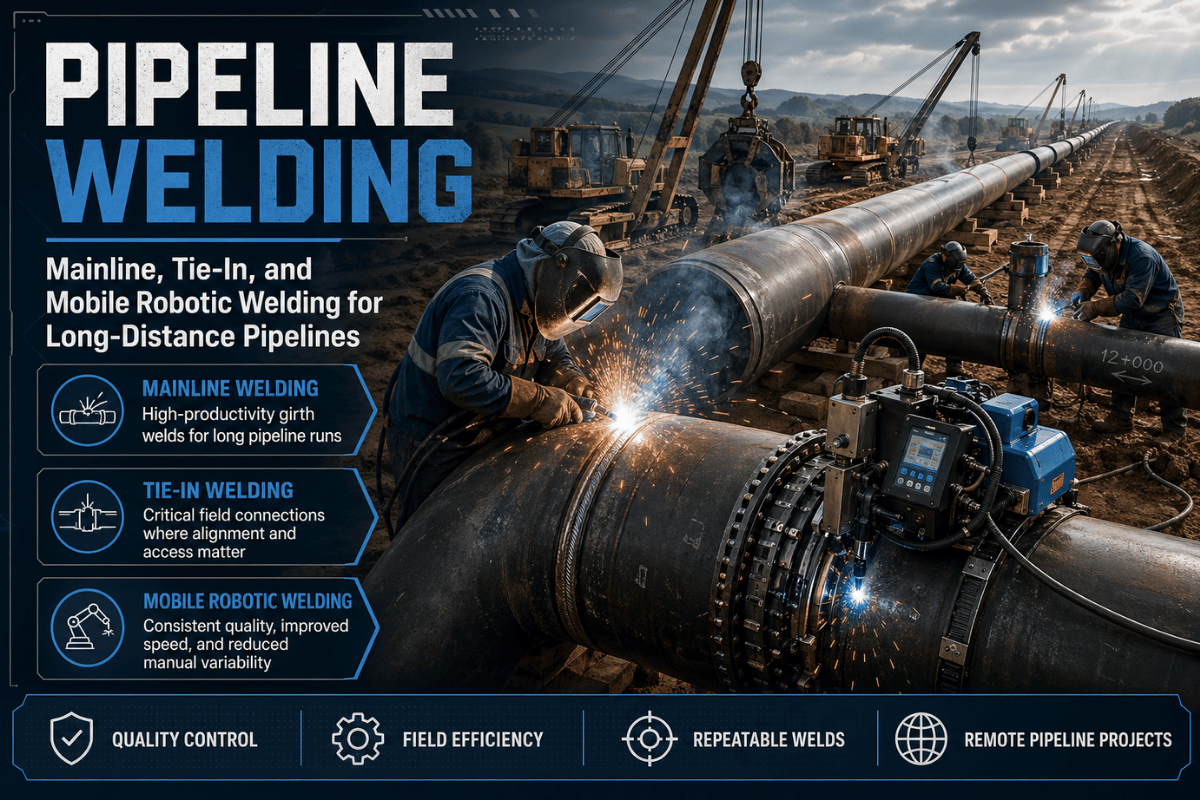
Mainline, tie-in, and mobile robotic welding decisions for pipeline projects
pipeline welding joins pipe sections into a pressure carrying pipeline used for oil, gas, water, utility service lines, process plants, energy infrastructure, and the wider welding industry. Field crews are not only trying to make a weld look clean. They are also trying to control fit-up, procedure, welder approval, inspection hold points, repair risk, and paperwork while moving through changing terrain.
That is why a good pipeline welding plan reads more like a field production system than a lone welding tip. In the real job, the pipe process has to connect pipe geometry, welder error, filler metal option, weather mitigation, NDT access, and hand-off records before the first root pass is started.
Quick Specs
| Common pipeline materials | Carbon steel and alloy steel pipe, with project-specific grade and wall thickness |
| Common processes | SMAW, GMAW, FCAW, GTAW, SAW, mechanized welding, automatic welding |
| Typical field sequence | Bevel, clean, align, root pass, hot pass, fill pass, cap pass, visual inspection, NDT, record closeout |
| Main risk | A weld defect can become a leak point or a delay before hydrotest, pressure test, or turnover |
| Automation fit | Best where the path repeats, access is stable, and the pipe or structure is too large to move into a fixed cell |
What Is Pipeline Welding?
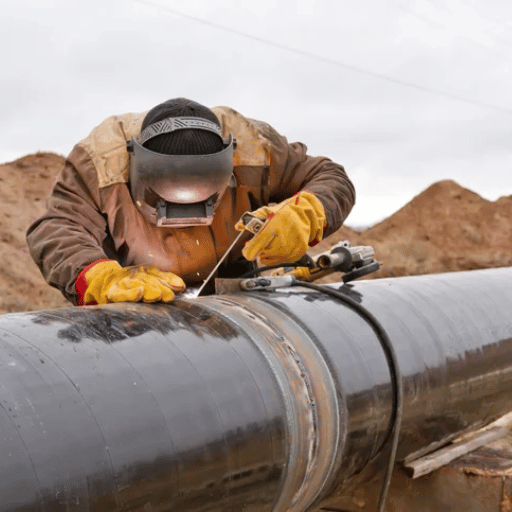
In short, pipeline welding is the welding of pipe sections into a continuous pipeline system. In practice, it covers joint preparation, pipe alignment, procedure control, qualified welders, inspection, testing, and repair rules for lines that may run through remote right-of-way, plants, stations, crossings, or cross-country terrain.
Pipe welding is the broader fabrication skill. Pipe welders may work on shop spools, process piping, structural pipe, or plant maintenance. For field construction, the term narrows the job to transmission or distribution lines, where the weld becomes one link in a long pressure system. That distinction matters because a line weld is judged by the owner specification, code basis, inspection result, and service risk, not only by bead appearance.
AWS describes a pipeliner as a welder who builds and maintains systems that transport oil, gas, water, and other materials over long distances. That career framing explains why search results mix technical pages with pipeline welder salary pages and certification pages. This article keeps those topics in view, but the main body stays on the field process.
How Pipeline Welding Works From Fit-Up to Cover Pass

Proper field girth welds begin before the electrode or wire reaches the pipe. Before welding, bevel angle, land, root gap, hi-lo fit-up, surface cleaning, clamp selection, and preheat concept plan determine how hard the root pass will be to execute. Experienced field personnel can offset some variation. The project plan should not depend on that every time.
| Stage | Field check | What can go wrong |
|---|---|---|
| Bevel and end prep | Face angle, land, cleanliness, coating setback | Too much grinding, contamination, wrong root face |
| Line-up | Root opening, internal mismatch, clamp pressure | Lack of penetration, concavity, added repair time |
| Root pass | Travel speed, amperage or voltage, keyhole control | Burn-through, suck-back, incomplete fusion |
| Hot, fill, and cap passes | Interpass temperature, slag removal, bead tie-in | Slag inclusion, undercut, poor cap profile |
| Inspection and records | Visual acceptance, NDT status, weld map, welder ID | Rejected weld, missing traceability, delayed turnover |
Each pass also throws a heat input question. Too low, and the penetration and fusion may suffer. Too high, and the joint may warp or develop metallurgical issues. Swing windows derive from the approved welding procedure specification, not human habit alone.
What Type of Welding Is Used for Pipelines?

TWI market shielded metal arc welding, flux-cored arc welding, gas metal arc welding, submerged arc welding, and gas tungsten arc welding among popular pipe welding techniques. Projects may choose one process for the root and another for fill or cap passes. Process selection depends on joint shape, access availability, shielding needs, labor calculation, inspector expectations, and the approved WPS.
| Method | Where it fits | Field limitation | Automation fit |
|---|---|---|---|
| SMAW / stick | Remote joints, repairs, tie-ins, changing access | Electrode changes and welder skill drive consistency | Limited |
| GMAW / FCAW | Mechanized fill and cap work, controlled work zones | Shielding and wire-feed stability matter outdoors | Strong when access and shielding are controlled |
| GTAW / TIG | High-quality root passes, small-bore or critical joints | Slower and skill-heavy | Conditional in controlled areas |
| SAW | Pipe mill, spool, or fabrication-yard work | Less practical for open-field girth welds | Strong in fixed or guided setups |
| Automatic pipe welding | Repeated joints, stable access, planned inspection points | Needs setup time, path control, and qualified procedure support | Strongest where repetition is real |
Is pipeline welding stick, MIG, or TIG?
It can be any of them. Many pipeliners continue to use SMAW because the portable equipment is good in hard-to-reach sites. MIG-type GMAW or FCAW is the average for faster shielding, wire feed, or carriage movement.
TIG is used where the root pass or material needs extra control. One pipeline welding procedure might even combine methods between passes.
Mainline Welding vs Tie-In Welding: Why the Workflow Changes
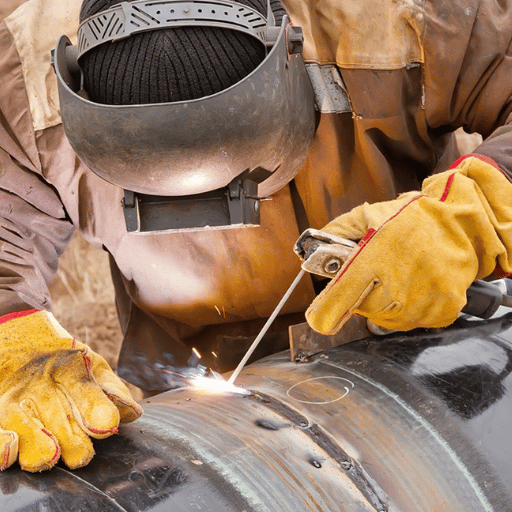
Mainline production welding is based on movement. Crews set the right-of-way, string pipe, bevel ends, align joints, do multiple-guides of the same girth weld, inspect, coat, and move on. Tie-in welding is different.
It bridges the hits, cross overs, stations, or repair points where one cannot just tip the pipe up to gain access.
Mainline work
Additional joints. Planned crew flow makes production time shorter. Make equipment lanes more obvious and allow more opportunity for mechanized/automatic welding.
Rhythm is important for production but inspection is still King.
Tie-in work
Limited access, backup welds completed, enhanced rework pains, and increased reliance on a senior welder, strict hold points, and clear communication between weld and inspection/test teams.
Generally, automation will fit mainline work before tie ins. the repetitive geometry of the joint give a robot, carriage, or guided torch a reasonable chance to recuperate its setup time. Tieins will still use positioners, crawlers, or special out fitting tools; however, that work is often too inconsistent for a single repeat program.
5G/6G Pipeline Welding Positions and Certification Basics

Pipeline welder is normally tested in predetermined positions because field pipe does not turn for welders ease. In 5G position pipe is horizontal and immovable, those tests are conducted through the combination of overhead, vertical, and flat around the joint. In 6G position pipe is fixed at an angle, such as 45 degrees, which makes the test more difficult and simulate more difficult field access.
Procedure control is not the same as skill of the welder. According to AWS standard welding procedure specifications is supported procedure qualification records. In project the welder, contractor, procedure, base, filler, preheat, pass sequence and acceptance criteria must exactly match the controlling specification.
What is 6G pipe welding?
6G pipe welding is a qualification position where the pipe is fixed at an angle and cannot be rolled. During 6G, the welder has to handle gravity, changing travel angle, puddle control, and body position through the full joint. Passing a 6G test does not automatically qualify a person for every pipeline job, but it signals advanced pipe welding ability.
Inspection, Codes, and Leak Risk Control

For U.S. gas pipelines, 49 CFR Part 192 includes a welding subpart covering welding procedures, welder qualification, weather, joint preparation, weld inspection, nondestructive testing, and defect repair or removal. For hazardous-liquid pipelines, 49 CFR Part 195 covers similar welding controls, plus tie-in testing and records in sections such as 195.308 and 195.310. Project teams still need to verify the current rule, owner specification, contract, and jurisdiction before work starts.
API Standard 1104, 22nd edition, covers welding pipelines and related facilities for construction and in-service repair of pipe and components for crude oil, petroleum products, fuel gases, carbon dioxide, and nitrogen. OSHA 1910.252 also gives welding safety rules, including fire-watch and ventilation requirements for certain work conditions.
Engineering Note: inspection hold points
Set hold points before weld production starts: fit-up release, root-pass visual check, final visual check, NDT release, repair acceptance, pressure-test boundary confirmation, and record closeout. Any weld map without welder ID, procedure number, NDT status, and repair history is weak evidence after the crew leaves the right-of-way.
The inspection is performed for surface and internal defects such as cracks, undercut, porosity, lack of fusion, lack of penetration, slag inclusion, excessive penetration, misalignment. The dimension-specific shape and surface mechanic defect detection is the strength of visual inspection, while the other essential questions of hidden defect size, shape, procedure or equipment performance are supplied by the non destructive testing including radiographic, ultrasonic, magnetic particle, eddy current, as well as destructive testing.
Manual, Automatic, and Mobile Robotic Pipeline Welding: When Each Fits

Manual welds are still important where joint access changes every joint, outside weather control is sub-standard, judgment is required to accept or reject repairs, or variable point-to-point geometry causes difficulty. Automatic pipe welding has advantages when the joint is repeated and the project has the capital cost of fixturing, test coupons, parameter monitoring, and qualified operators. Mobile robotic welding is positioned where field work on different pipe sections is the best compromise between factory repeatability, not welding without workers.
| Setup | Good fit | Bad fit |
|---|---|---|
| Manual crew | Tie-ins, repairs, remote access, small batch welding | Hundreds of repeated joints with tight cycle targets |
| Mechanized carriage | Repeated girth welds with stable pipe support | Irregular access, heavy obstruction, mixed weld paths |
| Fixed robotic cell | Shop fabrication and repeat pipe assemblies | Oversized sections that cannot be moved into the cell |
| Mobile robotic welding | Large, hard-to-move workpieces with teachable weld paths | One-off tie-ins with no repeat path or setup time |
Zhouxiang’s AGV Mobile Welding Robot is built around that mobile use case: a self-driving welding platform carrying a 6-axis arm, with 0.1 mm vision accuracy, 2.2 km/h travel speed, a 50 KVA power rating, and an approximately 3000 x 1500 x 2400 mm footprint. That does not make it the answer for every pipeline weld. It makes it worth evaluating when long pipe sections, large steel assemblies, repeated seams, or site mobility are the bottleneck.
For a first-pass screen, teams can compare the planned work against the AGV Mobile Welding Robot Selector and the welding robot ROI calculator. Shop-heavy projects may point instead to a single robot welding workstation, ground-rail welding robot station, gantry welding robot workstation, or cantilever welding robot.
Equipment Checklist for Long-Distance Pipeline Welding Projects
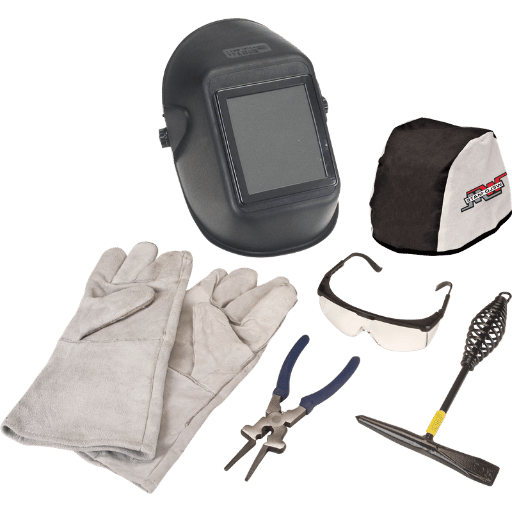
One pipeline welding method is only one part of the entire package: project teams will find the tools that deliver all otherwise technically demanding joints within the factory programmed length and track.
| Power source | Process capacity, duty cycle, generator match, cable length, grounding, parameter control |
| Line-up tools | Internal or external clamps, gap gauges, hi-lo gauges, fit-up release process |
| End prep | Beveling, facing, cleaning, coating setback, grinding control |
| Heat control | Preheat tools, temperature crayons or meters, interpass checks |
| Consumables | Electrode or wire handling, storage, issue control, traceability |
| Inspection access | Visual tools, NDT clearance, repair workflow, weld numbering |
| Automation support | Robot path teaching, torch access, shielding control, spare parts, operator training |
Internal planning pages can help narrow the route. Start with welding robot products, then compare the broader welding robot category, robotic welding technology, and how to choose a welding robot. Teams still comparing manual and robotic work can also read robotic welding vs manual welding, automated welding systems, and welding robot safety standards.
9-Stage Mainline-to-Tie-In Fit Matrix

This matrix is the practical bridge between a pipeline construction plan and the welding setup. It prevents a common mistake: choosing a welding machine before the team has named the work stage.
| Stage | Weld environment | Main risk | Best-fit setup | Robot or automation fit |
|---|---|---|---|---|
| 1. ROW preparation | Open field, changing ground | Access and logistics | Manual crew with mobile support | Use only after lanes, power, and access are stable |
| 2. Pipe stringing and bevel | Repeated sections | Fit-up drift | Prep tools, gauges, clamps | Worth testing when 20+ similar joints per shift are planned |
| 3. Root pass | Fixed pipe | Penetration and alignment | Qualified welder or qualified mechanized root process | Conditional: only with procedure support and stable joint geometry |
| 4. Mainline production | Repeated girth welds | Cycle variation and repair rate | Semi-automatic or automatic welding after procedure trials | Strong when access, shielding, and joint sequence repeat |
| 5. Crossing section | Road, river, or obstacle area | Alignment and inspection access | Manual crew plus special fixtures | Test only if clearance and path are known before mobilization |
| 6. Tie-in weld | Completed segments | Position, fit, rework cost | Senior welder with strict hold points | Rare unless geometry repeats and setup time is available |
| 7. Repair weld | Defect removal zone | Heat control and traceability | Manual specialist, repair WPS, inspector release | Rare because each repair has a different shape |
| 8. Inspection hold | NDT point | Record mismatch | Weld map, NDT status, repair history | Useful when machines capture parameters and weld IDs |
| 9. Turnover | Records package | Missing traceability | Digital weld logs and signed release steps | Strong if parameter logs link to joint numbers |
What Is Changing in Pipeline Welding in 2026?

Three shifts are visible in search demand and field practice. First, qualification pressure is not going away. Contractors still need people who can pass pipe tests and work to procedure. Second, buyers are searching for automatic pipe welding machines and robotic pipe welders, but the volumes are smaller and more commercial than the broad career keyword. Third, inspection records are becoming harder to treat as paperwork after the fact.
That last point favors systems that connect the weld, the parameter record, the welder or operator ID, the inspection status, and the repair log. It also changes the robot conversation. For mobile work, a robot is not only about faster travel. It is about repeatable torch motion, teachable paths, captured settings, and cleaner handoff to inspection when the work stage supports it.
For teams planning heavy pipe assemblies outside a classic pipeline right-of-way, Zhouxiang’s welding robot solutions, steel structure welding robot solution, and intelligent steel structure welding system may be closer to the real job than a pure mainline pipeline rig. Match the work stage before matching the machine.
FAQ: Pipeline Welding
What type of welding is used for pipelines?
SMAW, GMAW, FCAW, GTAW, SAW, mechanized welding, and automatic welding can all appear in pipeline or pipe fabrication work. Procedure approval decides which process is allowed for the material, pass, position, and service. Some projects use one method for the root and another for fill or cap passes.
Is pipeline welding stick, MIG, or TIG?
No single process owns pipeline welding. Stick welding is common in remote and repair work because the setup travels well. MIG-style GMAW or FCAW fits better where shielding and wire feed can be controlled. TIG may be used for certain root-pass or high-control joints. The procedure, not the nickname, decides what the crew may run.
What is 6G pipe welding?
6G is a fixed-pipe welding position with the pipe set at an angle. It is hard because gravity, body position, and travel angle keep changing. Qualification still depends on the code, procedure, material, process, and test coupon.
How much does pipeline welding pay?
AWS reported 2025 salary examples for pipeliners at about $52,000 entry level, $69,000 median, and $100,000+ at the high end. Actual pipeline welder salary varies by country, union status, travel, overtime, certification, project risk, and whether the role is field construction, repair, inspection support, or shop fabrication.
Is pipeline welding underwater?
Most pipeline welding is not underwater. Underwater welding is a specialty for certain offshore or repair jobs. Land, yard, lay-barge, and controlled field welding are far more common.
What is the best pipeline welding machine?
No single best machine exists. The right one matches the approved procedure, pipe size, power source, site access, weather control, inspection plan, and crew skill. For remote tie-ins, a portable SMAW setup may beat a complex system. Mechanized or mobile robotic equipment may win when repeated joints or large assemblies give the setup time a payoff. Before buying, ask the machine vendor to prove torch access, parameter control, shielding control, consumable handling, part repeatability, repair workflow, and NDT access on a sample joint that resembles the real project. A demo on a clean bench coupon is useful, but it is not the same as a pipeline joint in a trench, rack, station, or heavy fabrication bay.
Can mobile robotic welding replace pipeline welders?
No, not as a blanket rule. Used well, a mobile welding robot can reduce manual torch time on repeatable paths, capture parameter data, and help crews handle large workpieces. Certified welders, inspectors, and welding engineers still control procedure qualification, fit-up decisions, acceptance, repairs, and jobsite judgment.
Evaluate a Mobile Welding Setup for Long Pipe Sections
If your pipeline, pipe-spool, or heavy fabrication project has repeated weld paths on large workpieces, review the AGV mobile welding setup before locking the equipment plan.
View AGV Mobile Welding Robot Ask Zhouxiang about your weld path
References
The sources below were used for technical framing and verification. Project teams should still confirm the current rule text, owner specification, and local jurisdiction before field work.
AWS Pipeliner Career Profile | TWI: What Is Pipe Welding? | OSHA 1910.252 | 49 CFR Part 192 | 49 CFR Part 195 | API Standard 1104 notice | AWS SWPS | OMS weld inspection guide