Get in Touch with Zhouxiang

4.9/5 — Trusted by Global Clients
Cantilever Welding Robot
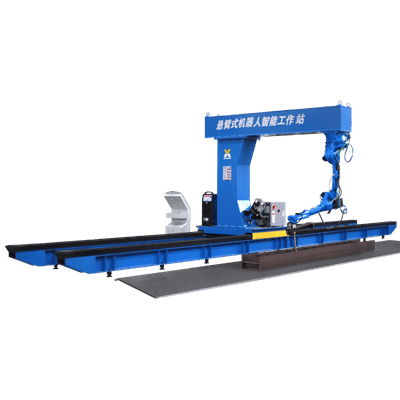
Cantilever Welding Robot (7/8/9 Axis) Intelligent Welding Workstation
The cantilevered, teaching-free welding robot from Zhouxiang integrates an intelligent welding system with 3D vision and laser seam tracking, delivering precise, automatic welding on complex steel-structure workpieces on a fully automated workstation.
95%
Less Programming Time
±0.1mm
Welding Accuracy
200%
Productivity Increase

Direct Factory Pricing
ISO 9001 & CE Certified
Industry-University R&D
Global Shipping & Installation
Lifetime Technical Support
Product Overview
What Is a Cantilever Welding Robot?
The cantilevering welding robot is a programmable industrial robot mounted on a solid arm-overhang, equipped with a smart welding system to perform precise welding operations automatically on bulky and intricate workpieces. Comprised of a sturdy welding power source, a water-cooled torch, and outboard multi-axis axes on adjustable running gears, this welding robot workstation provides unmatched welding quality, throughput, and flexibility for steel structure fabrication, shipbuilding, heavy mechanic applications, and so forth.
01
Superior Weld Quality
While unnecessary and inconsistent calibration is common in automatic welding, Parameter Arc Control technology enables an average worker to perform high-strength welds on large steel structures without risking miswelds, on both clean carbon steel and alloy workpieces.
02
Teaching-Free Welding
Retrieve a 3D model from Tekla or SOLIDWORKS or scan an existing component to produce a point cloud. The software recognizes weld joints, and besides setting up optimal welding parameters, it works with programs autonomously—meaning, without manual intervention.
03
Scalable Automation
Choose an axis manipulation unit with anywhere from 7 axes to 9 to match your envelope and complement it with modular positioners, rotary tables, and additional rail length, all united by the superior welding system control.
Core Technology
Intelligent Welding System Features: How It Works
An intelligent welding workstation integrates a welding machine, a welding power supply, a water-cooled welding torch, and external axes under a unified controller, forming an automatic welding system that supports adaptive parameter control to deliver high-quality welds.
01
3D Vision
Point Cloud Reconstruction & Digital Twin
A big-line-scan laser scanner generates a highly accurate digital model and point cloud of the workpiece to build the digital twin. This can then be used to detect deviations from the planned weld path and actual geometry in real time, enabling automatic correction before the welding torch touches in.
02
Laser Seam Tracking
Real-Time Seam Detection & Path Correction
The laser seam-tracking sensor measures the front sections of the welding gun joint geometry and provides profiles to the smart welding system. Therefore, the robot path and welding parameters can be adjusted in real-time to maintain the root gap and torch extension for accurate welding even with workpieces with changes in fixtures or heat distortion.
03
Smart Power
Welding Power Supply & Arc Control
A machine power system provides a consistent welding arc. Welders must have a steady, consistent arc source for MIG, arc, and robotic welding, and the system is upgraded to support hybrid mode. To support uninterrupted operation across long duty cycles, the wire feed and nozzles are kept clean through automated tolerance checks.
04
Water-Cooled Torch
Heavy Duty Torch & Clamp Systems
Thanks to its water-cooled system, gun torch life is extended even in the presence of high-intensity interference, enabling long, continuous operation. Payload-rated welding gun stands integrate with the workstation and clamping fixtures to keep the torch finely poised. Additionally, if the welding gun is equipped with an automatic nozzle-cleaning system, the setup will substantially reduce downtime and maintain weld quality.
05
Teaching-Free Programming
Model-Driven & Drawing-Free Welding Process Automation
Import models in Tekla, SOLIDWORKS, or UG, or reverse engineer them from point cloud scans. The cantilevered, teaching-free welding robot identifies weld seams, selects the best welding parameters, and automatically generates precise welding programs. This reduces manual intervention and brings down production costs and changeover times for variant workpieces. Using design software integration and AI-tuned parameterization, the system significantly reduces labor costs and enables in-effectivity, thereby scaling down your production line.
Interactive Configuration
Choose Your Axis Configuration of Cantilever Welding Robot
Select between 7-axis, 8-axis, and 9-axis cantilever welding robot setups. Each configuration adds degrees of freedom for accessing complex joints, synchronizing positioners, and covering larger welding envelopes on a ground rail or gantry.
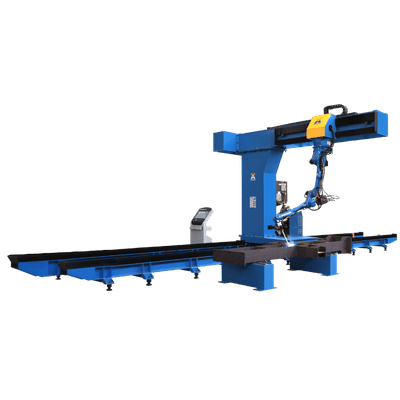
7-Axis Cantilever Welding Robot
The 7-axis configuration adds a linear ground rail to the 6-axis industrial robot, extending position reach over long workpieces such as steel beams and H-shaped steel. The axis-cantilever robot travels along the rail to produce continuous longitudinal weld seams without repositioning — ideal for straight-line and curved welds on plate assemblies.
Ground Rail Travel: Customizable length (up to 30 m+), automatic lubrication system
Welding Processes: MIG welding, arc welding, and hybrid MIG + 3D laser applications
Seam Tracking: Laser seam tracking with real-time deviation correction
Best For: Longitudinal seams on beams, box columns, diaphragm plates
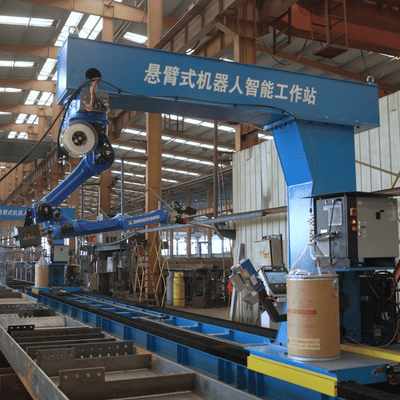 7-Axis
Linear Rail + Robot
7-Axis
Linear Rail + Robot
8-Axis Cantilever Welding Robot
The 8-axis configuration introduces a rotary positioner as an external axis, enabling synchronized robotic welding while the workpiece rotates for continuous circumferential seams. The welding robot and positioner move in concert, maintaining optimal torch posture and consistent welding parameters for 360° access on cylindrical and irregular assemblies.
External Axes: Ground rail + single rotary positioner (clamp and rotary table)
Synchronized Motion: Coordinated robot and positioner for uninterrupted welding
3D Vision: Point cloud reconstruction and digital twin for deviation correction
Best For: Rotating girders, cylindrical vessels, multi-face joints
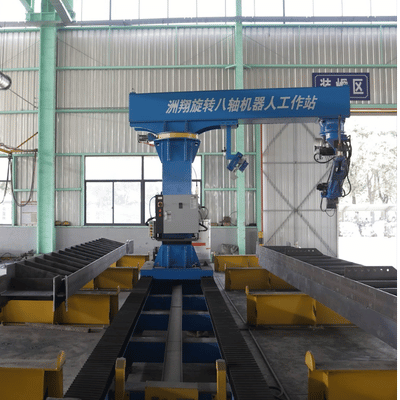 8-Axis
Rotary Positioner + Rail
8-Axis
Rotary Positioner + Rail
9-Axis Cantilever Welding Robot
The 9-axis system combines rail travel with dual-positioner control, maximizing flexibility for complex steel structure assemblies. Simultaneous manipulation of the workpiece and the welding robot eliminates repositioning, secures consistent weld puddle control, and achieves the largest working envelope — suitable for welding H-shaped steel, large plate assemblies, crane booms, gantry frames, and heavy duty shipbuilding structures.
External Axes: Ground rail + dual rotary positioners with clamp fixtures
Payload: Heavy duty construction with high payload capacity for large assemblies
Welding Coverage: 360° access with multi-axis motion — flat, vertical, overhead
Best For: Complex steel structures, shipbuilding, bridge girders, heavy machinery
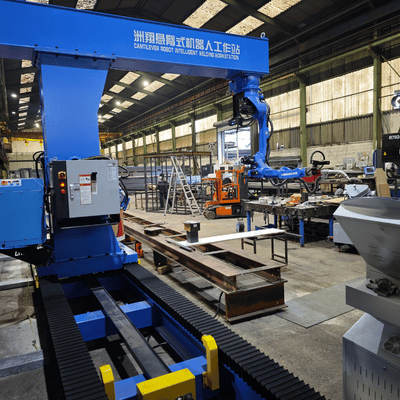 9-Axis
Dual Positioners + Rail
9-Axis
Dual Positioners + Rail
Technical Data
Cantilever Welding Robot Specifications — Compare All Configurations
Below is a side-by-side comparison of our 7-axis, 8-axis, and 9-axis cantilever welding robot workstation specifications. All systems integrate the intelligent welding system with laser seam tracking, water-cooled welding torch, and automatic torch cleaning unit. Rail length and workstation layout can be fully customized to your production requirements.
| Parameter | 7-Axis Cantilever 7-AXIS | 8-Axis Cantilever 8-AXIS | 9-Axis Cantilever 9-AXIS |
|---|---|---|---|
| Total Axes | 6 (robot) + 1 (rail) | 6 (robot) + 2 (rail + Y-axis) | 6 (robot) + 3 (rail + Y-axis + positioner) |
| Working Envelope (L×W×H) | Customizable × 3.0m × 0.5m | Customizable × 3.5m × 0.5m | Customizable × 3.5m × 0.5m + rotation |
| Ground Rail Length | Up to 30m+ (customizable) | Up to 30m+ (customizable) | Up to 30m+ (customizable) |
| Welding Accuracy | ±0.1mm (with vision) | ±0.1mm (with vision) | ±0.1mm (with vision) |
| Programming Mode | Teaching-free (Tekla/SolidWorks/UG import) | Teaching-free (Tekla/SolidWorks/UG import) | Teaching-free (Tekla/SolidWorks/UG import) |
| Vision System | Large line-scan 3D laser | Large line-scan 3D laser | Large line-scan 3D laser |
| Welding Positions | Flat, horizontal | Flat, horizontal | Flat, vertical, horizontal, overhead |
| Weld Types Supported | Straight, arc, curved | Straight, arc, curved | Straight, arc, curved, multi-pass |
| Welding Process | MIG / MAG / Arc | MIG / MAG / Arc | MIG / MAG / Arc / Hybrid |
| Welding Torch | Water-cooled + auto cleaning | Water-cooled + auto cleaning | Water-cooled + auto cleaning |
| Workstation Layout | Single-side / Dual A-B station | Single-side / Dual A-B station | Single-side / Dual A-B station + positioner |
| Rail Lubrication | Automatic lubrication system | Automatic lubrication system | Automatic lubrication system |
| Digital Twin | Supported | Supported | Supported |
← Swipe to view full table →
Need help choosing the right configuration? Tell us your workpiece type, dimensions, and production volume — our engineers will recommend the optimal setup.
Get Expert Advice
Why Zhouxiang
Your Trusted Cantilever Welding Robot (7/8/9 Axis) Supplier
1991
Founded — 30+ Years of Welding Equipment Expertise
200+
Patents Including 50+ Invention Patents
50+
Countries — Global Welding Solution Delivery
∞
Customizable Rail Length & Configuration
As a teaching-free welding robot supplier, Zhouxiang combines deep process expertise with proven automation deployments across steel structure, shipbuilding, bridge construction, and power equipment fabrication. Every welding solution — from the welding machine and welding power supply to the intelligent welding workstation controller — is backed by onsite commissioning, comprehensive training, remote diagnostics, and dedicated after-sales service.
Headquartered in Wuxi, Jiangsu Province, China, with industry–university–research collaborations and a strong R&D team, Zhouxiang delivers intelligent welding equipment with excellent performance, stable quality, and outstanding cost-effectiveness — exported to Europe, North America, Southeast Asia, the Middle East, and beyond.
Industry Solutions
Application Cases Across Industries of Cantilever Welding Robot
The cantilever welding robot workstation meets demanding application requirements across industries where long-seam access, multi-axis motion, and precise welding are essential for steel structure, shipbuilding, and heavy duty fabrication.
01
Steel Structure
H-beams, box columns, plate assemblies, diaphragm plates — full automation on ground rail.
02
Shipbuilding
Hull panels, bulkheads, structural frames — heavy duty welding suitable for large-scale fabrication.
03
Bridge Construction
Long girders and steel beams with complex joint geometries and real-time quality control.
04
Heavy Machinery
Crane booms, gantry frames, chassis modules — 360° welding with positioner access.
Comparison
Gantry vs. Cantilever Welding Robot: Which Configuration Is Right?
Two dominant structural configurations serve the large-workpiece welding automation market: gantry welding robots (portal frames spanning the work area with dual drives) and cantilever welding robots (single-sided arms extending over the work area). Each excels in different scenarios — selection depends on workpiece characteristics, floor space, production workflow, and automation budget.
| Criteria | Gantry Welding Robot GANTRY | Cantilever Welding Robot CANTILEVER |
|---|---|---|
| Structure | Portal frame with dual-column drives | Single-sided cantilevered arm on ground rail |
| Footprint | Larger — clearance both sides | Compact — open side for crane loading |
| Loading Flexibility | Limited — between columns | Flexible — batch loading from open side |
| Rigidity | Higher — dual-column support | Moderate — suitable for welding torch loads |
| Best For | Very large, heavy symmetric assemblies | H-beams, columns, mid-size plates |
| Initial Cost | Higher investment | Lower cost, comparable capability |
| Scalability | Fixed within portal | Scalable rail length, modular expansion |
← Swipe to view full table →
Cantilever welding robots are most effective for welding H-beams, columns, and medium-sized bridge components due to their reach, accessibility, and cost-effectiveness. In contrast, when the workpiece mass exceeds the cantilever’s load-bearing capacity, or when symmetric bilateral welding access is required for very large assemblies, gantry systems are usually recommended.
Challenges & Solutions
Common Welding Challenges — And How Automation Solves Them
Steel structure fabrication shops all over the globe are now under great pressure due to a scarcity of welders, erratic quality, and the doldrums of conservative manual or semi-automatic methods of welding. These pools of problems are all but solved right under the roof of a cantilever welding robot workstation.
Challenge
Solution
Skilled Welder Shortage
In 2030, an estimated shortage of 400,000 welders by the American Welding Society. There are ever-greater numbers of shell-shocked hiring managers who are not able to locate MIG and arc-welding qualified operators for heavy-duty steel-structure work.
Teaching-Free Automation
Our cantilever welding robot requires zero manual programming. Import Tekla or SolidWorks models, and the intelligent welding system auto-generates paths. A single operator — even without welding certification — can manage the workstation after brief training.
Inconsistent Weld Quality
Manual welding produces variable bead geometry, porosity, and undercut defects — especially on long seams of H-beams and box columns where operator fatigue is a factor.
3D Vision + Arc Tracking
Large-line-scan 3D laser vision, combined with real-time arc tracking, ensures ±0.1mm accuracy and automatic deviation correction. The welding system maintains stable parameters throughout every weld, from root to cap.
Large Workpiece Accessibility
Standard robot cells can’t reach long steel beams, bridge plate units, or ship sub-assemblies. Repositioning wastes time and introduces alignment errors.
Cantilever + Ground Rail Design
The axis cantilever robot rides on a customizable ground rail (up to 30 m), covering a massive work envelope. Dual-side A/B station design enables continuous welding — load one side while the robot welds the other.
Complex Programming for Custom Parts
Traditional robot teaching takes 4–8 hours per workpiece variant. For high-mix, low-volume steel-structure production with non-standard parts, automation becomes economically unviable.
Model-Driven + Point Cloud Reconstruction
Import 3D CAD models directly, or use 3D vision scanning to reconstruct models from point cloud data for drawing-free welding. Switch between workpiece variants in minutes, not hours.
Proven Results
Cantilever Welding Robot Application Cases: Real-World Performance
Steel Structure Plant
9-Axis System on 30 m Ground Rail
Case Study
A steel structure fabrication facility deployed an axis cantilever robot on a 30-meter ground rail with 9-axis motion — rail travel and dual positioners — to execute multi-pass fillet welds with water-cooled welding. The intelligent welding workstation maintained torch position and arc stability across all external axes, documenting repeatable robot welding performance on H-shaped steel and plate assemblies.
40%
Cycle Time Reduction
50%
Changeover Reduction
99.2%
First-Pass Weld Quality
Heavy Equipment Fabrication
8-Axis Cell for Rotating Girders
Case Study
Replacing manual fixtures with an 8-axis welding robot cell enabled automatic welding of rotating girders using a rotary table as external axis. Teaching-free welding cut changeover time in half while the intelligent welding system adapted MIG welding parameters to varying gaps. The arc welding robot system reduced rework, eliminated manual intervention, and stabilized the welding process with consistent weld quality — reducing labor costs and production costs.
2×
Production Efficiency
65%
Reduce Labor Costs
30%
Lower Production Costs
Free Online Tools
Plan Your Welding Robot Investment with Interactive Tools
Use these free engineering tools to evaluate your cantilever welding robot options — calculate your return on investment, find optimal weld parameters, and determine the ideal axis configuration for your production line.
Popular
Financial Analysis
ROI Calculator
Compare manual vs. robotic welding costs. Enter your production data to see payback period, annual savings, and 5-year return on your welding robot investment.
Payback Period
Cost Comparison
5-Year Projection
Calculate Your ROI
Engineering Tool
Welding Parameter Recommender
Select your base material, plate thickness, and joint type to get optimized voltage, current, speed, and gas flow settings for your MIG/MAG welding robot.
4 Materials
6 Parameters
Application Notes
Get Parameters
Configuration Guide
Axis Configuration Selector
Answer 5 quick questions about your workpiece type, dimensions, seam complexity, and production needs — and get a personalized 7, 8, or 9-axis recommendation with match scores.
5-Question Quiz
Match Scoring
Spec Comparison
Find Your Config
Gallery
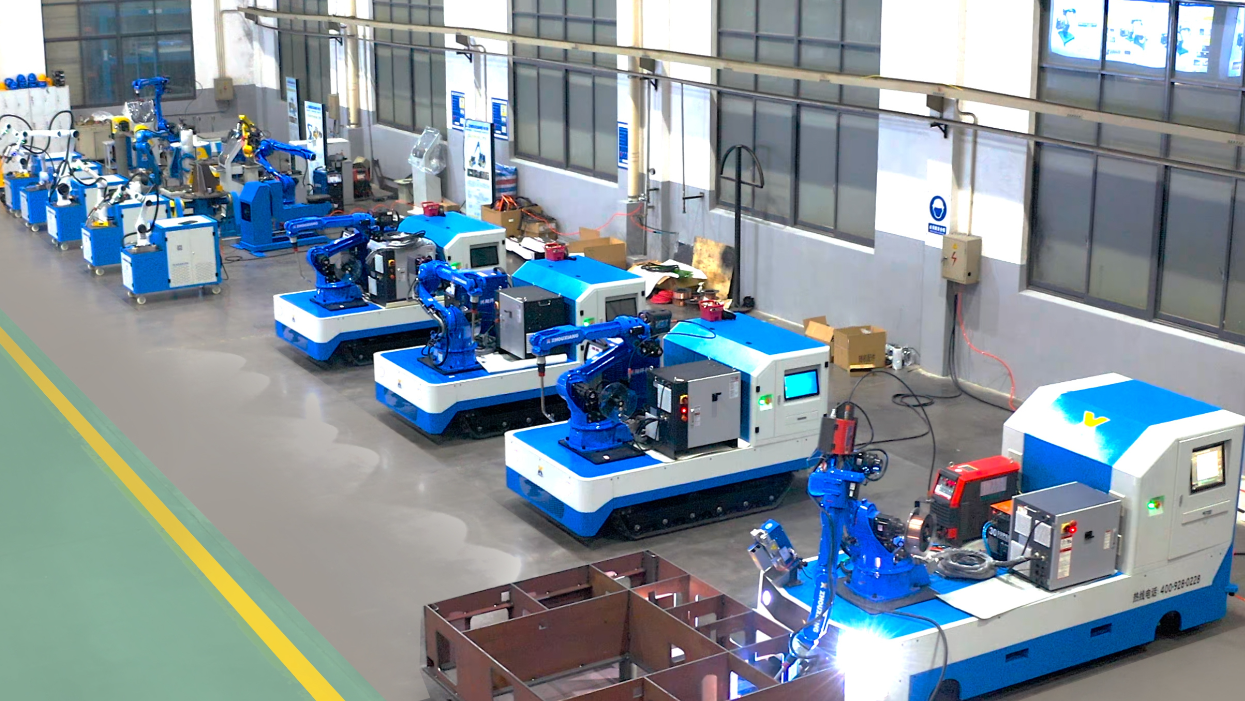
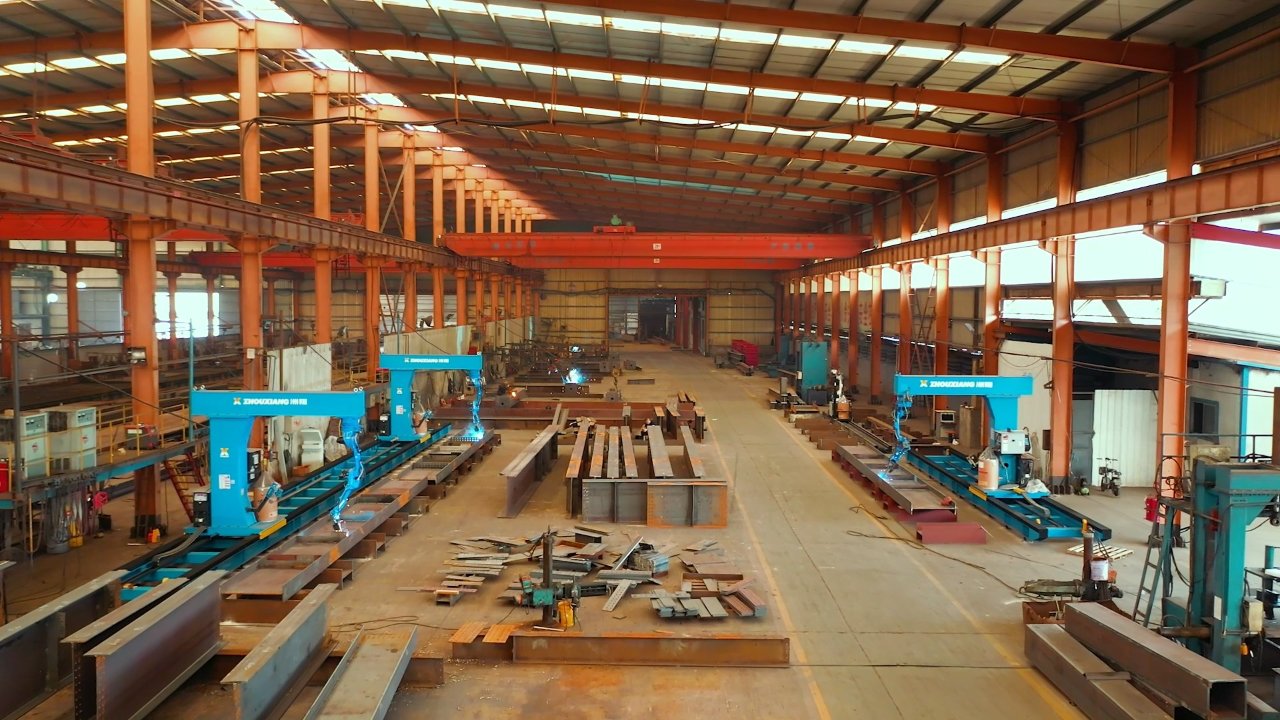
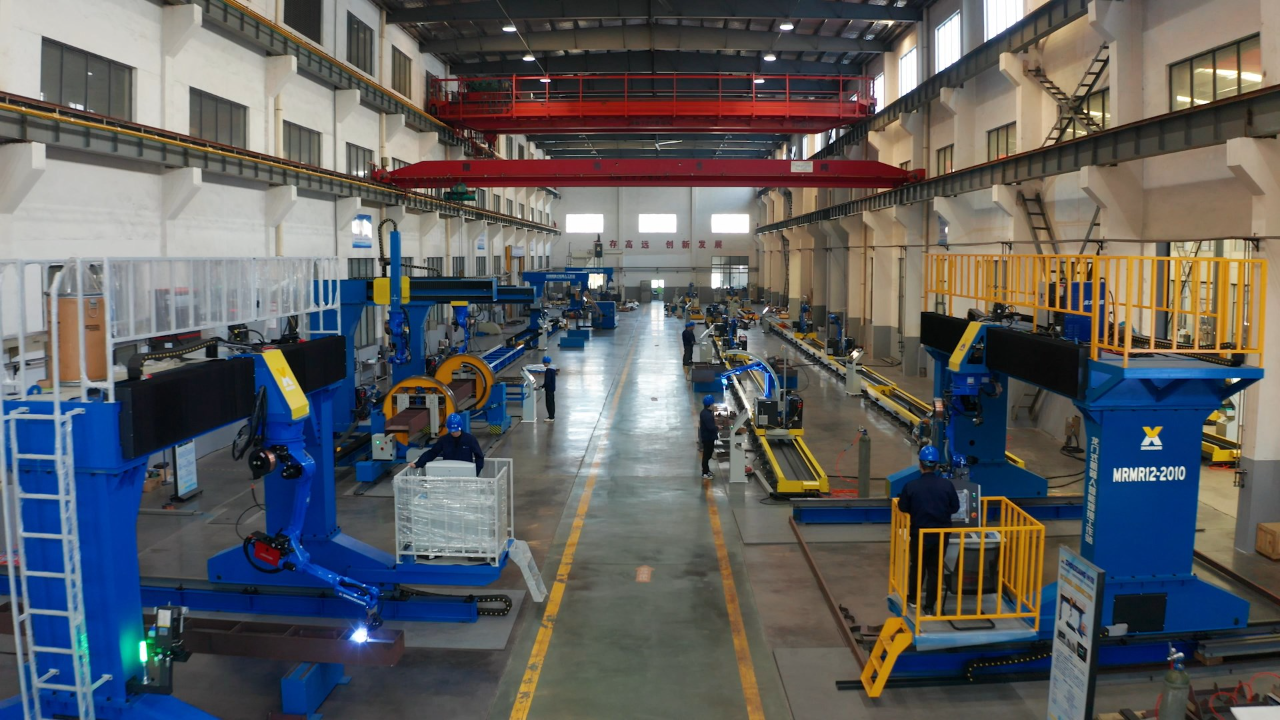
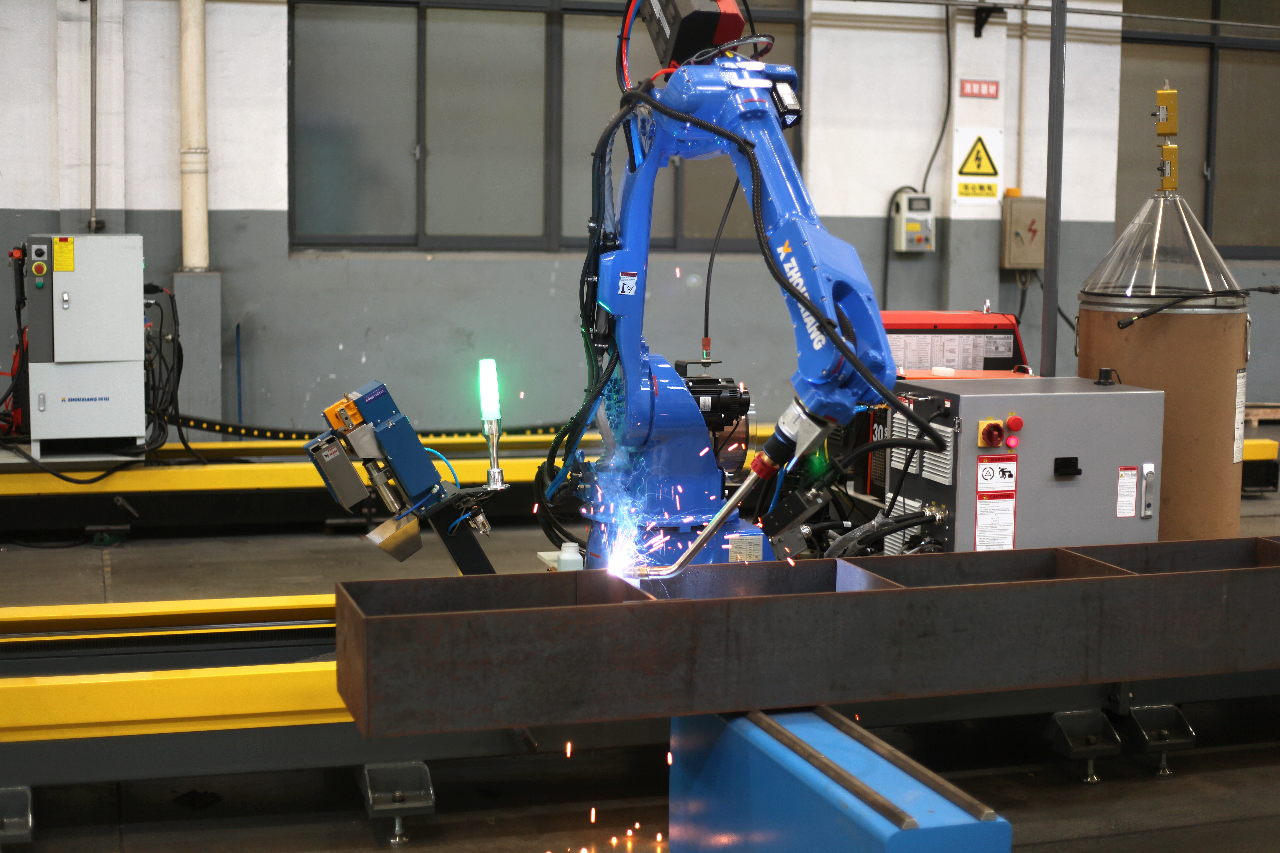
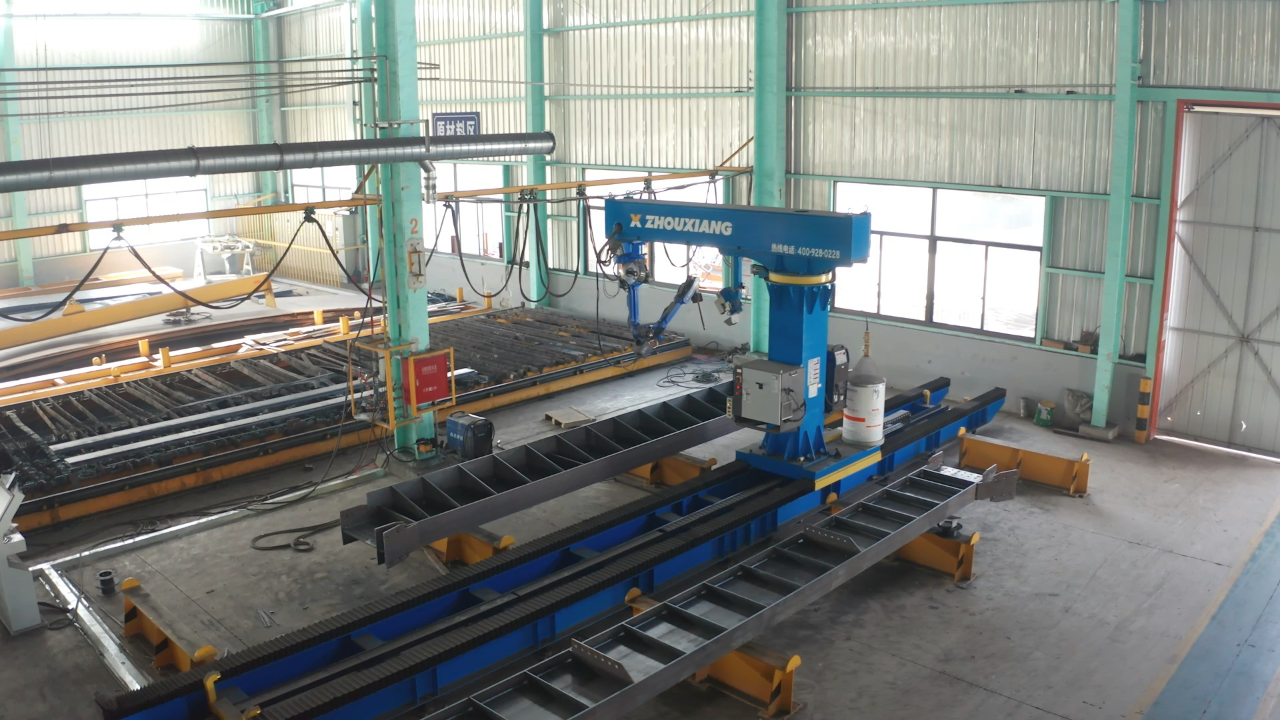
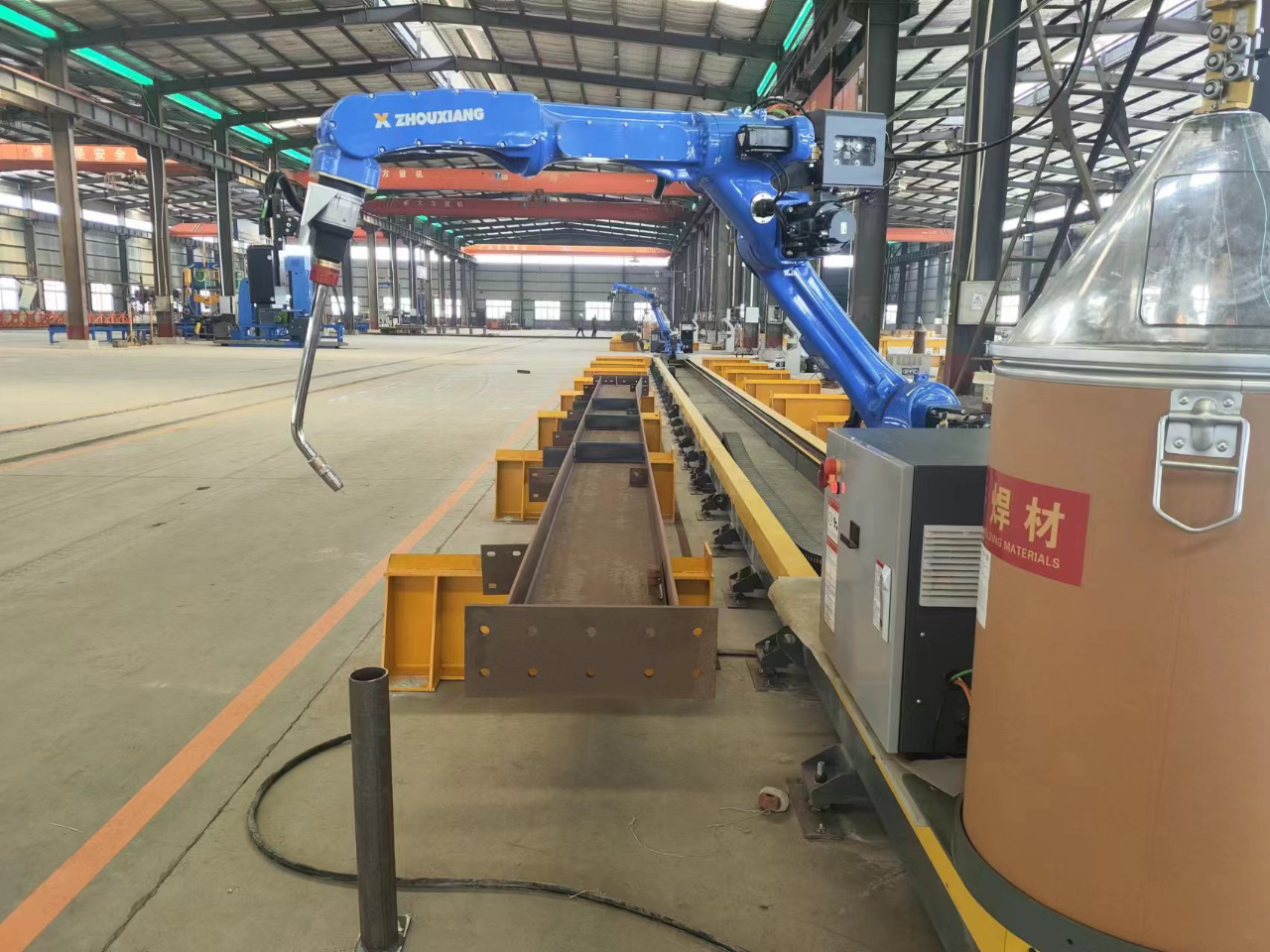
Cantilever Welding Robot in Action
Workshop scenes and on-site equipment views of our cantilever welding robot workstations in real production environments.
FAQ
Frequently Asked Questions (FAQs)
A cantilever welding machine is an automated welding system mounted on a cantilever arm, providing access to large or oddly shaped workpieces such as H-shaped steel, steel beams, or heavy machinery. What makes the cantilever system unique among the group is its extended reach and greater flexibility compared to floor-mounted and booth-style welding structures. Many times these types of machines are combined with axis welding robot configurations (7/8/9 axis), which help to improve the torch posture control and reduce the need for human intervention in welding heavier portions.
A 7/8/9-axis welding robot provides the flexibility necessary to perform complex welds by enabling more than 4 (or 5) motions, allowing full 360° access and better torch positioning in MIG and arc welding applications, as well as mixed MIG and laser solutions. These robots achieve shorter lead times by enabling optimal tool orientation (i.e., grip or fixturing) and seamless positioning, which reduces cycle times, repositioning costs, and improves production efficiency. This, in turn, reduces production costs and labor costs associated with robotic automation.
Depending on the model, the payload required for cantilever-welding robots varies. For operations such as shipbuilding or handling large steel beams and H-shaped beams, heavy-duty systems require high payload ratings to support heavy torches, cleaning station modules, rotary table interfaces, and clamping devices. Properly selecting payloads ensures system heritage, facilitates torch positioning, and preserves system value, with the potential addition of peripherals such as 3D laser scanners, nozzle changers, and digital twin sensors.
Yes. Cantilevered-axis welding robots can be configured for MIG welding, MIG, arc welding robot setups, or hybrid systems combining 3D laser and any other standard arc processes. Fitted with appropriate welders, wire feeders, nozzles, and a gas management system to adapt to welding carbon steel, stainless, or specialty alloys as per the demand of the application.
Digital Twin and 3D vision systems use laser scanning or 3D laser/laser scanning to create a digital model and point cloud of the actual workpiece. This information is used for real-time comparison with robot execution to detect deviations that can be used to tune automatic correction, enhance weld quality, reduce rework, and inform design software adjustments. By digitizing, manual oversight is reduced, maintaining response consistency even in high-interference source environments.
The workbench must secure and orient models within the cantilever system to enable high-precision welding. A high-quality clamp and table help maintain consistent gaps between the work and the torque position in the system. Workbenches rotate under computer control about a central axis, enabling continuous welding around a circular joint or complex assembly. These components enable testing of heavy-load cycles in applications such as shipbuilding and large-scale steel beam fabrication.
Cleaning stations are often found on automated lines and are designed to clean the nozzle and torch. The purpose of the cleaning stations is to maintain the nozzle and wet tip in good condition by preventing spatter buildup. The MIG nozzles and other components are maintained in good condition through sensor-driven, scheduled cleaning cycles and real-time monitoring and intervention via the weld control system, resulting in reduced downtime, extended consumable life, higher production efficiency, and improved weld quality.
Major requirements include high capacity for payload, sturdy heavy-duty construction, long reach cantilever design, multi axes of movement (7/8/9 axis) for 360° welding, support of arc welding robot and MIG processes, integration with digital twin and cage, and 3D vision/point cloud, supports the sphere for grip and rotary table, and protection from high interference levels. These are essential features toward meeting required tolerances for H-beams, carbon steel, and large assemblies, resulting in lower cost and labor.