Get in Touch with Zhouxiang

Collaborative Welding Robot (Cobot)
Collaborative Welding Robot for Precision Automation
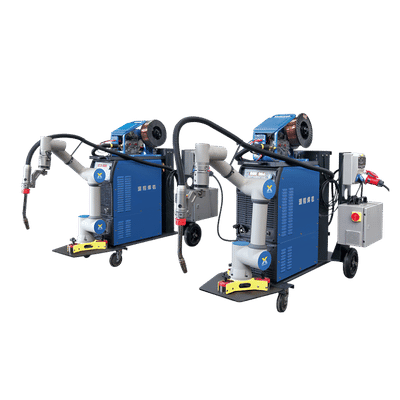
Zhouxiang’s collaborative welding robot combines a lightweight robot arm, intelligent welding power source, and drag-and-teach easy programming to deliver high-precision cobot welding for shipbuilding, metal fabrication, and industrial welding applications. Engineered for human-robot collaboration on your factory floor.
34
Years in Welding
200+
Patents Held
50+
Countries Served
2,400+
Robots Deployed
Understanding Cobot Welding
What is a Collaborative Welding Robot?
Collaborative welding robots, or cobot welders, are designed to operate alongside human welding experts. They use robotic welding tips and perform welding tasks as a human would. Industrial robots require large fenced-off areas and extensive programming to operate, while welding cobots are designed for ease of use and include safety features to protect users, increasing the flexibility of welding automation.
01
Collaborative Operation
Cobot welders allow safe operation with human welders. They can work in the same spaces and don’t need to be separated by extensive fencing to keep them safe.
02
Easy Programming
Facilitated coding is eliminated by the drag-and-teach system. Robots can be guided by the telescoping arm to record a welding path and a waypoint. There are also welding interference factors that can be adjusted.
03
Superior Weld Quality
For the same welding task, a consistent, repetitive travel speed and arc energy, as well as an appropriate heat input, are very important. Integrated arc tracking can correct deviations caused by heat fluctuations.
04
Enhanced Productivity
Transform non-value tasks, increase rework, and eliminate changeover time. Manual welding operations can be integrated with cobot systems, resulting in lower welding costs and improved system efficiency.
05
Cost-Effective Automation
Compared with classic robotic welding systems, costs are significantly lower. The system’s simple layout and lower integration and component costs from wholesale Chinese manufacturers mean better ROI.
06
Flexible Deployment
Best suited for high-mix, low-volume production workflows and environments with frequent job changes. Their portable design and magnetic base enable quick repositioning between multiple welding stations.
Welding Cobot Models: Collaborative Robots Built for Welding Tasks
Every Zhouxiang cobot ships as a complete welding system — not a bare robot arm that needs six months of integration work. Each model includes the robot arm, welding power source interface, torch mount, control software, and your choice of MIG or TIG welding package.
01
Compact
ZX-CW6 Lightweight Cobot
6 kg payload · 900 mm reach · ±0.03 mm repeatability
Built for tight spaces — shipbuilding compartments, small structural parts, brackets. The whole unit weighs under 24 kg. One person carries it. Magnetic base mount locks down in seconds. This is the one our shipyard customers keep reordering.
02
Versatile
ZX-CW10 Mid-Range Cobot Welder
10 kg payload · 1,300 mm reach · ±0.02 mm repeatability
The workhorse. Handles most MIG welding and arc welding jobs in steel fabrication — gussets, base plates, frame assemblies. Fits on a rolling cart or fixed pedestal. Integrated arc tracking with real-time deviation correction. Probably our best-selling model, if we’re being honest.
03
Heavy Duty
ZX-CW16 Extended-Reach Cobot
16 kg payload · 1,700 mm reach · ±0.02 mm repeatability
For larger weldments — tank shells, bridge components, heavy structural members. The extra reach means fewer repositions on long seams. Supports multi-pass weld sequences and weave patterns. Pairs with our laser vision tracking system for variable-fitup joints.
04
Shipbuilding
ZX-CWM Marine Series
IP54 Protection · Magnetic Base · Portable Design
Purpose-built for shipyard environments. IP54 dust and splash protection. Smooth-rolling wheels for deck-level transport. Magnetic base holds firm on steel surfaces — hull plates, bulkheads, tank walls. The drag-to-teach interface was designed around operators who’ve never touched a robot before, which, in most shipyards, is everyone.
05
Rail-Mounted
ZX-CWR Ground Rail System
Extended Travel · Visual Seam Finder · Auto Optimization
Cobot mounted on a linear ground rail for extended travel on long seam welds. Visual seam finder plus automatic process optimization. Teaching-free operation on straight runs — the system reads the joint geometry and generates the weld path. Works both sides of the rail with a single robot arm. Built for H-beam lines and box beam production.
06
Cantilever
ZX-CWG Gantry Cobot Station
Large-span Gantry · Stereo Camera · Point Cloud Tech
Large-span gantry structure for oversized workpieces. Bochu stereo camera system with point cloud reconstruction. Handles complex subassemblies — T-ribs, U-ribs, pipe assemblies. Can run model-driven or drawing-free operation. This one blurs the line between cobot and full robotic welding cell, but the programming stays just as simple.
Specifications
Welding Cobot Specifications and Capacity Comparison
Real numbers, not marketing fluff. Every parameter below comes from production units — not lab prototypes. If you need a specific configuration or custom reach/payload, we do that too (more on OEM options below).
| Parameter | ZX-CW6 | ZX-CW10 | ZX-CW16 | ZX-CWM Marine |
|---|---|---|---|---|
| Axes | 6 | 6 | 6 | 6 |
| Payload | 6 kg | 10 kg | 16 kg | 8 kg |
| Reach | 900 mm | 1,300 mm | 1,700 mm | 1,100 mm |
| Repeatability | ±0.03 mm | ±0.02 mm | ±0.02 mm | ±0.03 mm |
| Robot Weight | 24 kg | 33 kg | 52 kg | 28 kg |
| Weld Processes | MIG, TIG | MIG, TIG, Arc | MIG, TIG, Arc, Laser | MIG, Arc |
| IP Rating | IP44 | IP54 | IP54 | IP54 |
| Programming | Drag-to-teach | Drag-to-teach | Drag-to-teach + Vision | Drag-to-teach |
| Arc Tracking | Standard | Standard | Laser vision | Standard |
| Base Options | Magnetic / Pedestal | Cart / Pedestal / Rail | Pedestal / Rail / Gantry | Magnetic / Wheels |
| Safety | Force-limited (ISO/TS 15066) | Force-limited (ISO/TS 15066) | Force-limited (ISO/TS 15066) | Force-limited (ISO/TS 15066) |
| Power | 220V single-phase | 220-380V | 380V three-phase | 220V single-phase |
Wholesale
Wholesale Cobot Welding Solutions: OEM, Bulk Orders, and Custom Configurations
We work with system integrators, equipment distributors, and end-user plants directly. No middlemen adding markup. Whether you need a single cobot welder for a pilot project or twenty units for a multi-plant rollout, the process is the same — we spec it to your welding application, build it, test it under load, and ship it.
Get Wholesale Pricing →OEM / ODM
Custom branding, software interfaces, and hardware configurations. We’ve white-labeled cobot welding systems for integrators in Germany, Turkey, and Brazil. Your brand, our manufacturing.
Fleet / Bulk Orders
Volume pricing on 3+ units. Standardized configurations for multi-site deployment. Consistent build quality from a single factory floor in Wuxi.
Custom Engineering
Non-standard reach? Specific welding power source integration? Unusual mounting requirements? We’ve done it. Our R&D team handles custom mechanical and software modifications in-house.
Global Logistics
Export-packed, CE marked, shipped CIF or FOB Wuxi/Shanghai. Typical lead time: 4-6 weeks for standard models, 8-12 weeks for custom configurations. We handle customs documentation.
Problems & Fixes
Real Problems, Real Fixes: Why Shops Switch to Collaborative Robot Welding
We’ve installed cobots in shipyards, steel plants, job shops, and power equipment factories. The problems that drive adoption aren’t abstract — they’re the same headaches you’re probably dealing with right now.
The Problem
Can’t Find Welders — And the Ones You Have Are Aging Out
The AWS says the U.S. needs 330,000 new welding professionals by 2028. Average welder age is 55. You’ve probably posted the same job listing three times this year. Sound familiar?
Our Approach
A Cobot Welder Multiplies Your Existing Crew
One skilled welder running a cobot can outproduce two manual welders on repetitive joints. Your experienced people focus on the complex work — fixture setup, multi-pass welds, quality inspection. The robot handles the straight seams. That’s not a theory; we’ve seen it play out in dozens of shops.
The Problem
Traditional Robotic Welding Is Too Expensive and Too Rigid
A fenced robotic welding cell runs $150K-$300K, takes months to integrate, and needs a robot programmer on staff. If you’re doing 200 part numbers a month, the programming overhead alone eats your ROI.
Our Approach
Cobot Welding Systems Start Under $45K — With Drag-to-Teach Setup
No safety fencing, no dedicated programmer, no six-month integration timeline. Your shop foreman — the guy who’s been welding for 20 years but has never written a line of code — can teach the cobot a new weld path in under ten minutes. We’ve watched it happen. It still surprises us how fast it clicks.
The Problem
Weld Quality Varies Shift to Shift
Monday morning crew puts down beautiful beads. Friday night crew — different story. Manual welding means human variation: fatigue, posture changes, inconsistent travel speed. Rework piles up.
Our Approach
Cobots Don’t Get Tired. Every Pass Looks Like the First.
Once you teach the weld path, the cobot repeats it within ±0.02-0.03mm. Same travel speed, same torch angle, same standoff distance — shift after shift. Our customers typically see rework rates drop from 5-9% down to under 2%. The robot doesn’t drift after lunch. It doesn’t have a bad Friday.
The Problem
No Floor Space for a Full Automation Cell
Your shop is already packed. Asking for 200 square feet of caged floor space plus safety interlocks isn’t realistic. Especially if you rearrange the floor seasonally.
Our Approach
Roll It In. Mag-Lock It Down. Weld.
Zhouxiang cobots on a rolling cart occupy about 4 square feet of floor space. The magnetic base mount holds firm on any steel surface — you don’t even need bolts. When the job changes, pick it up and wheel it somewhere else. One of our Polish customers moves their cobots between stations six or seven times a month.
Welding Cobot vs Traditional Robot
How Collaborative Welding Robots Compare
When comparing traditional robotic welding and welding cobots, cobots prioritize maximum speed over safety, quick deployment, and flexible programming, which may be better suited to high-mix, low-volume environments.
| Feature | Cobot Welding (Zhouxiang) | Traditional Industrial Robot | Manual Welding |
|---|---|---|---|
| Setup Time | Hours – 1 Day | Weeks – Months | Immediate |
| Programming | Drag-and-Teach, No Code | Specialist Required | N/A |
| Safety Fencing | Not Required | Full Fencing Required | PPE Only |
| Footprint | Compact, Mobile | Large Fixed Cell | Minimal |
| Flexibility (High-Mix) | ★★★★★ | ★★☆☆☆ | ★★★★★ |
| Consistency | ±0.05mm Repeatable | ±0.02mm Repeatable | Operator Dependent |
| Arc-On Time | 60–80% | 75–95% | 15–30% |
| Investment Cost | $50K – $150K | $200K – $500K+ | Low Capex, High Labor |
| ROI Period | 12–18 Months | 24–48 Months | N/A |
| OEM/ODM Customization | ✓ Full OEM Available | Limited | N/A |
Trusted China Manufacturer
Why Manufacturers Worldwide Choose Zhouxiang
20+
Years of Welding Expertise
Over two decades of welding equipment manufacturing experience. Our engineering team holds certifications from the American Welding Society (AWS) and the Chinese welding industry standards.
OEM
Full OEM/ODM Customization
As a direct factory manufacturer, we offer complete OEM and ODM collaborative welding robot solutions—customized payload, reach, welding process, branding, and software integration — to your specifications.
40%
Cost Advantage
Compared to Western brands, Chinese manufacturing offers 30–40% savings while also maintaining top-tier quality. CE, ISO 10218, and global tech support compliant.
50+
Countries Served
Partnering with local distributors, we provide responsive after-sales support in 50+ countries worldwide, including Asia, Europe, North America, South America, and the Middle East.
ISO
Quality Certifications
Each collaborative welding robot is quality-tested and certified to ISO 9001. We comply with all international welding standards and safety regulations (ISO 10218) for robots.
24/7
Global Technical Support
Worldwide engineering support, remote assistance, and video training. Spare parts ship within 48 hours, and installations can be guided via video assistance.
Welding Automation Analysis Tools
Welding Cobot ROI Calculator
Discover the financial benefits of automation. Input your current labor costs and production data to instantly estimate your return on investment with our collaborative welding robots.
Calculate ROI
Cobot vs Manual Welding: Productivity Estimator
Compare traditional manual welding against cobot efficiency. Visualize the difference in output, consistency, and speed to understand the true productivity gains for your production line.
Compare Productivity
Implementation of Welding Cobots
How to Get Started with Collaborative Welding Robot
Programming converts welder expertise into a repeatable cobot welding system. Begin with teach-by-demonstration to capture approach, torch angle, and travel speed.
01
Assess Your Application
Map your welding application mix, base materials, joint types, and cycle-time targets. Our engineers evaluate part geometry and recommend the optimal cobot welding configuration.
02
Configure Your System
Match the robot arm reach, payload, and welding power source for MIG, TIG, arc, or laser welding. Validate compatibility of welding torches and fixtures with existing welding machines.
03
Teach & Program
Use drag-and-teach easy programming to record weld paths. Codify welding parameters — voltage, current, wire feed, and arc initiation — into job templates. No coding background needed.
04
Produce & Scale
Validate with short production pilots, then scale. Connect the cobot welding solution to production data for job scheduling, traceability, and weld quality records. Boost productivity from day one.
Frequently Asked Questions (FAQs)
A collaborative robot, or ‘cobot’, is a type of robot designed to operate safely in conjunction with human workers and is, therefore, generally much easier to implement than conventional industrial welding robot cells. Collaborative robot welding focuses on worker-robot collaboration, ease of programming, and less restrictive safety zones, whereas industrial robotic welding emphasizes larger robotic arm systems, fenced cells, and greater welding capacity for heavier, more throughput-dense production. Cobot welding solutions are designed for small- to medium-range welding applications while delivering precise welds for tasks that previously required manual welders or highly skilled robot programmers.
Automation, along with welding cobot packages, increases productivity by allowing manual welders to focus on more intricate work while automating tasks that are repetitive, ergonomically challenging, or require high precision. Cobot welding solutions are generally designed for ease of use and therefore tend to include lead-through programming or other simple programming features that minimize setup time. The use of cobots with robotic arms from Universal Robots or other collaborative robot models can help lower cycle times, reduce rework, and improve weld quality consistency, all of which contribute to greater production capacity for limited-volume repetitive tasks.
The difference between welding and manual welding shows that welding cobots are repeatable, produce a consistent weld bead quality, and reduce operator fatigue, while manual welding offers flexibility and the ability to adapt to complex or singular parts. A cobot welder will decrease variability and increase throughput by welding long seams with consistent weld parameters. However, manual welders still have the advantage in complex fit-up scenarios or when some tactile judgement is needed. Many manufacturing shops with skilled manual welders have begun using collaborative robot welding to augment, not replace, manual welders.
The welding equipment and systems that are included in the packs of cobots welding are a robotic arm, a welding power source (MIG, TIG, or arc welding inverter), a welding wire feeder, a welding torch, some welding fixtures, some welding safety cobots, safety sensors, a welding intuitive control panel, and a welding ease of use controller. Some vendors will pack a Universal Robot or other cobot models with proprietary software to instruct the cobot and facilitate quick activation. The packages for high-precision welding and TIG welding will include the proposed torches and settings to comply with American Welding Society standards and meet the specific requirements of the welding procedure.
Most collaborative robot models feature simple programming techniques, lead programming, user-friendly graphical interfaces, and industry-specific toolboxes, so even those with no programming knowledge can teach the cobot. Programming the cobot can be achieved by guiding the robotic arm along the intended route or by using click-and-point software to program it, rather than writing levels of proprietary software. Such user-friendly programming methods enable most, if not all, companies to quickly train the cobot and begin welding with it as quickly as possible.
The cost of a cobot welding solution is determined by the payload and welding capacity, as well as tooling and software. However, in most cases, cobot solutions cost significantly less than fully integrated industrial robotic welding cells from the outset. There is a notable cost advantage to using a cobot due to the reduced need for heavy guarding and complex integration, especially in small to medium-sized workshops. In terms of overall cost, fewer labor hours, higher yields, and shorter ramp-up periods need to be factored in. The consistency in product quality delivered by the robots, along with the new automated welding under flexible, lower-cost conditions, remains the most advantageous factor for most manufacturers and clearly justifies the investment. The multiple templates traditionally required for automated welding systems are no longer needed with the new systems, marking a revolution in welding systems.
Absolutely, welding cobots support a range of applications, such as arc welding (MIG/MAG) and TIG, among others, as long as they are equipped for them. Cobot welding packages are modular and allow you to customize your setup, welding torch, and power source depending on whether you plan to do a lot of precision welding or heavy fillet work. Although many complex welds are best achieved with manual welding, many applications that require consistent results have shifted towards automated welding.
When integrating collaborative welding robots into your process, the first step is to understand your welding application, including part geometry, cycle time, and weld requirements. That will allow you to determine which cobot package offers the best welding performance and safety, as well as the best fit for your application. Follow your process with vendors to determine which robotic arms and welders will work best together, and train your team to teach the cobot to use simple programming or lead-through methods. Run a pilot to test a single workstation to ensure you have the correct weld parameters and fixtures to achieve your desired output. As you progress with your process, integrate collaborative robots for welding into your work centers, and focus on the manual welding roles you need to maintain for other work.